
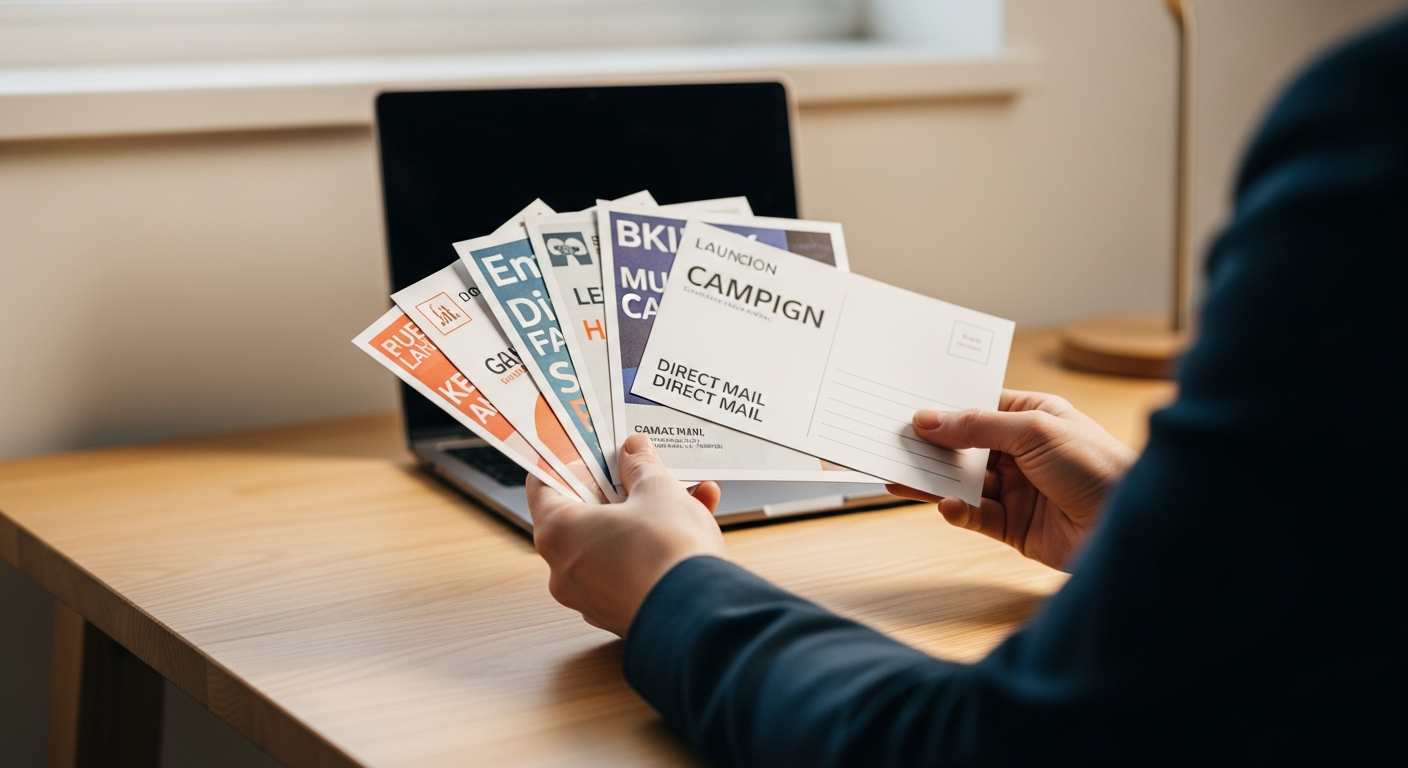
Physical mail is having a moment. Response rates for direct mail postcards average 5.3% for house lists — compared to 0.6% for paid search and 0.2% for online display ads, according to the Data & Marketing Association. For small businesses, that gap is significant. A well-targeted postcard lands in someone's hand, survives the "junk mail" sort, and stays on the kitchen counter for days.
The challenge has always been execution. Designing postcards, printing them, addressing envelopes, buying stamps — for a small business owner already stretched thin, the friction was enough to kill the campaign before it started.
That's no longer the case. With WriteToMail's postcard mailing service for small business, you can design a postcard, upload a CSV of recipient addresses, and have USPS deliver it — all without touching a printer or visiting the post office. The ideas below work across industries and are all launchable in minutes on the platform.
Here are 10 direct mail postcard ideas for small business that actually drive sales.
1. Grand Opening Announcement
Who it's for: New brick-and-mortar businesses, second locations, or relaunched brands.
A grand opening postcard is one of the highest-ROI campaigns a new business can run. You're not competing for attention online — you're landing something physical in the hands of neighbors who are already primed to try local businesses. The window matters. Send this 1–2 weeks before opening, not the day of.
Sample headline: "We're opening [Month] [Date] — and your first visit comes with a gift."
Design tips:
- Use a bold, high-contrast image of your storefront or interior
- Include a specific offer (10% off, free drink, free consultation) — not vague "come check us out" language
- Add your address, hours, and a QR code linking to your Google Maps listing
- Keep the back of the card simple: offer, date, CTA
Targeting: Upload a CSV of addresses within a 2–5 mile radius of your location. If your customer base skews toward a specific demographic (families, professionals, retirees), filter accordingly before uploading.
2. "Just Listed" Real Estate Postcard
Who it's for: Real estate agents, brokers, and property investors.
Real estate postcards remain one of the most trusted lead generation tools in the industry. A "Just Listed" card mailed to surrounding homeowners does two things simultaneously: it markets the property and it markets the agent. Neighbors often know someone looking to buy — and they remember which agent sent the card.
Sample headline: "Just Listed at [Address] — 3BR/2BA, $[Price]. Your neighbors are moving. Thinking about it too?"
Design tips:
- Lead with a professional photo of the property
- Include the key selling stats (beds, baths, sq ft, price)
- Add your headshot, name, phone, and brokerage logo
- Use a QR code linking to the listing page or virtual tour
Targeting: Mail to homeowners within a quarter-mile radius. You can also target by estimated home value to reach sellers with comparable properties. The bulk postcard mailing for real estate agents workflow makes radius-based campaigns easy to scale across multiple listings.
3. Seasonal Discount Offer
Who it's for: Retailers, restaurants, spas, home services businesses — any seasonal-demand business.
Seasonal postcards are time-sensitive by design, which is exactly what makes them work. Urgency drives action. A "Spring Tune-Up Special" for an HVAC company, a "Back to School" sale for a children's clothing boutique, a "Summer Closing Sale" for a furniture store — all of these create a natural reason to act now.
Sample headline: "Summer is here. Your AC shouldn't fail. $29 tune-up through July 31."
Design tips:
- Use seasonal color palettes and imagery that signal the time of year immediately
- Put the expiration date in large type — it's your best urgency driver
- Include a promo code so you can track redemptions
- Keep the offer singular. One deal per postcard, not five.
Targeting: Existing customer lists work well here — people who've bought before are far more likely to redeem a seasonal deal. Upload your CRM export as a CSV and send. If you're expanding reach, add a radius-based prospecting list.
4. Customer Win-Back Campaign
Who it's for: Any business with a lapsed customer segment — gyms, salons, restaurants, subscription services, home services.
Customers don't always leave because they're unhappy. Life gets busy. They forget. A postcard that says "we miss you" — with a real incentive attached — is often enough to bring them back. The math is compelling: reactivating a lapsed customer costs 5x less than acquiring a new one, according to research from Bain & Company.
Sample headline: "It's been a while. Here's 20% off to come back — no strings attached."
Design tips:
- Keep the tone warm, not guilt-inducing
- Make the offer meaningful — 10% off won't move someone who's drifted. 20–25% will.
- Include an expiration date (30–45 days is a good window)
- Add a personal touch: use variable data merge to include the customer's first name
Targeting: Pull a list from your CRM of customers who haven't purchased in 90–180 days. Upload via CSV. With WriteToMail's variable data merge, you can personalize each card with the recipient's first name automatically — no manual editing required.
5. Referral Request Card
Who it's for: Service businesses where word-of-mouth drives growth — contractors, dentists, chiropractors, accountants, real estate agents.
Most satisfied customers will refer you — if you ask. The problem is most businesses never ask in a memorable way. A physical postcard, sent a week or two after a completed job or appointment, creates a tangible reminder that arrives when the experience is still fresh.
Sample headline: "Loved your experience? So will your neighbor. Get $25 when they book."
Design tips:
- Make the referral mechanism simple: a phone number, a URL, or a QR code
- Reward both the referrer and the new customer — two-sided incentives outperform one-sided ones
- Use a photo of a happy customer or a before/after if you're a home services or beauty business
- Keep the copy short. This is a reminder card, not a brochure.
Targeting: Send to your recent customer list — anyone who completed a transaction in the last 30–60 days. This is the warmest list you have. Export from your CRM or booking software, format as CSV, and upload.
6. Service Area Introduction
Who it's for: Home services businesses (landscaping, pest control, plumbing, cleaning, roofing) expanding into a new zip code or neighborhood.
When you've just completed a job in a new neighborhood, every surrounding homeowner is a warm lead. They can see the work you did. They may have watched the truck pull up. A postcard that arrives within a week of the job completion turns passive awareness into active inquiry.
Sample headline: "We just finished a project on your street. Here's what your neighbors got — and a deal for you."
Design tips:
- Reference the neighborhood by name — it creates immediate relevance
- Include a before/after photo or a photo of the completed work
- Use a deadline-driven offer ("Call by [Date] for 15% off")
- Put your license number and Google review rating on the card — trust signals matter in home services
Targeting: Pull addresses within a one to two block radius of each job site. For a recurring campaign, this becomes a systematic neighborhood farming strategy. For a deeper look at how to structure this kind of campaign, see how to run a postcard marketing campaign via CSV.
7. Appointment Reminder or Rebooking Prompt
Who it's for: Healthcare providers, dentists, veterinarians, salons, spas, and any business that runs on recurring appointments.
Digital appointment reminders get ignored. A physical postcard is different — it has presence. For healthcare settings, it also signals professionalism in a way a text message doesn't. Sending a rebooking prompt to patients or clients overdue for a visit is one of the simplest revenue-recovery campaigns a practice can run.
Sample headline: "It's been 6 months since your last cleaning. Your next appointment is waiting — just call us."
Design tips:
- Use a calm, clean design — this isn't a sales card, it's a care prompt
- Include a phone number in large type and a scheduling link/QR code
- Personalize with the patient or client name using variable data merge
- Keep the back of the card minimal: name, date reminder, contact info
Targeting: Segment by days since last visit. Patients who are 6 months overdue, 12 months overdue, and 18+ months overdue warrant different offers and tones. Upload as separate CSVs for each segment.
8. Event or Pop-Up Promotion
Who it's for: Retailers, galleries, wineries, food businesses, fitness studios — any business hosting a time-limited event.
Event postcards are deadline marketing at its most effective. The event date creates hard urgency. A postcard announcing a private shopping night, wine tasting, trunk show, or fitness class kicks off the event's buzz with a physical artifact people actually keep.
Sample headline: "You're invited: Private Shopping Night, August 8, 6–9 PM. Exclusive discounts, wine, and first look at our fall collection."
Design tips:
- Design it like an invitation, not an ad — borders, elegant typography, a clear event graphic
- Include the date, time, location, and RSVP mechanism prominently
- If the event is capacity-limited, say so — scarcity works
- Add a QR code that takes the recipient directly to the RSVP page
Targeting: Split your list into existing customers (high priority, send first) and neighborhood prospects (secondary wave). A two-wave mailing strategy — one 3 weeks out, one 1 week out — drives higher RSVP rates than a single send.
9. "We've Moved" or Rebrand Announcement
Who it's for: Any business changing location, updating its name, or relaunching after a significant change.
A business that moves or rebrands and doesn't tell its existing customers will lose them — not to competition, but to confusion. A physical postcard solves this because it exists in the real world, unlike an email that disappears into an inbox or a social post that gets buried in an algorithm.
Sample headline: "Same great service. New address. Come see us at [New Address] starting [Date]."
Design tips:
- Use a side-by-side layout: old brand/location vs. new brand/location
- Include a map or screenshot of the new location for quick orientation
- Offer a "Welcome Back" discount for the first visit at the new location
- If rebranding, explain the new name briefly — don't assume customers will figure it out
Targeting: Your full existing customer list, especially anyone active in the past 12 months. For a location move, also target households in the vicinity of your new address — these are your new neighbors.
10. Holiday or Local Community Tie-In Card
Who it's for: Any small business — this one is about staying top of mind, not driving an immediate transaction.
Not every postcard needs a hard offer. A well-designed holiday card or community appreciation card that arrives with your brand on it keeps you in the rotation when the customer is ready to buy. This type of campaign has a longer payback window but builds brand loyalty in a way discount cards never will.
Sample headline: "Happy [Holiday] from all of us at [Business Name]. Thank you for being part of our community."
Design tips:
- Invest in photography or illustration — this card represents your brand, not a sale
- Include a subtle reminder of what you offer on the back
- Avoid making the card feel like a thinly-veiled promotion. If you include an offer, make it small and secondary.
- Handwritten-style fonts and warm color palettes perform well for this format
Targeting: Your best customers — highest lifetime value, most frequent visits, or longest tenure. This is the list you treat as VIPs. Export from your CRM, upload as a CSV, and let the mailing handle itself. If you haven't used CSV-based bulk mailing before, the bulk direct mail from spreadsheet guide walks through the full setup.
How to Launch Any of These Campaigns with WriteToMail
Every campaign above follows the same execution path on WriteToMail:
- Design your postcard using the online editor — add text, customize fonts, colors, and layout
- Prepare your recipient list as a CSV file — name, address, city, state, zip
- Upload the CSV and map columns to the postcard's variable fields (first name, address, offer code, etc.)
- Preview and confirm — review how each card will look before anything goes to print
- Submit — WriteToMail handles printing, postage, and USPS delivery
No trips to the post office. No bulk postage accounts. No vendor relationships to manage. The platform's variable data merge means every card can include the recipient's name or a personalized detail, even in a batch of thousands. For a full walkthrough of the targeting and CSV workflow, the direct mail marketing guide for small businesses covers list segmentation and campaign setup from scratch.
Key Takeaways
- Direct mail postcard response rates significantly outperform most digital channels, making them a high-ROI tool for small businesses with limited budgets.
- The best postcard campaigns are specific: one offer, one audience, one CTA. Trying to say everything kills conversion.
- Personalization — even just using the recipient's first name — consistently improves response rates. Variable data merge makes this possible at scale without manual effort.
- Timing matters as much as design. Grand opening cards sent too early go stale. Win-back cards sent too late miss the window. Build the send date into your campaign strategy from the start.
- Every campaign on this list is CSV-launchable. Your existing customer database is likely your most valuable, most underused marketing asset.
Methodology
These 10 postcard campaign ideas were selected based on three criteria: proven response rate benchmarks across industries, applicability to small businesses without large marketing budgets, and compatibility with CSV-based list targeting via WriteToMail. Priority was given to campaigns that work across multiple industries rather than niche-specific plays, and to formats where direct mail has a documented advantage over digital alternatives. Campaign concepts were validated against direct mail response benchmarks from the Data & Marketing Association and marketing ROI research from Bain & Company.
Sources
- Data & Marketing Association — Response Rate Report — Direct mail response rate benchmarks (5.3% house list average) compared to digital ad channels
- Bain & Company — Retaining Customers Is the Real Challenge — Research on the cost differential between customer reactivation and new customer acquisition