
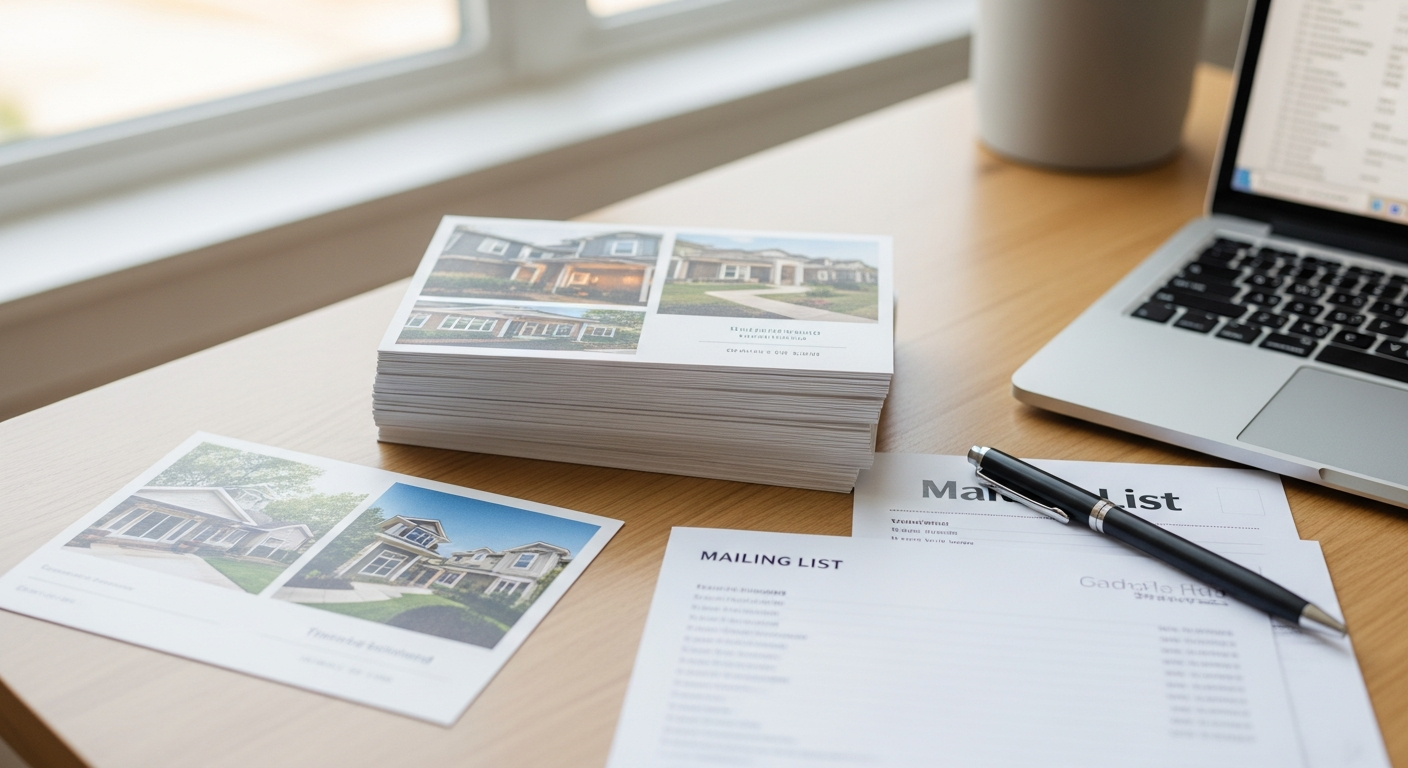
Bulk postcard mailing for real estate agents isn't a new idea. What's changed is how easy and affordable it's become — and how many agents are still leaving it on the table.
The math is hard to ignore. According to the Data & Marketing Association, direct mail achieves a response rate of 4.4% on average, compared to 0.12% for email. For a neighborhood farm of 500 homes, that's the difference between 2 callbacks and 22. One listing pays for months of postcard campaigns.
This guide walks you through the exact playbook: which postcard types convert, how to build your prospect list, how to use variable data to personalize every card, and what cost-per-lead benchmarks to expect. By the end, you'll have everything you need to launch your first (or next) bulk postcard campaign.
Prerequisites
Before you start, you need:
- A defined target farm area (zip code, subdivision, or a radius around a recent sale)
- A mailing list of homeowner addresses in that area — from your MLS, county assessor records, or a list provider
- A recent transaction or market hook (just sold, just listed, or a market update with real numbers)
- A WriteToMail account at writetomail.com
You do not need a printer, stamps, a graphic designer, or a trip to the post office. WriteToMail handles printing, postage, and USPS delivery entirely online.
Step 1: Choose the Right Postcard Type for Your Goal
Not all real estate postcards work the same way. Each template serves a different stage of the seller journey.
Just Sold Postcards
This is the single highest-converting postcard type for listing generation. It answers the question every neighbor is quietly asking: "What would my house sell for?" A just sold card with a real sales price, days on market, and list-to-sale ratio is social proof in physical form.
What to include:
- Property photo (exterior)
- Sold price and days on market
- A comparison to current neighborhood value trends
- Your name, headshot, brokerage, and a CTA like "Find out what your home is worth — text HOME to [your number]"
Market Update Postcards
These work for agents who don't have a recent sale in the target area. Pull the last 90 days of data from your MLS — median days on market, average sale price, and list-to-sale ratio — and present it in a clean, readable format.
Homeowners respond to specificity. "Homes in Maple Ridge sold for 103% of asking price in Q2 2026" is far more compelling than "It's a great time to sell." According to the National Association of Realtors, 70% of sellers say they would consider listing if they knew the market was favorable. Give them the data.
Free Home Valuation Postcards
A CTA-heavy postcard driving traffic to a landing page or phone call. These work best when paired with a specific offer — not just "free CMA" but "see what 3 homes near yours sold for this month." The more specific the offer, the higher the conversion.
Use a QR code that goes directly to a home valuation tool or a pre-filled contact form. Reduce every point of friction between the postcard and the lead.
Expected outcome from Step 1: You have a clear postcard concept matched to your goal — whether that's immediate listing leads (just sold), credibility building (market update), or direct response (free valuation).
Step 2: Build and Format Your Prospect Mailing List
Your list is the most important variable in the campaign. A great postcard sent to the wrong people wastes money. A mediocre postcard sent to the right people still gets calls.
Where to Get Your List
- County assessor records — public data, often downloadable as CSV, includes owner name and mailing address
- Your MLS — many boards allow address exports for geographic farming
- List brokers — services like USPS Every Door Direct Mail (EDDM), ListSource, or Melissa Data let you filter by homeowner status, years in residence, and estimated equity
- Your own CRM — past clients, open house visitors, and sphere contacts
Format the CSV Correctly
WriteToMail accepts CSV uploads for bulk postcard campaigns with variable data merge. Each column in your spreadsheet maps to a placeholder in your postcard design.
A standard real estate farming CSV should include these columns:
| Column | Example |
|---|---|
| first_name | Sarah |
| last_name | Chen |
| address_line1 | 142 Maple Ridge Dr |
| city | Austin |
| state | TX |
| zip | 78704 |
| neighborhood | Maple Ridge |
| median_sold_price | $612,000 |
The last two columns — neighborhood and median_sold_price — are what make your postcard feel personal, not mass-produced. Every recipient sees their own neighborhood name and a real number from their own market. That specificity is what drives response.
Expected outcome from Step 2: A clean, formatted CSV with at least 200–500 records, ready to upload. Fewer than 200 addresses is fine for testing, but neighborhood farming typically performs best at 300+ consistent touches.
Step 3: Design Your Postcard with Variable Data Fields
This is where bulk becomes personal. WriteToMail's variable data merge maps your CSV columns directly to placeholders in your postcard design — so each card is automatically customized for its recipient without you manually editing a single one.
How Variable Data Works
In your postcard template, you insert placeholders like {{first_name}} or {{neighborhood}}. When WriteToMail processes the campaign, it replaces those placeholders with the actual data from each row in your CSV. The result: 500 postcards, each with a different name, address, and neighborhood stat — all printed and mailed without any manual work.
This is the same technology enterprise direct mail houses charge thousands to implement. You're doing it in a browser.
Design Principles That Convert
Front of card:
- Bold headline using a variable field: "[Neighborhood] Homes Are Selling Fast — Here's What That Means for You"
- A striking property image or neighborhood aerial photo
- The key stat (sold price, days on market, or market update number)
- Your headshot and name — faces build trust and recognition
Back of card:
- Personalized opening: "Hi [first_name], I recently helped a family on [street_name] sell their home for [sold_price]…"
- 2-3 sentences of social proof or market context
- One clear CTA with a phone number, QR code, or URL
- Your brokerage logo and license number (required in most states)
For design inspiration and a deeper look at postcard campaign structure, the postcard marketing campaign service guide covers layout strategies that apply directly to real estate.
Expected outcome from Step 3: A postcard template with 3–5 variable fields mapped to your CSV columns, ready to merge and mail.
Step 4: Upload Your CSV and Launch the Campaign
With your design ready and your CSV formatted, the actual send takes minutes.
- Log into your WriteToMail account
- Navigate to the postcard creation tool
- Upload your CSV file — the platform validates your columns and flags any formatting issues
- Map your CSV columns to the variable fields in your template
- Preview several individual cards to confirm the merge is working correctly
- Review the total recipient count and confirm postage costs
- Submit the campaign
WriteToMail handles everything after that — printing, postage, and USPS delivery. You don't touch a stamp.
For a more detailed walkthrough of the CSV upload process and how to troubleshoot common data errors, see the guide on launching a direct mail campaign from CSV.
Expected outcome from Step 4: Your campaign is queued for printing and mailing. Depending on your order size, cards typically enter USPS delivery within a few business days.
Step 5: Track Response and Optimize for the Next Wave
Direct mail farming is a long game. Most agents see meaningful results after three to five consistent touches to the same list — not one blast. The first card builds awareness. The third builds familiarity. The fifth is when the phone rings.
How to Measure Response
- Unique phone number — use a Google Voice number or a call tracking service to isolate postcard-driven calls
- QR code URL — create a campaign-specific landing page URL so you can count scans
- Keyword text response — "Text HOME to [number]" is trackable and low-friction
- Personal follow-up log — note every inbound call or door conversation that references the card
Cost-Per-Lead Benchmarks for Real Estate Postcards
Direct mail costs for real estate farming typically run $0.50–$1.00 per postcard including design, printing, and postage. At a 2% response rate on a 500-piece campaign, you're spending roughly $250–$500 to generate 10 leads. If one of those becomes a listing at even a $600,000 sale price with a 2.5% commission, the ROI is roughly 75:1.
Compare that to Zillow Premier Agent, where costs per lead can run $20–$60 per lead in competitive markets — with no guarantee of exclusivity.
The agents who win with postcards aren't spending more. They're spending consistently.
Expected outcome from Step 5: A repeatable system — same list, same cadence, tracked response — that compounds over 6–12 months.
Common Mistakes to Avoid
Mailing once and giving up. One postcard to a cold list rarely produces leads. The conversion comes from repetition. Plan for a minimum of four touches over six months before evaluating ROI.
Ignoring variable data. A postcard that says "Dear Homeowner" gets treated like junk mail. A postcard that says "Hi Sarah — here's what homes on Maple Ridge Drive are selling for" gets read. The data merge feature exists for a reason. Use it.
Skipping the CTA. Beautiful postcard designs fail when there's no clear next step. Every card needs one primary call to action — not three. Pick the action you most want the recipient to take and make it obvious.
Using bad list data. A 20% undeliverable rate on your mailing list isn't just wasted postage — it signals that your list needs cleaning. Before uploading a large CSV, run it through a USPS address validation tool or verify a small batch first.
Not including your license number. Most states require real estate agents to display their license number and brokerage on all advertising, including direct mail. Check your state's requirements before printing.
For a broader look at what separates winning postcard campaigns from wasted ones, the comparison of postcard vs. letter formats for direct mail is worth reading before you finalize your approach.
Next Steps
You have the playbook. Here's how to put it into motion this week:
- Define your farm area and pull a list of 300–500 homeowner addresses
- Choose your postcard type — just sold, market update, or free valuation
- Format your CSV with at least five variable columns
- Design your postcard with merged fields for name, neighborhood, and a key market stat
- Upload to WriteToMail and send the first wave
Neighborhood farming with bulk postcard mailing for real estate agents isn't complicated. It's consistent. The agents who dominate a zip code aren't necessarily the best agents in the market — they're the ones who showed up in the mailbox every month until they became the obvious call.
Start your first campaign at writetomail.com.
Sources
- Data & Marketing Association — Direct Mail Response Rate Report — statistics on direct mail vs. email response rates
- National Association of Realtors — 2025 Profile of Home Buyers and Sellers — data on seller motivations and market awareness
- Inman — How Much Are Real Estate Portals Really Charging for Leads? — cost-per-lead benchmarks for Zillow Premier Agent and competing portals
- USPS — Every Door Direct Mail (EDDM) — geographic list targeting and postage options for direct mail campaigns
- ListSource — Real Estate Mailing Lists — homeowner data filtering by equity, years in residence, and geographic area