
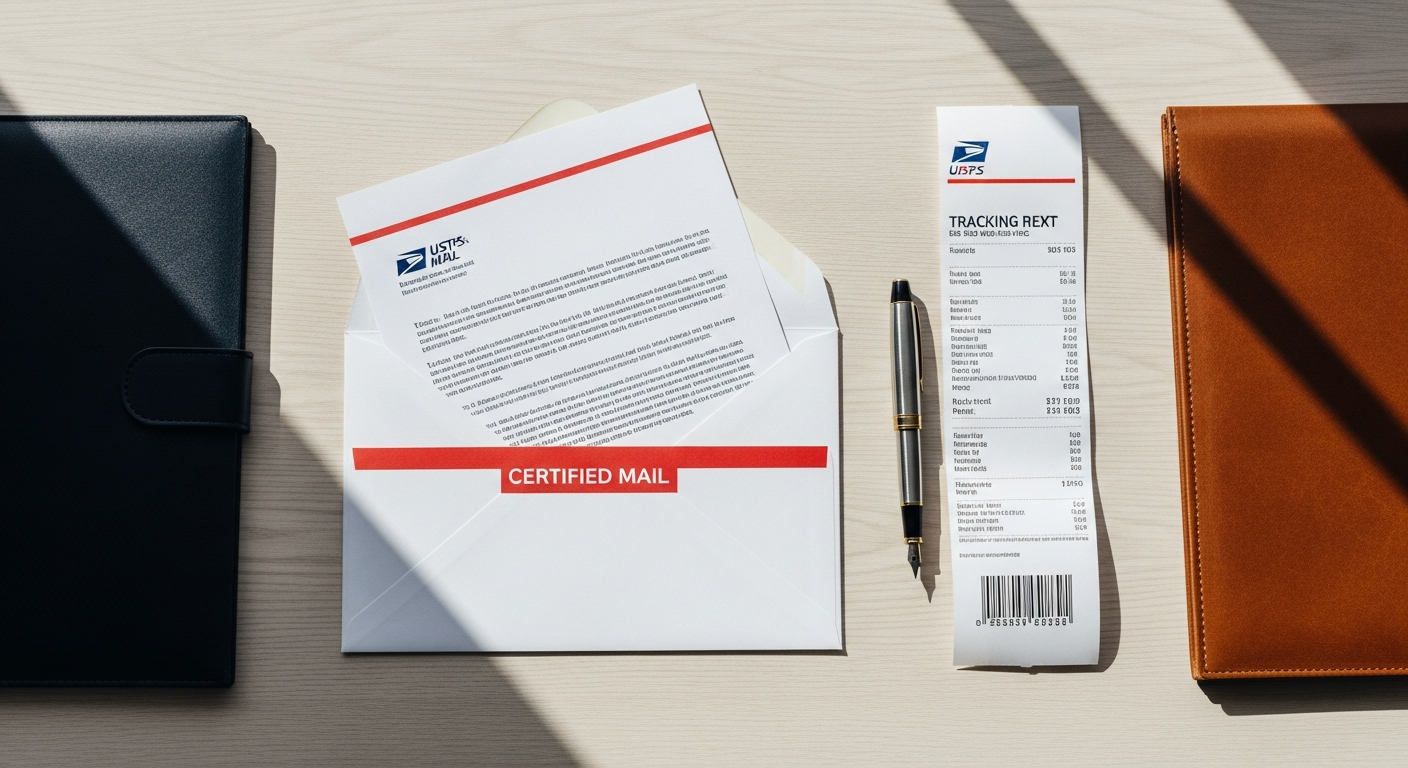
Sending a legal notice by mail isn't just about getting a letter into someone's hands. It's about creating an undeniable, timestamped record that the notice was sent, received, and — if necessary — can be presented in court. Do it wrong and your notice may be legally defective, even if the other party actually read it.
This guide covers everything you need: which mail methods satisfy statutory requirements, what types of legal notices require physical mail, how to document delivery, and how to send legal notices without a printer or a trip to the post office.
Table of Contents
- Why Physical Mail Still Has Legal Weight
- Types of Legal Notices That Require Physical Mail
- Certified Mail vs. First-Class Mail: Which Do You Need?
- Proof of Delivery: What Courts Actually Want to See
- How to Address and Format a Legal Notice
- Sending Legal Notices Online Without a Printer
- Common Mistakes That Invalidate Legal Notices
- FAQ
- Sources
Why Physical Mail Still Has Legal Weight
Email is fast, but it's legally fragile. Delivery failures are silent. Spam filters are invisible. Read receipts can be disabled. And proving that the other party actually received a digital message is harder than it sounds.
Physical mail — especially USPS First-Class Mail or Certified Mail — carries a different legal presumption. Under the mailbox rule, a legal doctrine recognized across U.S. jurisdictions, a letter is presumed delivered once it's properly addressed, stamped, and deposited with the postal service. The recipient doesn't need to actually open it. That presumption alone gives physical mail a structural legal advantage over email.
Courts routinely rely on USPS tracking, signed delivery receipts, and certificate of mailing as evidence that notice was properly served. Many statutes governing landlord-tenant relationships, debt collection, contract disputes, and intellectual property enforcement explicitly require physical mail or only recognize it as valid service.
The stakes are real. Miss the mailing requirement on an eviction notice and you may have to restart the entire process — losing weeks of time and rental income.
Types of Legal Notices That Require Physical Mail
Not every legal communication needs to go by physical mail, but several categories either require it by statute or are significantly stronger when delivered that way.
Eviction and Landlord-Tenant Notices
Most states require physical written notice for pay-or-quit notices, lease termination, and notices to cure. California Civil Code § 1162, for example, specifies that a landlord must either personally serve the tenant, leave notice at the property with a person of suitable age, or send it by certified or registered mail. Oral notice is not valid. Email typically isn't either, unless the lease explicitly authorizes it.
For landlords and tenants alike, understanding how to send landlord-tenant notices by mail is the difference between a legally valid notice and one that gets thrown out at an eviction hearing.
Demand Letters
A demand letter formally requests payment, action, or resolution before litigation. While no federal statute mandates mailing a demand letter, physical delivery is standard practice for two reasons: it demonstrates good faith to a court, and it creates a paper trail that email simply doesn't match. Small claims courts and civil courts regularly ask whether the claimant "put it in writing" and whether it was sent by mail.
Cease and Desist Notices
A cease and desist letter demands that the recipient stop a specific activity — trademark infringement, harassment, copyright violation, or breach of a non-compete. Physical mail matters here because the letter may be exhibit A if you end up in litigation. Sending it by USPS First-Class Mail or Certified Mail proves the sender took the matter seriously and gave formal notice.
If you need to send a cease and desist letter, physical mail is the standard — and the safest approach for establishing that the other party was formally put on notice.
Breach of Contract Notices
Many contracts contain a notice clause that specifies exactly how notice must be delivered — often requiring certified mail or overnight courier to a specific address. If your contract contains this language, you must follow it. Sending notice by email when the contract says certified mail can mean your breach notification is legally ineffective, even if the other party acknowledges receiving it.
Review your contract's notice provision before sending anything. A breach of contract letter sent by mail with proper documentation is far more defensible than one dashed off by email.
Debt Collection Notices
The Fair Debt Collection Practices Act (FDCPA) requires debt collectors to send a written validation notice within five days of first contact with a consumer. That notice must go by physical mail — it cannot be satisfied by a phone call or email alone, under current regulatory interpretation.
Statutory Pre-Litigation Notices
Many state statutes require a written notice before a lawsuit can be filed. California's consumer protection laws, for instance, require a 30-day written notice before filing certain class action claims. Construction defect claims in Florida require a notice of claim letter before litigation. These notices must be physical, properly addressed, and provably delivered.
Certified Mail vs. First-Class Mail: Which Do You Need?
This is the question most people get wrong.
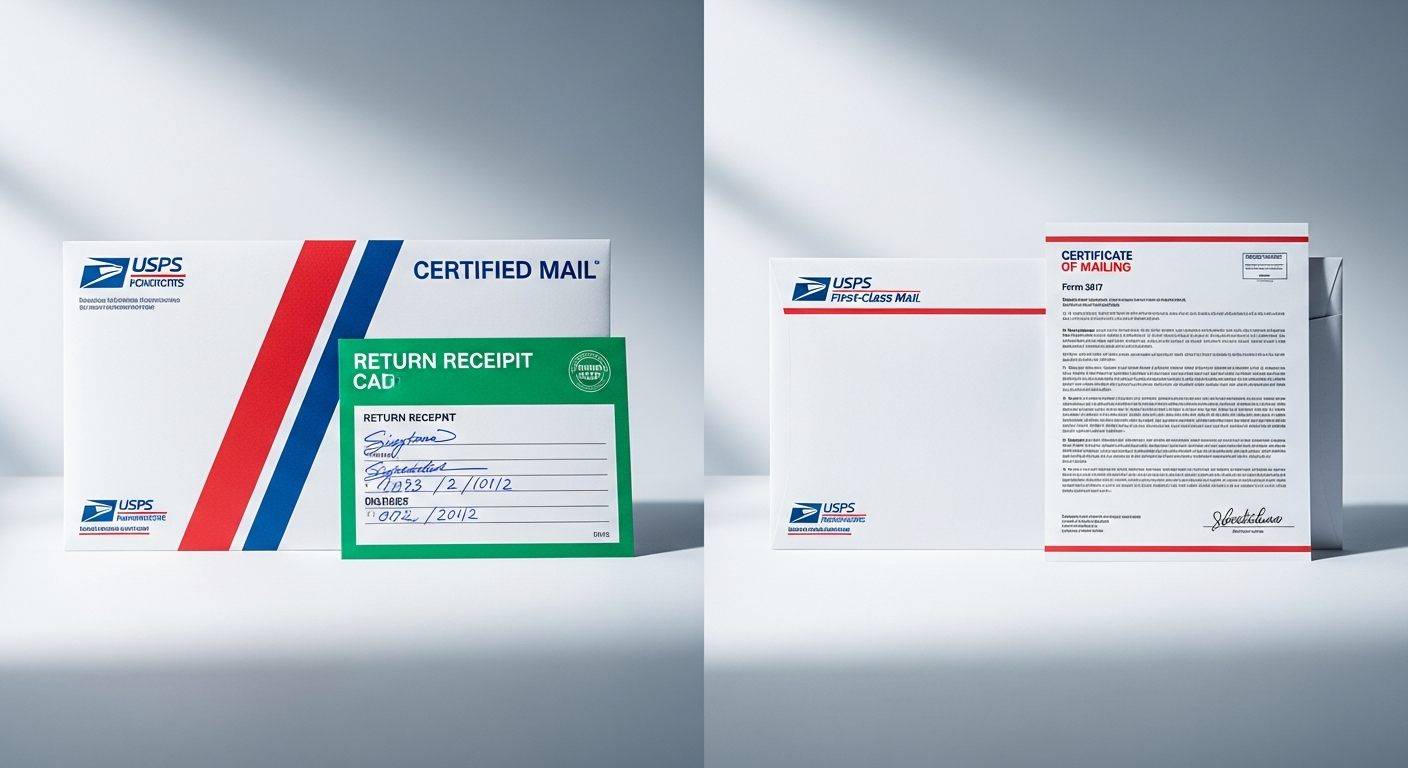
Certified Mail provides a signed delivery receipt and proof of attempted delivery. It's the gold standard when you need evidence that a specific person received your notice. Courts accept it as strong proof of service. The downside: the recipient must be home (or at their place of business) to sign, which means it can be refused or sit unclaimed at the post office.
First-Class Mail — particularly when paired with a Certificate of Mailing (USPS Form 3817) — is legally sufficient for many notice types and actually has a tactical advantage: it gets delivered even if the recipient isn't home. Under the mailbox rule, once it's in the mail with the right address and postage, delivery is legally presumed. Certificate of Mailing is obtained at the post office window at the time of mailing — it's a dated, postmarked record that your letter was accepted by USPS, even without a signed receipt.
Registered Mail is the most secure option USPS offers — it's tracked at every point in transit and requires signatures at each stage. It's rarely required but worth knowing for high-stakes international notices or extremely valuable documents.
Which to Use
| Situation | Recommended Method |
|---|---|
| Eviction notice (most states) | Certified Mail or First-Class with Certificate of Mailing |
| Contract notice clause — "certified mail required" | Certified Mail |
| Demand letter | First-Class Mail (with Certificate of Mailing) |
| Cease and desist | First-Class Mail or Certified Mail |
| FDCPA debt validation notice | First-Class Mail |
| Pre-litigation statutory notice | Certified Mail (check state statute) |
When the statute is silent on method, default to Certified Mail with Return Receipt. It's rarely wrong and always gives you documentation.
Proof of Delivery: What Courts Actually Want to See
The goal isn't just delivery — it's provable delivery. Here's what actually holds up.
USPS Certified Mail Return Receipt (PS Form 3811) — the green card — is the most recognized proof of delivery in U.S. courts. It shows the signature of the person who signed, the date, and the delivery address. Keep the original.
USPS Tracking — for Certified Mail, Priority Mail, and other tracked services, USPS provides an online delivery record tied to the tracking number. Screenshot and save this the moment delivery is confirmed.
Certificate of Mailing — proves the letter was given to USPS on a specific date. Doesn't confirm delivery, but establishes the mailing date for statute of limitations and notice deadline purposes.
Affidavit of Mailing — a sworn statement that you placed a properly addressed, stamped letter in the mail. Used frequently in landlord-tenant and collections contexts. Courts give it real weight.
Keep copies of everything: the letter itself, the envelope (front and back), the tracking confirmation, and any return receipt. If the matter escalates, your documentation package needs to be complete.
How to Address and Format a Legal Notice
Format matters more than people think. A sloppily presented letter signals to the recipient — and to a judge — that you're not serious.
Header and date — include your full legal name or business name, your address, and the date. The date is critical. It establishes when the notice period began.
Recipient information — full legal name of the individual or entity, their current mailing address. If it's a business, use the registered agent address for any dispute that may end in litigation.
Subject line — be explicit: "NOTICE OF BREACH AND DEMAND TO CURE," "LEGAL NOTICE — CEASE AND DESIST," or similar. This tells the recipient immediately what they're holding.
Body — state the facts clearly: what happened, what the legal basis is, what you're demanding, and what the consequence of non-compliance will be. Set a specific deadline — "within 30 days of receipt of this notice" is standard.
Signature and contact information — sign by hand if sending a physical copy. Include your email and phone number so the recipient can respond without further escalation.
Send in a letter-size envelope, not a postcard. A sealed envelope signals that the contents are private and formal.
Sending Legal Notices Online Without a Printer
Most people assume sending a physical legal notice means printing the letter, buying stamps, driving to the post office, and waiting in line. That's not the case anymore.
WriteToMail is a platform that handles the entire process online. You compose your letter using a rich text editor or let the AI drafting tool write it from a description of your situation. You upload an existing PDF if you've already drafted the notice. You enter the recipient's address. WriteToMail prints it, applies postage, and mails it via USPS First-Class Mail — all without you touching a printer or leaving your desk.
For law firms managing high volumes of legal correspondence, the direct mail tools for law firms include bulk mailing via CSV upload — useful for sending notices to multiple parties simultaneously, with variable fields for names, addresses, amounts due, and other personalized data.
For individuals and small businesses, built-in templates for demand letters and cease and desist notices mean you don't need to start from scratch. And because WriteToMail uses USPS First-Class Mail, your notice carries the same legal delivery presumption as anything you'd drop at the post office counter.
The platform is also SOC 2 compliant and HIPAA-compliant, which matters when the content of your notice includes sensitive financial or medical information.
If you want to send a legal notice by mail online without dealing with printers, stamps, or a post office visit, this is a direct path to doing that.
Common Mistakes That Invalidate Legal Notices
Using the wrong mailing method — if a contract or statute specifies certified mail and you send first-class, your notice may be legally void.
Sending to the wrong address — always use the current registered address for businesses, not an old address from a previous contract. For individuals, use the address they've provided in writing most recently.
Missing the notice period deadline — many statutes require notice within a specific timeframe. Missing the window can eliminate your legal rights entirely.
Failing to keep copies — you need the letter, the envelope, and the proof of mailing. "I sent it" is not proof. "Here is the USPS tracking confirmation and Certificate of Mailing" is.
Inadequate description of the legal basis — vague letters ("you owe me money and I want it") are weaker than notices that cite the specific contract, statute, or right being enforced. Be specific.
No deadline for response or cure — a notice without a deadline is toothless. "Respond within 30 days" is standard. Without it, you haven't triggered any response obligation.
FAQ
Does a legal notice have to be sent by certified mail?
Not always. Many legal notices are valid when sent by USPS First-Class Mail, especially when paired with a Certificate of Mailing. However, some statutes and contracts explicitly require certified or registered mail. Always check the governing statute and any applicable contract notice clause.
Can I send a legal notice by email instead of physical mail?
In most legal contexts, email is not an adequate substitute for physical mail unless the relevant statute, regulation, or contract explicitly allows it. Email lacks the legal delivery presumption that physical mail carries under the mailbox rule. For anything with real legal consequence, physical mail is the safer choice.
What is the mailbox rule?
The mailbox rule is a common law doctrine providing that an offer or notice is effective upon dispatch — meaning once it's properly addressed, stamped, and placed in the mail — not when it's received. This protects the sender from situations where the recipient claims they never got the letter.
Do I need a lawyer to send a legal notice by mail?
No. Individuals can send demand letters, cease and desist notices, breach of contract letters, and many other legal notices without an attorney. However, for complex matters — disputes involving significant money, potential litigation, or regulated industries — legal counsel is advisable. The physical mailing process itself requires no attorney.
What if the recipient refuses to accept certified mail?
Refusal of certified mail is still legally meaningful in many jurisdictions. Courts generally view it as constructive notice — the recipient was aware that a piece of official mail was waiting and chose not to accept it. In those cases, you may also want to send a duplicate copy by First-Class Mail to the same address.
How long should I give someone to respond to a legal notice?
Thirty days is the most common standard for demand letters and breach of contract notices. Eviction notices vary by state — many require only 3, 5, or 10 days. Cease and desist letters often give 10–30 days. When in doubt, 30 days is a defensible timeframe that signals good faith.
Can I send a legal notice to a business by mail?
Yes — send it to the registered agent of the business, which is public record in every state. For small businesses without a formal registered agent, send it to the business's principal place of business, addressed to the owner by name.
Next Steps
Knowing how to send a legal notice by mail is only half the equation. The other half is actually doing it quickly and correctly, before deadlines expire.
If you need to send a notice today, here's the fastest path:
- Identify the notice type — demand letter, cease and desist, breach of contract, eviction notice, or other.
- Check the applicable statute or contract clause for mailing requirements.
- Draft your notice using a template or AI drafting tool. Be specific about the facts, the legal basis, and the deadline.
- Choose your mailing method — Certified Mail when you need signed proof of delivery, First-Class Mail when you need reliable delivery without signature.
- Mail it — either at a USPS location with a Certificate of Mailing, or through an online platform that handles printing and postage for you.
For those who want to skip the printer and post office entirely, WriteToMail lets you compose, customize, and send physical legal notices via USPS First-Class Mail in minutes — including AI-assisted drafting, PDF upload, and built-in templates for demand letters and cease and desist notices.
Sources
- USPS — Certified Mail Overview — details on Certified Mail service, return receipt options, and proof of delivery documentation
- USPS — Certificate of Mailing (Form 3817) — explanation of Certificate of Mailing as proof of dispatch
- California Civil Code § 1162 — Service of Notice — statutory requirements for service of eviction notices in California
- Fair Debt Collection Practices Act — 15 U.S.C. § 1692g — requirement for written debt validation notice within five days of first contact
- Restatement (Second) of Contracts § 63 — Mailbox Rule — Cornell Law School Legal Information Institute summary of the mailbox rule and its application
- Florida Statute § 558.004 — Notice of Claim in Construction Defect Cases — pre-litigation written notice requirement before construction defect lawsuits in Florida
- American Bar Association — Model Rules of Professional Conduct, Rule 1.4 — communication obligations relevant to attorney-supervised legal notice practices