
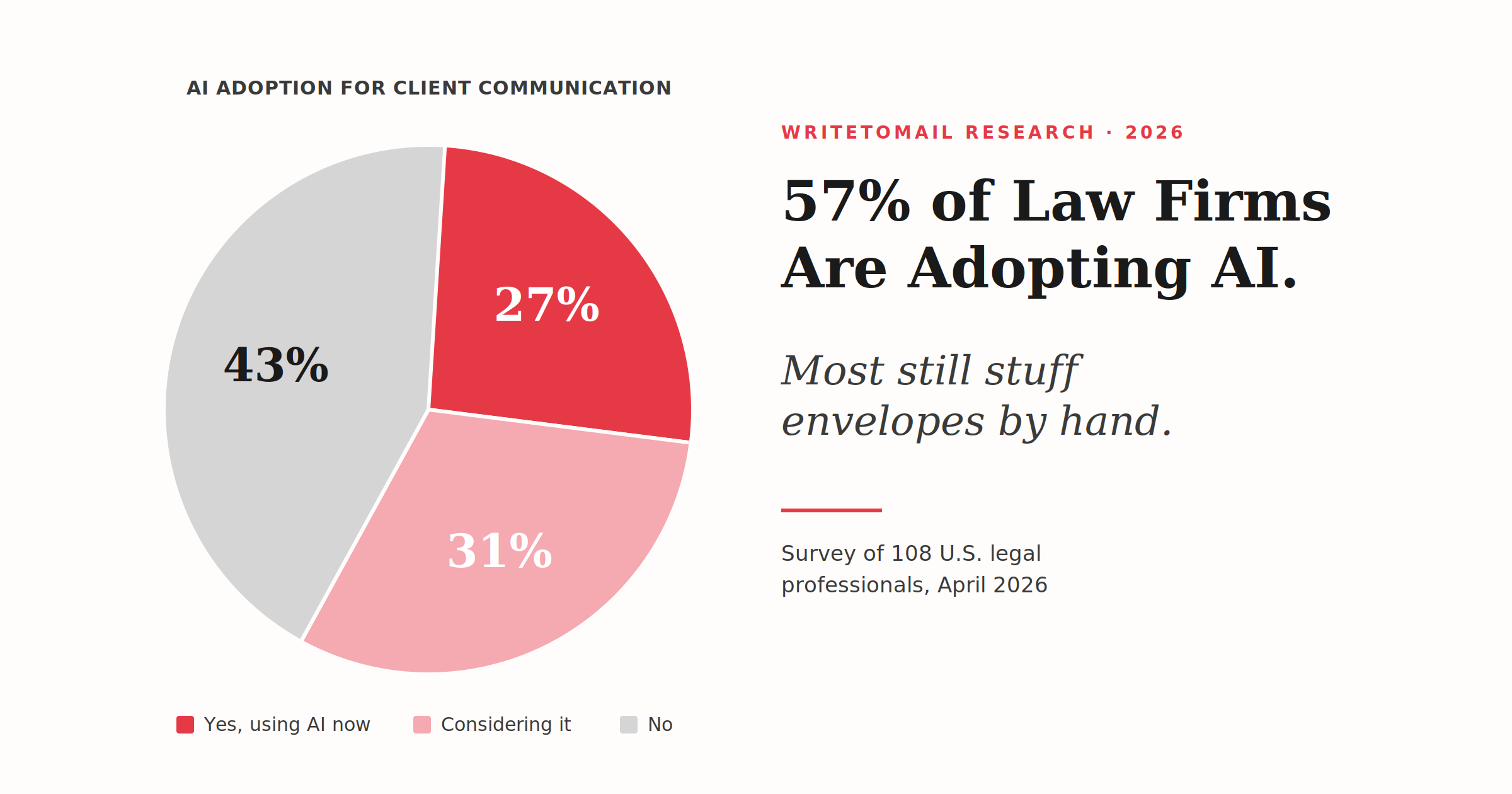
U.S. law firms are racing to adopt artificial intelligence for client communication — but are ignoring a simpler, lower-risk automation sitting directly in front of them. That's the core finding of a new survey of 108 legal professionals conducted by WriteToMail in April 2026.
The headline numbers tell a paradoxical story. A combined 57% of firms are already using or actively considering AI tools for client communication. In the same survey, 65% of firms said they still produce and send physical mail manually — printing, stuffing, stamping, and logging every piece by hand.
Key numbers at a glance:
- 57% of firms are using or considering AI for client communication
- 65% of firms still send physical mail manually
- 37% name physical mail their most trusted client channel
- 80% of firms that trust physical mail most still send it by hand
Put bluntly: firms are leaping at frontier technology while walking right past the deterministic, lower-risk automation that would free up the staff time AI is supposed to unlock in the first place.
What the Survey Asked
Respondents answered three questions about how their firm communicates with clients:
- Which communication method do your clients trust most?
- How does your firm send physical mail?
- Has your firm adopted AI tools to perform client communication?
Finding 1: AI Is Moving Into Client Communication Fast
27% of firms reported they are already using AI tools for client communication. Another 31% said they are actively considering it. Only 43% said no — a minority, notable given how recently generative AI entered the mainstream legal tech conversation.
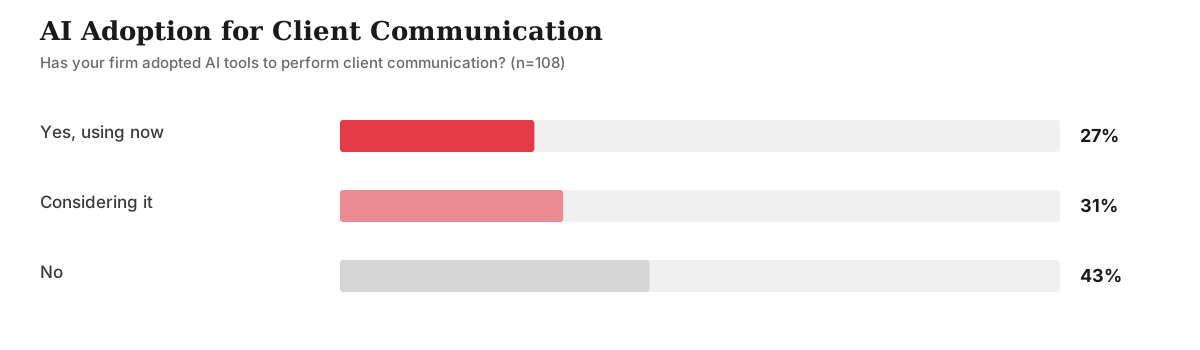
The pace here is real. Two years ago, a similar survey would almost certainly have shown single-digit adoption. The combined 58% engagement rate (using plus considering) puts AI in client communication roughly on par with how quickly firms adopted cloud case management a decade ago — and ahead of how quickly many firms adopted e-filing.
Finding 2: Mail Automation Is Lagging Far Behind
Only 34% of firms use software to send physical mail. The remaining 65% still handle outbound mail manually — printing, folding, stuffing, stamping, logging, and walking it to the post office. One respondent reported not sending physical mail at all.
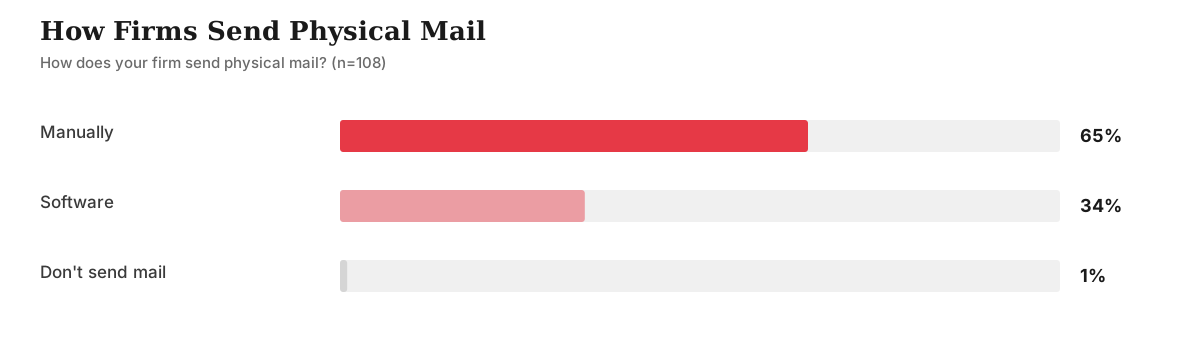
The gap between AI adoption (57%) and mail automation (34%) is the single most surprising data point in the survey. Every firm has outbound mail. Very few have deployed AI at scale. Yet the latter is moving faster than the former.
This matters operationally. Manual mail handling is the kind of task that silently consumes paralegal and administrative hours: every hour spent at a printer is an hour not spent on billable work. For context on why firms should care about this specifically, the guide on how to send bulk mail without going to the post office walks through the mechanics of replacing that workflow entirely.
Finding 3: Physical Mail Still Wins on Trust
Asked which channel their clients trust most, 37% of respondents named physical mail — narrowly beating email (35%), custom software portals (25%), and phone (3%). In 2026, with email fatigue, phishing concerns, and inbox saturation at all-time highs, the physical envelope is quietly reclaiming trust.
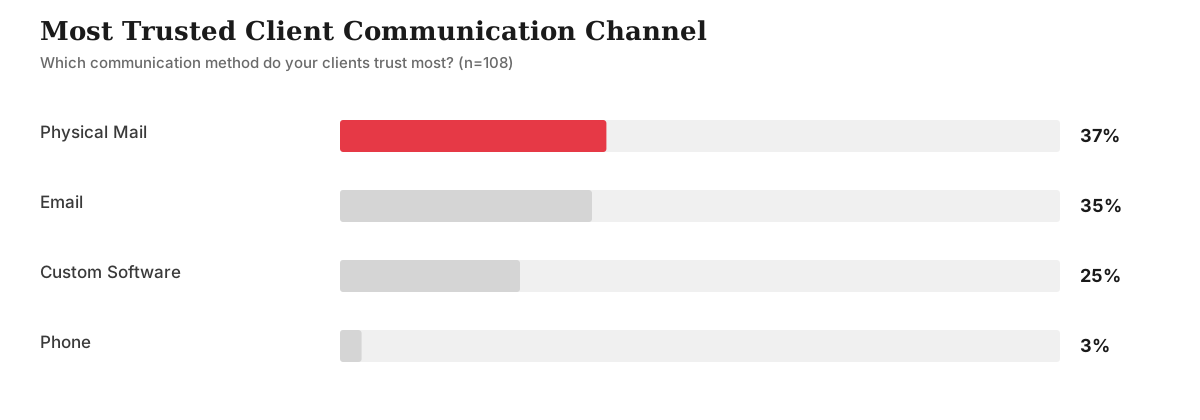
This is the stat most likely to surprise legal marketers. The assumption for the last decade has been that email is the default trust channel and mail is a legacy relic. The data says otherwise: when clients have to pick a single channel they trust most, they're slightly more likely to pick the one that physically arrives at their door than the one that lands in their inbox.
Finding 4: The Automation Gap Is Widest Where Trust Is Highest
Here's the cross-tab that ties the whole survey together: among firms that named physical mail their most trusted client channel, 80% still send that mail manually. The channel firms trust most is the channel they've automated least.
That's the operational paradox of legal communication in 2026. Firms recognize mail as high-stakes and high-trust. Firms are actively investing in AI for lower-stakes interactions like intake, scheduling, and FAQ handling. But the highest-trust channel is still running on 1985 workflow.
Why This Matters
AI adoption in legal has dominated industry conversation for the last two years. Firms have poured budget into drafting assistants, document review, and contract analysis. The WriteToMail survey suggests that race is happening in parallel to, not in place of, the operational work of running a firm. The mundane, higher-certainty automations — outbound mail chief among them — remain largely manual.
That matters because physical mail is still where the legally consequential communication happens: engagement letters, retainers, certified notices, statute-of-limitations deadlines, and settlement documents. A missed or mis-logged piece of mail can cost a case.
The firms that get both right — AI on top, automation underneath — are the ones that will pull ahead on cost, speed, and auditability over the next 24 months.
Methodology
The WriteToMail 2026 Law Firm Communication Survey collected 108 responses from U.S. legal professionals between April 17–18, 2026, via a Tally-hosted survey distributed through legal industry channels. Percentages are rounded to the nearest whole number. Anonymized raw data is available on request at press@writetomail.com.
About WriteToMail
WriteToMail is a physical mail automation platform built for law firms. Integrated directly with Clio, WriteToMail lets firms send letters, certified mail, and client correspondence from inside their case management system — no printers, no trips to the post office, no manual logging. WriteToMail is a product of AE Software LLC, based in New York.
Media & press inquiries: AE Software LLC · press@writetomail.com