
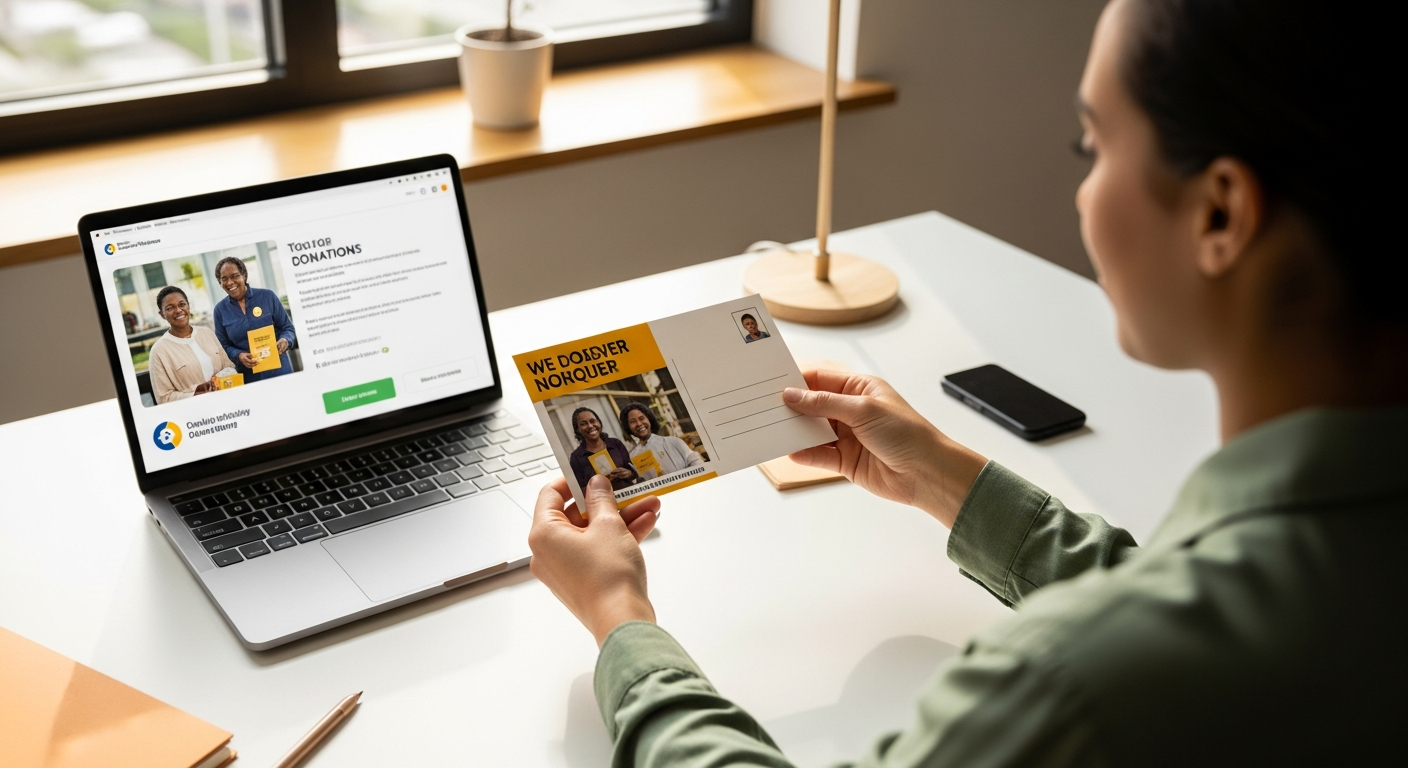
Physical mail still moves donors. While nonprofit marketers debate email open rates and social media algorithms, postcards quietly keep landing in mailboxes — and getting read. A postcard mailing service for nonprofits removes every barrier that once made direct mail feel complicated: no printer, no bulk mail permit, no trip to the post office. You design, upload your donor list, and send.
This guide covers exactly how to make that work — from designing postcards that prompt donations to uploading a CSV of 5,000 lapsed donors and launching a campaign before lunch.
Table of Contents
- Why Postcards Work for Nonprofit Donor Outreach
- Types of Nonprofit Postcard Campaigns
- How to Design an Effective Nonprofit Postcard
- Uploading Your Donor List via CSV
- Personalizing at Scale with Variable Data
- Measuring Campaign ROI
- What to Look for in a Postcard Mailing Service
- How WriteToMail Works for Nonprofits
- Sources
- FAQ
Why Postcards Work for Nonprofit Donor Outreach
Email is cheap and easy to ignore. The average nonprofit email open rate sits around 25–30%, which sounds acceptable until you realize most of those opens are fleeting. Postcards don't have a spam folder. They arrive in the hand. They get looked at — even briefly — before anyone decides what to do with them.
According to the USPS Household Diary Study, 98% of Americans check their mail daily, and 77% sort through physical mail immediately. For nonprofits trying to break through the noise, that's a meaningful advantage.
There's also a credibility signal in physical mail that digital channels can't replicate. A postcard showing up with your organization's name and a genuine ask communicates effort. Donors perceive it differently than another promotional email. That perception translates to response rates: direct mail response rates average 4.4%, compared to 0.12% for email, according to the Data & Marketing Association.
For donor acquisition specifically — reaching people who've never given before — physical mail remains one of the most reliable channels nonprofits have.
Types of Nonprofit Postcard Campaigns
Not every postcard campaign serves the same goal. Matching the campaign type to the right audience dramatically improves response rates.
Donor Acquisition Campaigns
These go to cold lists: prospects who've never donated. The goal is a first gift, so keep the ask small and the story compelling. Focus on one beneficiary, one outcome, one action. A $25 ask with a clear impact statement ("feeds one child for a month") outperforms a vague appeal every time.
Lapsed Donor Reactivation
Donors who gave 12–36 months ago and went quiet are your warmest cold audience. They already said yes once. A postcard acknowledging their previous support — and showing what's happened since — reactivates far more efficiently than a cold acquisition campaign.
Fundraising Appeals
Year-end giving season, Giving Tuesday, emergency appeals — these are time-sensitive campaigns where speed matters. A well-designed postcard landing in mailboxes 7–10 days before a campaign deadline creates the urgency that drives action.
Event Invitations
Galas, volunteer days, community forums, webinars. A physical invitation signals importance in a way that a calendar invite doesn't. Including a QR code that goes straight to the RSVP page removes friction.
Thank-You and Stewardship Cards
Thanking donors within 48 hours of a gift is one of the strongest predictors of a second gift. A postcard thank-you — personal, simple, not asking for anything — is faster to send than a letter and stands out more than an email receipt.
How to Design an Effective Nonprofit Postcard
Design decisions directly affect whether someone donates or drops the card in recycling. A few principles that consistently improve results:
Lead with a human story, not your organization's name. The reader cares about impact, not your brand. "Maria's daughter can now read" gets attention. "Our literacy program serves 2,400 students" doesn't.
Use one clear call to action. Donate online, scan the QR code, or mail back the reply card — not all three. Every additional option reduces the likelihood of action.
Keep body copy to 50 words or fewer. Postcards aren't brochures. The limited space is an asset: it forces discipline. Three sentences that communicate who you help, how, and what the donor makes possible is enough.
High-contrast, single-image photography. Abstract graphics underperform. A real face — a real person your work has helped — performs better than any illustration. Make sure the image has enough contrast to read on matte paper stock.
Include a donation URL and QR code. Most donors who respond to direct mail still give online. A QR code that goes directly to your donation page eliminates the typing friction. Track it with a UTM parameter so you can attribute donations to the campaign.
For more design principles that translate across campaign types, the guide on direct mail postcard ideas that drive real responses covers format-specific tactics that nonprofits can adapt.
Uploading Your Donor List via CSV
This is where most nonprofit teams save the most time. Instead of printing individually, stuffing envelopes, or paying a mail house for a minimum order of 10,000 pieces, you upload a spreadsheet and the platform handles everything.
Here's what a clean CSV for nonprofit postcard mailing should include:
| Column | Example |
|---|---|
| FirstName | Sarah |
| LastName | Okonkwo |
| Address1 | 412 Birchwood Lane |
| Address2 | Apt 3B |
| City | Portland |
| State | OR |
| Zip | 97201 |
| LastGiftAmount | 50 |
| LastGiftDate | 2024-11-15 |
| Segment | lapsed |
Columns like LastGiftAmount and Segment become variable fields — more on that in the next section. For now, the priority is clean data: no duplicates, valid addresses, consistent formatting.
USPS has strict address standardization requirements. Before uploading, run your list through a free address verification tool or use your CRM's built-in deduplication. A 5% undeliverable rate on a 2,000-piece campaign means 100 wasted postcards.
The detailed walkthrough on running a bulk direct mail campaign from a spreadsheet covers data formatting requirements in depth — including how to handle apartment numbers, international addresses you want to exclude, and common CSV errors that cause upload failures.
Personalizing at Scale with Variable Data
Mass mail that reads like mass mail gets ignored. Variable data merge lets you personalize each postcard using columns from your CSV — without writing 5,000 individual cards.
Practical examples:
- "Dear [FirstName]," — basic, but still meaningfully better than "Dear Friend"
- "Your last gift of $[LastGiftAmount] helped us [specific outcome]." — acknowledges the donor's history, makes them feel seen
- "We haven't heard from you since [LastGiftDate] — we'd love to welcome you back." — specific, personal, non-accusatory
- "As a [Segment] supporter, your impact in [City] has been..." — geo-specific, segment-relevant
The psychology here isn't complicated. People respond to their own name, their own gift history, their own city. Every personalized field increases the perceived relevance of the card. Relevance is what drives response.
Variable data works the same way whether you're mailing 50 cards or 50,000. The platform maps each CSV column to a placeholder in your postcard template, then renders a unique version for every recipient. No manual effort — and no extra cost per personalization.
For a tactical breakdown of how CSV-based personalization works across different campaign types, see the guide on launching a postcard marketing campaign via CSV.
Measuring Campaign ROI
Direct mail ROI is measurable — you just have to set it up before the campaign goes out.
Track donations by source. Use a campaign-specific donation URL (e.g., yourorg.org/donate?utm_source=postcard&utm_campaign=year-end-2026) and a QR code pointing to the same URL. Any donation that comes through that URL is attributable to the campaign.
Measure cost per dollar raised. Total campaign cost ÷ total donations raised = cost per dollar raised. A well-executed nonprofit postcard campaign typically sees $3–$5 raised for every $1 spent on acquisition mail, and significantly higher ratios for lapsed donor reactivation.
Calculate response rate by segment. If you mailed 500 lapsed donors and 200 cold prospects, track them separately. This tells you where your next campaign budget should go.
Watch for time-lag. Physical mail response doesn't peak at day one. Donations from a postcard campaign often come in over 2–3 weeks. Wait at least three weeks before evaluating campaign performance.
A/B test systematically. Change one variable per campaign: the headline, the ask amount, the image, the CTA. After 3–4 campaigns, you'll have clear data on what moves your specific donor base.
What to Look for in a Postcard Mailing Service
Not every platform is built for nonprofit scale or flexibility. The right service should offer:
- CSV/bulk upload with variable data merge — mandatory for any campaign over 50 recipients
- No minimum order requirement — nonprofits often need to test small before scaling
- Transparent per-piece pricing — hidden fees destroy ROI calculations
- USPS delivery — First-Class Mail is the standard for donor communications; it's faster and more reliable than Every Door Direct Mail for list-based campaigns
- Online-only workflow — no printing, no stamps, no post office required
- Data security — donor data is sensitive; look for SOC 2-compliant handling
The comparison between postcard and letter formats is also worth revisiting before every major campaign. Some fundraising appeals — particularly multi-page year-end letters — outperform postcards. The guide on postcard vs. letter for direct mail walks through when each format wins.
How WriteToMail Works for Nonprofits
WriteToMail is a platform that lets you design, customize, and send physical postcards entirely online. No printer. No stamps. No trip to the post office. The platform handles printing, postage, and USPS delivery — for single sends and bulk campaigns alike.
For nonprofits specifically, the workflow looks like this:
Step 1: Design your postcard. Use the online editor to create your layout — add your headline, copy, image, QR code, and donation URL. The rich text editor supports font, style, and color customization.
Step 2: Upload your donor list. Export your donor list from any CRM (Salesforce, Bloomerang, DonorPerfect, etc.) as a CSV. Upload it directly to the platform.
Step 3: Map variable fields. Connect CSV columns to placeholders in your postcard template — FirstName, LastGiftAmount, City, or any other field you've included.
Step 4: Review and send. Preview a sample card, confirm your recipient count, and submit. WriteToMail handles printing, addressing, postage, and USPS delivery.
No minimum order. No mail house negotiation. No bulk permit required. A nonprofit staff member with no direct mail experience can launch a campaign in under an hour.
WriteToMail's infrastructure is SOC 2 compliant, which matters when you're uploading files containing donor names, addresses, and giving history.
For an overview of how the full online postcard workflow operates — including design options and delivery timelines — the online postcard mailing service guide is a useful starting point.
Sources
- Nonprofit Marketing Guide — Email Benchmarks — nonprofit email open rate statistics cited in the introduction
- USPS Office of Inspector General — Household Diary Study — data on daily mail checking behavior and sorting habits
- Data & Marketing Association — Response Rate Report — direct mail vs. email response rate comparison (4.4% vs. 0.12%)
- USPS — Address Quality and Deliverability — USPS address standardization requirements for bulk mail
- Nonprofit Tech for Good — State of Nonprofit Fundraising — context on multi-channel donor engagement benchmarks
FAQ
How much does it cost to send postcards for a nonprofit?
Per-piece costs vary by platform and volume. As a general benchmark, expect to pay $0.70–$1.20 per postcard when using an online mailing service — this typically includes printing, postage, and delivery. At 1,000 pieces, that's a $700–$1,200 campaign. For lapsed donor reactivation, where response rates can hit 10–20%, that math works very favorably.
Do we need a bulk mail permit to send postcards?
No. When you use an online postcard mailing service like WriteToMail, the platform handles all postage through its own USPS account. You don't need a bulk mail permit, a Business Reply Mail license, or any postal infrastructure. You just upload and send.
Can we segment our donor list and send different postcard versions to each segment?
Yes. If your CSV includes a segment column (e.g., "lapsed," "major donor," "first-time"), you can upload one list and use variable data merge to customize the message for each group. Alternatively, export separate CSVs per segment and create distinct postcard designs for each campaign.
How long does it take for postcards to reach donors?
USPS First-Class Mail typically delivers within 3–5 business days domestically. Plan for 7–10 days of lead time if you're mailing ahead of a campaign deadline — that includes 1–2 days for the platform to process and print your order before USPS picks it up.
Should nonprofits use postcards or letters for fundraising?
Both work — but for different purposes. Postcards work better for event invitations, brief seasonal appeals, and stewardship. Letters work better for detailed year-end appeals, grant communications, and cases where you need to tell a longer story. Many nonprofits use postcards as a teaser or follow-up, and letters as the primary ask vehicle. The comparison guide on postcard vs. letter for direct mail covers the data behind each format.
Can we track which donors responded to a postcard campaign?
Yes. Use a campaign-specific donation URL with UTM parameters and a matching QR code on the postcard. Any donation arriving through that URL is attributable to the campaign. Some nonprofits also set up a dedicated phone extension or a campaign-specific landing page for tracking purposes.
Is donor data safe when we upload a CSV to an online mailing service?
It depends on the platform. WriteToMail is SOC 2 compliant, which means its data handling practices have been independently audited against established security standards. When evaluating any service, look for explicit SOC 2 certification and a clear data retention policy for uploaded lists.
What's the ideal postcard size for nonprofit fundraising?
Standard 4×6 postcards are the most cost-effective. Jumbo 6×9 or 6×11 postcards have higher production costs but stand out more in the mailbox — some nonprofits find the increased response rate justifies the premium for major campaigns. For testing, start with 4×6 and upgrade to larger formats once you have baseline response data.