
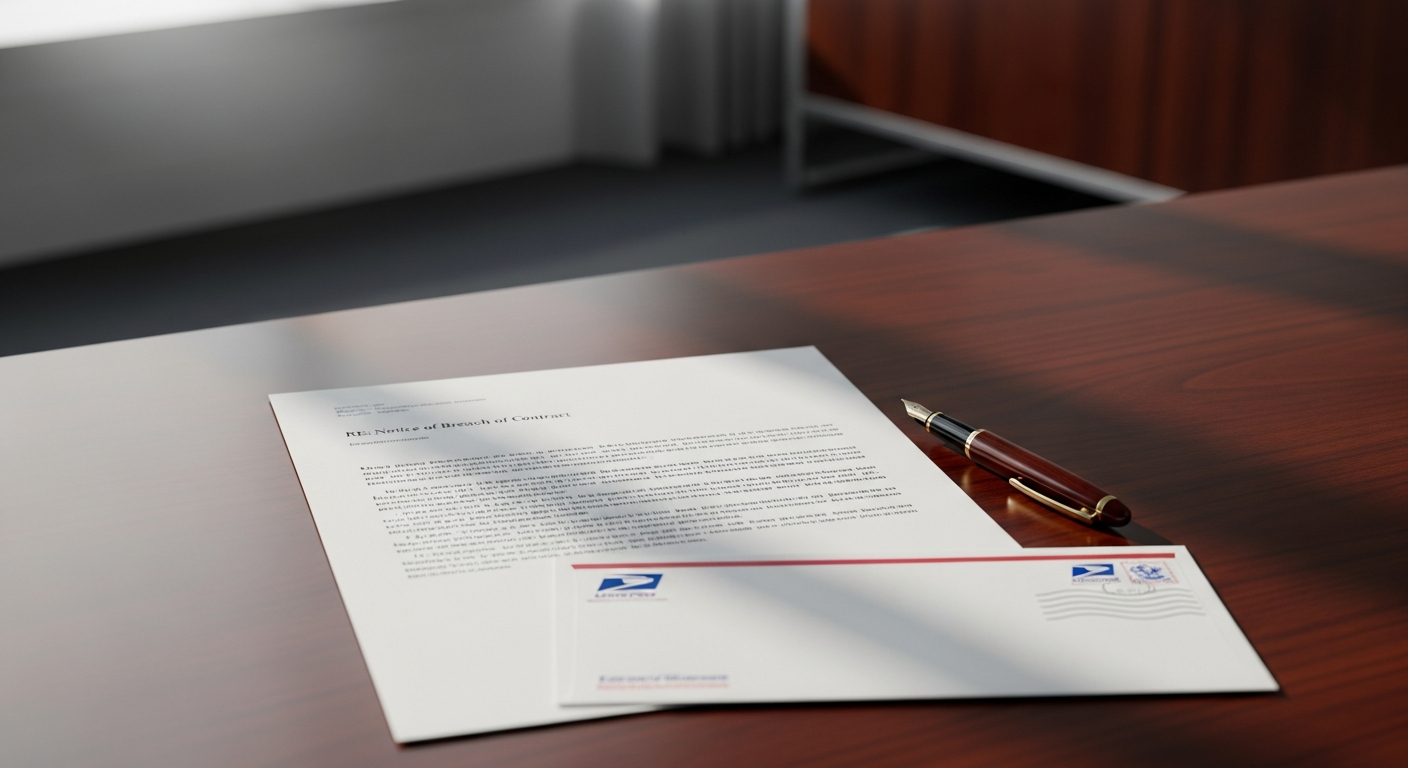
When someone breaks a contract, a well-drafted physical letter does three things at once: it puts the other party on formal notice, creates a documented paper trail, and signals that you're serious. This guide gives you a ready-to-use template for a breach of contract notification letter, walks through each section with examples, and explains how to send breach of contract letter by mail using WriteToMail — without a printer, stamps, or a post office trip.
This template is built for freelancers, small business owners, contractors, landlords, and anyone in a contractual dispute who needs to notify the other party formally before escalating to legal action.
Why Physical Mail Matters in Contract Disputes
Email is easy to ignore, forward to spam, or claim was never received. A physical letter is harder to dismiss.
Many contracts include a "notice" clause specifying that formal communications must be delivered by physical mail — sometimes by certified mail. Even when contracts don't require it, courts generally treat written, mailed correspondence as stronger evidence than email threads. A physical letter with a postmark date establishes a clear timeline that's difficult to dispute.
According to the American Bar Association's 2023 Litigation Survey, written pre-litigation notices — including breach of contract letters — are a critical step in most commercial disputes before formal legal proceedings begin. Skipping this step can actually weaken your legal position.
Physical mail also carries psychological weight. Receiving a formal letter at a home or business address signals escalation in a way that a strongly worded email simply doesn't.
The Breach of Contract Letter Template
Copy the template below and customize the bracketed fields for your situation.
[Your Full Name or Business Name] [Your Address Line 1] [City, State, ZIP Code] [Date]
[Recipient's Full Name or Business Name] [Recipient's Address Line 1] [City, State, ZIP Code]
RE: Notice of Breach of Contract — [Brief Description of Agreement]
Dear [Recipient Name or "To Whom It May Concern"],
1. Identification of the Contract
This letter concerns the [type of agreement] entered into between [Your Name/Company] and [Recipient Name/Company] on [contract date], referenced herein as "the Agreement." [Optional: Include a contract number, project name, or invoice reference if applicable.]
2. Description of the Breach
Under Section [X] of the Agreement, [Recipient Name/Company] was obligated to [describe the specific obligation — e.g., "deliver the completed website design by March 15, 2026" or "remit payment of $4,500 within 30 days of invoice"]. As of the date of this letter, [Recipient Name/Company] has failed to fulfill this obligation by [describe what has or has not happened — e.g., "failing to deliver any portion of the agreed work" or "making no payment despite two prior written requests"].
This failure constitutes a material breach of the Agreement.
3. Cure Period and Demand
You are hereby given [number of days — typically 10–30] calendar days from the date of this letter — until [specific cure deadline date] — to cure the breach by [specific action required, e.g., "delivering the completed deliverables as specified in Exhibit A" or "remitting full payment of $4,500 to the address above"].
4. Consequences of Non-Cure
If the breach is not remedied within the cure period stated above, [Your Name/Company] reserves the right to pursue all available legal remedies, including but not limited to: filing a civil lawsuit for damages, terminating the Agreement in full, and seeking recovery of legal fees and costs as permitted by law or the terms of the Agreement.
5. Governing Law
This notice is issued pursuant to the Agreement and the laws of the State of [State].
Please consider this letter a formal attempt to resolve this matter without litigation. We strongly encourage your prompt attention and response.
Sincerely,
[Your Signature] [Your Printed Name] [Your Title, if applicable] [Your Phone Number or Email]
Walking Through Each Section
Section 1: Identification of the Contract
The goal here is precision. Vague references like "our agreement from last year" create room for dispute. Name the type of agreement (service contract, lease agreement, consulting agreement, non-disclosure agreement), provide the exact date it was executed, and include any reference numbers.
Example:
This letter concerns the Freelance Web Development Agreement entered into between Clearwater Digital LLC and Marcus Holt on January 9, 2026, referenced herein as "the Agreement," Contract No. WD-2026-041.
If you have a signed PDF of the contract, keep it ready. You may need to reference or attach it.
Section 2: Description of the Breach
This is the most critical section. Be specific about which obligation was violated and which section of the contract covers it. Courts look for clarity here — "they didn't do what they were supposed to" is not enough.
Identify:
- The specific obligation (deliver X by Y date, pay Z amount, maintain confidentiality of...)
- The section or clause number in the contract
- Exactly what happened — or what didn't happen
Example:
Under Section 4.2 of the Agreement, Marcus Holt was obligated to deliver a fully functional e-commerce website no later than March 15, 2026. As of June 3, 2026 — 80 days past the agreed deadline — no deliverables have been submitted, and no communication has been provided explaining the delay.
Avoid emotional language. Stick to facts and contractual language.
Section 3: Cure Period and Demand
Most jurisdictions and contracts require you to give the breaching party a reasonable opportunity to fix the problem before you can terminate the contract or sue. This is called a "cure period" or "notice to cure."
Common cure periods are 10, 14, or 30 days depending on the nature of the breach and the terms of the contract. Check your contract first — some agreements specify the exact cure period in the notice clause.
Example:
You are hereby given 14 calendar days from the date of this letter — until June 17, 2026 — to cure the breach by delivering a fully functional website meeting all specifications outlined in Exhibit A of the Agreement.
Always write out the specific deadline date. Don't make the recipient count days themselves.
Section 4: Consequences of Non-Cure
This section puts real weight behind the letter. List the remedies you intend to pursue if the breach isn't cured. These typically include:
- Filing a civil lawsuit (small claims court or circuit court, depending on the amount)
- Terminating the contract
- Seeking damages, including consequential damages where applicable
- Recovering attorney's fees (if your contract allows it)
Keep this professional — the goal is to motivate compliance, not to threaten irrationally.
Section 5: Governing Law
Include the state law that governs the contract. This is usually specified in the contract itself under a "governing law" or "choice of law" clause. If your contract doesn't specify one, use the state where the contract was primarily performed.
Customization Tips for Different Use Cases
Unpaid invoices / contractor payment disputes For payment breaches, specify the exact dollar amount owed, the invoice number, and the original due date. Reference any prior payment requests you've made. This template works alongside a demand letter for unpaid invoices — the two letters overlap significantly when the breach is financial.
Service delivery failures When a vendor or contractor fails to deliver services, describe the deliverables by name and attach the original scope of work if possible. Specify exactly what was agreed versus what was received (or not received).
Non-disclosure or non-compete violations Be careful here. NDA and non-compete breaches often involve sensitive information. State what the obligation was and how you believe it was violated without disclosing additional confidential details in the letter itself. These situations often benefit from attorney review before sending.
Lease or property agreements Landlord-tenant contracts are governed by state-specific statutes that may override your contract terms. If you're a landlord or tenant sending a formal breach notice, the landlord-tenant notice guide has state-specific requirements worth reviewing.
Business-to-business contract disputes For B2B disputes involving large contract values, consider having an attorney review the letter before sending. The template above works as a starting point, but complex commercial contracts often have specific notice requirements embedded in the agreement.
When to Send Breach of Contract vs. Other Legal Letters
A breach of contract letter is a notice-to-cure and formal demand rolled into one. It's not the same as a demand letter (which focuses purely on payment) or a cease and desist letter (which demands someone stop an action). Understanding the difference between a demand letter and a cease and desist helps you choose the right letter for your situation.
Use a breach of contract letter when:
- A signed agreement exists between you and the other party
- A specific obligation in that agreement has not been met
- You want to give the other party a formal opportunity to fix the problem before escalating
If there's no formal contract but money is owed, a demand letter may be more appropriate. If someone is continuing an infringing or harmful behavior that needs to stop, you may need to send a cease and desist letter instead.
How to Use This Template with WriteToMail
Sending a physical breach of contract letter used to mean printing, folding, stamping, and driving to a post office. WriteToMail eliminates all of that.
Here's exactly how to send breach of contract letter by mail using the platform:
Step 1: Compose or upload your letter Go to writetomail.com and start a new letter. You have two options:
- Paste the completed template from this guide into the rich text editor and format it as needed
- Use the AI drafting tool — describe your situation in plain language and let the AI generate a first draft based on your inputs, then customize it
Step 2: Customize the formatting Use the built-in editor to adjust fonts, spacing, and layout. A breach of contract letter should look formal — clean serif or sans-serif font, standard business letter formatting. WriteToMail's editor supports full formatting customization.
Step 3: Enter the recipient's address Add the recipient's full mailing address. Double-check it — a letter that arrives at the wrong address doesn't establish notice.
Step 4: Choose your delivery method WriteToMail sends via USPS First-Class Mail. This creates a postmark date and a delivery record, both of which are useful for legal documentation. The postmark date establishes when notice was sent, and your account history provides a record of what was mailed and when.
Step 5: Send WriteToMail handles printing, folding, envelope insertion, postage, and USPS drop-off. Your letter is physically in the mail without you leaving your desk.
No printer. No stamps. No post office line. The letter goes out the same day.
If you have an existing document — say, a letter your attorney already drafted — you can also use the PDF upload feature to mail it directly through WriteToMail without retyping anything.
Building Your Legal Documentation Record
Keeping records is as important as sending the letter itself. After you send, document the following:
- The date you sent the letter — this establishes when the cure period began
- A copy of the final letter as sent — save the exact text you mailed
- The recipient's address — proves where notice was delivered
- Your WriteToMail account confirmation — provides a digital record of the mailing transaction
If the dispute escalates to litigation, your attorney will need all of this. Having a clear paper trail from the beginning protects your legal position significantly.
For situations involving multiple parties — say, you're a business owner sending breach notices to several contractors simultaneously — WriteToMail supports bulk mailing via CSV upload. You can send personalized letters to multiple recipients in one session.
Frequently Asked Questions
Does a breach of contract letter need to be notarized? No. A breach of contract notification letter does not require notarization. It simply needs to accurately state the breach, be signed by the sender, and be delivered to the breaching party.
Can I send a breach of contract letter myself, or do I need an attorney? You can send one yourself. For high-value disputes (generally over $10,000–$15,000) or complex commercial agreements, attorney review is advisable. For smaller disputes, a well-drafted letter sent by physical mail is often enough to prompt resolution without legal escalation.
Is USPS First-Class Mail sufficient, or do I need certified mail? Many contracts specify certified mail for formal notices. Check your contract's notice clause. If it doesn't specify, First-Class Mail with a delivery record provides meaningful documentation. If your contract requires certified mail, you can upload your finalized letter as a PDF and coordinate accordingly.
What if the other party ignores the letter? Document that the cure period passed without response or remedy. Your next steps typically include filing in small claims court (for smaller amounts), hiring an attorney to file a civil suit, or pursuing mediation or arbitration if your contract requires it.
Sources
- American Bar Association — Section of Litigation Resources — referenced for pre-litigation written notice practices in commercial disputes
- Cornell Law School Legal Information Institute — Breach of Contract — definition and elements of breach of contract under U.S. law
- Cornell Law School LII — Cure Period (Contract Law) — definition and legal basis for cure periods in contract disputes
- USPS — First-Class Mail Service Details — delivery standards and postmark documentation for First-Class Mail
- Nolo — Breach of Contract: What You Should Know — practical guidance on notice requirements and legal remedies in contract disputes