
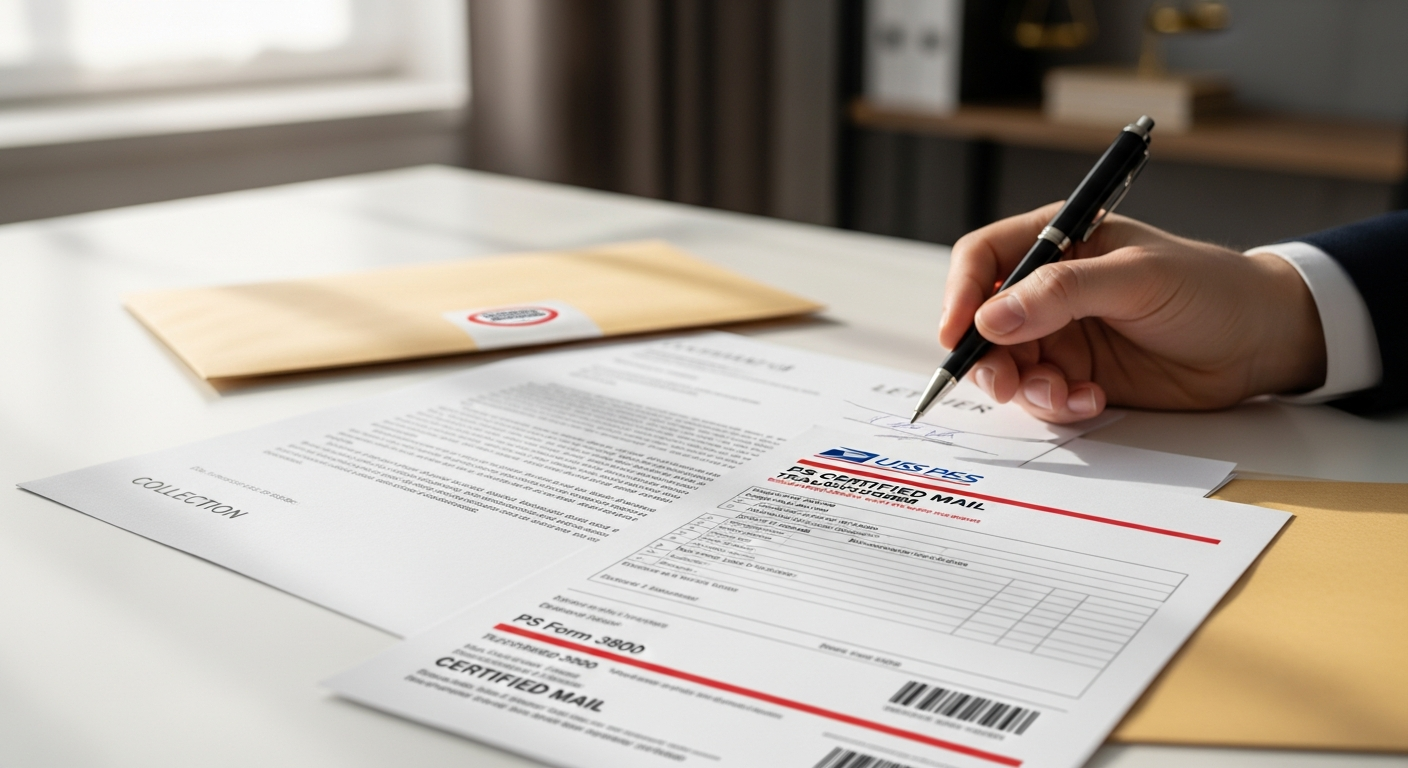
Sending a collection letter by certified mail is one of the most effective ways to create a documented paper trail when pursuing an unpaid debt. Whether you're a landlord chasing overdue rent, a small business owner with an outstanding invoice, or a creditor preparing for potential litigation, certified mail transforms a letter into a legal artifact — something with a timestamp, a tracking number, and proof that the recipient had every opportunity to respond.
This guide walks you through exactly how to do it: when certified mail is legally required versus simply recommended, what FDCPA rules apply, and how to send collection letters with USPS delivery confirmation without leaving your office.
What You'll Need Before You Start
Before mailing anything, gather the following:
- The debtor's full legal name and current mailing address
- The exact amount owed, including any applicable interest or fees
- Documentation of the original debt (invoices, contracts, lease agreements)
- Any prior written correspondence (emails, earlier collection letters)
- A clear deadline for payment — typically 14 to 30 days from the letter date
- Knowledge of whether the FDCPA applies to your situation (more on this below)
By the end of this guide, you'll have a collection letter mailed via USPS with delivery confirmation — and a documented record you can use in court if needed.
Step 1: Determine Whether Certified Mail Is Legally Required
Not every collection letter legally requires certified mail. But many situations do — and confusing the two is a costly mistake.
When certified mail is legally required:
- Eviction proceedings: Most states require landlords to send pay-or-quit notices and eviction notices via certified mail or personal service. California, New York, Texas, and Florida all have statutory requirements for this. For a detailed walkthrough, see how to send a landlord-tenant notice by mail.
- Pre-litigation statutory notices: Some states require a formal written notice sent by certified mail before you can file a lawsuit. This is especially common in consumer protection cases and lemon law claims.
- Debt collection under state law: Several states impose certified mail requirements on debt collectors operating in-state, layered on top of federal FDCPA rules.
When certified mail is strongly recommended (but not strictly required):
- Initial collection letters from original creditors (not third-party collectors)
- Demand letters preceding small claims filings
- Collection notices from landlords to commercial tenants
- Any situation where you anticipate the debtor will claim they never received the notice
The practical rule: if there's any chance this dispute ends up in court, send it certified. The cost is minimal. The documentation value is significant.
Step 2: Understand FDCPA Compliance If You're a Debt Collector
The Fair Debt Collection Practices Act (FDCPA) applies specifically to third-party debt collectors — agencies, law firms collecting on behalf of clients, and debt buyers. If you are the original creditor (e.g., a business collecting your own invoice), the FDCPA generally does not apply to you directly, though many states have analogous rules.
If you are a covered debt collector, your initial collection letter must:
- Be sent within 5 days of first contact with the debtor
- Include the amount of the debt and the name of the creditor
- State that the debtor has 30 days to dispute the debt in writing
- Inform the debtor that if they dispute within 30 days, you will obtain and mail verification
- Avoid any language that is false, deceptive, or misleading — even technically true statements can violate the FDCPA if they create a false impression
Under the Consumer Financial Protection Bureau's Regulation F, which modernized FDCPA rules effective November 2021, debt collectors can use electronic communication — but physical mail still triggers specific validation notice requirements. Sending by certified mail creates an objective, court-admissible record of when the 30-day dispute window began.
The CFPB has reported that debt collection complaints are among the most common it receives, making compliance documentation essential for any collector. Certified mail provides that documentation automatically.
One more point: FDCPA Section 809(a) requires validation notices to be sent "in writing." Courts have consistently held that physical mail satisfies this standard. Email is murkier.
Step 3: Draft Your Collection Letter
A collection letter is not the same as a demand letter, but they share structural DNA. A well-drafted collection letter includes:
- Sender identification: Your name, business name, address, and contact information
- Date: The date the letter is written (not the date you mail it)
- Debtor identification: Full name and address of the recipient
- Debt details: Amount owed, original invoice or account number, and due date
- Summary of prior contact: Brief reference to any previous invoices, emails, or calls
- Payment instructions: How to pay, where to send payment, and by what deadline
- Consequences of non-payment: What happens if they don't pay — typically small claims filing, credit reporting, or referral to a collection agency
- Your signature: Name and title
Keep the tone firm and factual. Avoid emotional language, threats that you don't intend to follow through on, and any statement that could be construed as harassment. If the FDCPA applies, include the required validation notice language verbatim.
If you need a starting point, WriteToMail's demand letter template provides a professionally formatted base that you can customize for collection scenarios. The AI drafting feature lets you describe your situation in plain English and generates a structured letter in seconds.
For more detail on what makes a demand letter legally persuasive, see how to write a demand letter that gets paid.
Step 4: Choose Your Mailing Method
You have two options for sending a collection letter by certified mail:
Option A: The post office Print your letter, fold it, stuff the envelope, purchase a certified mail form (PS Form 3800), pay for postage plus the certified mail fee, and stand in line. USPS charges approximately $4.85 for the certified mail add-on as of 2026, on top of First-Class postage. If you want a return receipt (the green card), that's an additional $3.55 for a physical card, or $2.10 for an electronic return receipt.
This works. It's just slow, manual, and entirely unsuitable if you're sending collection letters at volume.
Option B: Send online through WriteToMail WriteToMail lets you compose, customize, and send physical letters entirely online — no printer, no stamps, no post office trip required. You write or upload your letter, enter the recipient's address, and the platform handles printing, postage, and USPS delivery. For bulk collection mailings — say, a property manager sending notices to 40 tenants simultaneously — the CSV upload with variable data mail merge makes the entire process manageable without paralegal overhead.
For anyone chasing multiple unpaid accounts, the difference between these two options is hours of work per month.
Step 5: Send the Letter and Capture Proof of Delivery
Once your letter is ready, here's how to ensure you have a documented paper trail:
- Save a copy of the letter: Keep the exact text you sent, with the date on the letter preserved. Don't edit the document after sending.
- Note your send date: Record when you mailed it, not just when you wrote it.
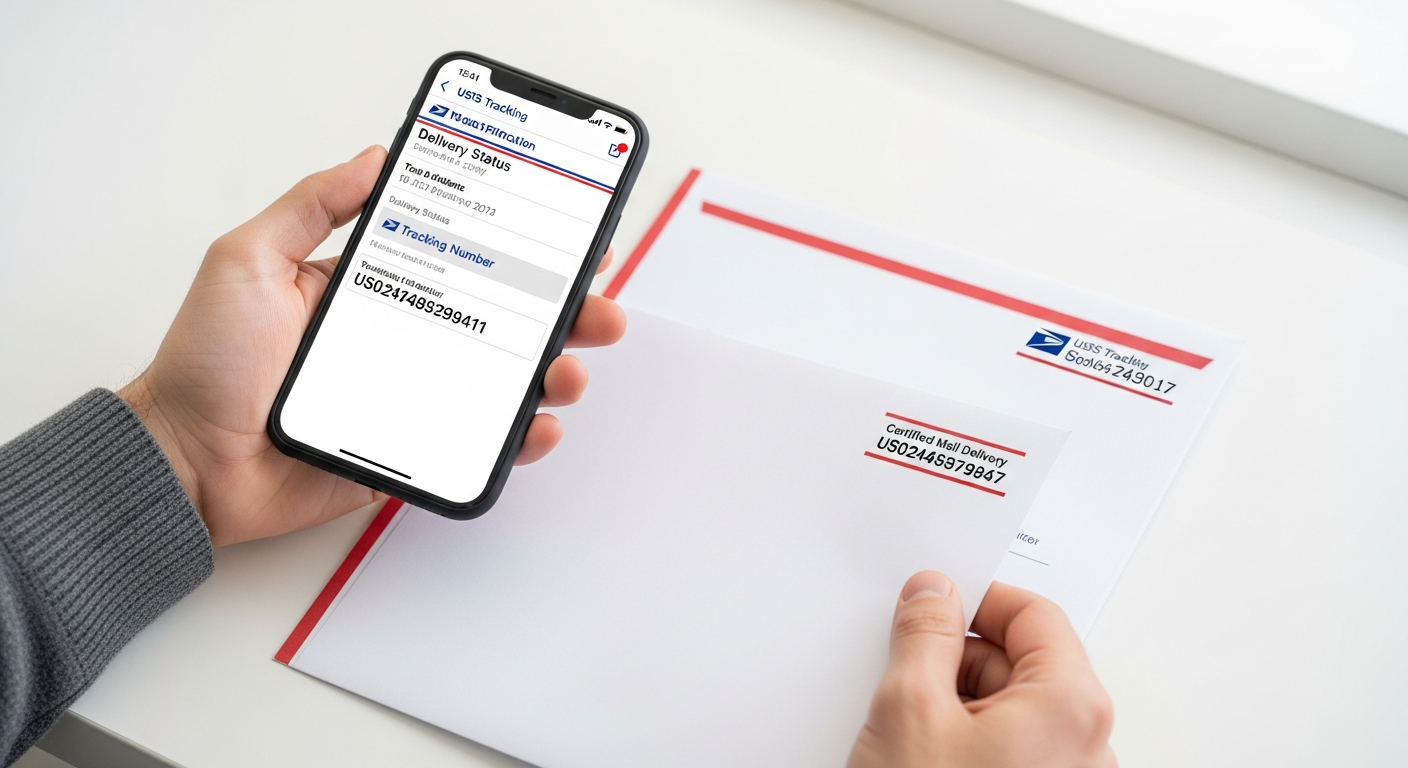
- Track the delivery: With USPS certified mail, you receive a tracking number that confirms when the letter was delivered (or when a delivery attempt was made).
- Save the tracking confirmation: Screenshot or download the USPS tracking page showing delivery. This is your proof.
- Document refused delivery: If the debtor refuses to sign for the certified letter, USPS notes the refusal. Courts in most jurisdictions treat a refused certified letter as constructive notice — meaning the debtor cannot claim they didn't receive it.
Keep all of this documentation in a file organized by debtor. If you end up in small claims court, you hand the judge a folder: the letter, the tracking confirmation, the delivery date. That's a credible paper trail.
Step 6: Follow Up After Delivery
Most debtors respond within the deadline you set — or they don't respond at all. Either way, the certified mail record tells you which situation you're in.
If payment arrives: document it, apply it correctly, and send a brief written acknowledgment.
If the deadline passes without response: you now have grounds to escalate. Common next steps include:
- Sending a final demand letter before filing a lawsuit
- Filing in small claims court (most states allow claims up to $10,000–$25,000)
- Referring the account to a licensed debt collection agency
- Engaging an attorney if the amount warrants it
Your certified mail record is evidence in any of these paths. The debtor cannot credibly claim ignorance of the debt.
Common Mistakes to Avoid
Sending to an outdated address. Certified mail only proves delivery to the address you used. If that address is wrong, you've lost both the postage and the documentation value. Verify the address through a credit report, skip tracing service, or property records before mailing.
Using vague deadlines. "Please remit payment promptly" is unenforceable. "Payment is due by August 15, 2026" is not. Give a specific date.
Making threats you won't follow through on. If your letter says you'll file suit within 30 days and you don't, you've undermined your credibility and — for FDCPA-covered collectors — potentially violated the Act.
Skipping the copy. If you don't save the exact text of the letter you sent, you can't prove what it said. This matters if the debtor disputes the amount or claims the letter was threatening.
Ignoring state-specific rules. FDCPA is federal, but many states have their own debt collection laws with stricter requirements. California's Rosenthal Act, New York's Consumer Protection laws, and Texas Finance Code Chapter 392 all impose additional obligations. If you're collecting across multiple states, research each one.
Conflating FDCPA obligations with your own. If you're a small business owner collecting your own past-due invoices, the FDCPA's specific requirements don't apply to you — but that doesn't mean you can say anything you want. State unfair business practice laws still apply.
When to Consider Sending in Bulk
If you're managing multiple overdue accounts — common for property managers, medical billing departments, or B2B service businesses — sending individual certified letters quickly becomes a bottleneck.
WriteToMail's bulk mailing via CSV upload lets you send personalized collection letters to hundreds of recipients simultaneously. Each letter can include variable data fields like the recipient's name, account number, and amount due, all drawn from a spreadsheet. This is the same workflow that accounts receivable teams and law firms use to process high volumes of collection correspondence without proportional staff overhead.
For more on scaling this kind of outreach, how to send bulk mail without going to the post office covers the full workflow.
Next Steps and Related Resources
Sending a collection letter by certified mail is often the step that separates a debt that gets paid from one that gets written off. The documentation isn't bureaucratic overhead — it's what makes your claim credible if the dispute escalates.
A few resources worth reading alongside this guide:
- What is a demand letter — understand the legal weight of formal written notice before you send
- Debt validation letter template — if you're on the receiving end of a collection, this explains your rights
- Send physical mail online: the complete 2026 guide — if this is your first time using an online mail platform, this is the starting point
The post office isn't going anywhere. But for anyone sending collection letters regularly, the manual workflow — print, stamp, stand in line — is a tax on your time that has a better alternative.
Sources
- Fair Debt Collection Practices Act — Full Text — Federal Trade Commission — statutory requirements for third-party debt collectors, including validation notice obligations under Section 809(a)
- Debt Collection Practices (Regulation F) — Final Rule — Consumer Financial Protection Bureau — modernized FDCPA rules effective November 2021, covering electronic communications and validation notice standards
- CFPB Consumer Complaint Database Overview — Consumer Financial Protection Bureau — context on debt collection being among the most frequently complained-about practices
- USPS Certified Mail — Domestic — United States Postal Service — current pricing and service details for certified mail and return receipt options
- Rosenthal Fair Debt Collection Practices Act — California — California Legislative Information — state-level debt collection requirements that layer onto federal FDCPA rules
- Texas Finance Code Chapter 392 — Debt Collection — Texas Legislature Online — Texas-specific debt collection regulations for creditors and collectors operating in-state