
Before you file in small claims court or hire a litigation attorney, there's one move that costs almost nothing and works more often than people expect: send a final demand letter before the lawsuit.
Not a follow-up email. Not another invoice reminder. A formal, physical letter that puts the other party on notice — pay up, comply, or face court. Studies show that a significant portion of pre-litigation disputes resolve after a formal demand letter, without either party setting foot in a courtroom.
This guide walks you through every step — what to include, how courts treat these letters, common mistakes that kill their effectiveness, and how to use WriteToMail's AI demand letter generator to draft and physically mail one in under five minutes.
What You'll Need Before You Start
Prerequisites:
- Documentation of the dispute (invoices, contracts, text messages, photos)
- The full legal name and mailing address of the person or business you're writing to
- A clear, specific dollar amount or action you're demanding
- Your own name and return address
What you'll achieve: A professionally written, physically mailed final demand letter that creates a documented paper trail, signals serious intent, and gives the other party one last opportunity to resolve the dispute before you escalate to court.
Step 1: Understand What Makes a Final Demand Letter Different
A final demand letter isn't just another version of your first one. It's a distinct legal communication — and the distinction matters.
Your first demand letter opens a negotiation. It says: "You owe me this, please pay." A final demand letter closes that window. It says: "Every reasonable opportunity to resolve this has passed. This is your last chance before I file."
The word "final" carries weight because it signals that you've already attempted to resolve the matter. Courts take notice of this. Many jurisdictions — including small claims procedures in states like California, Texas, and Florida — treat documented pre-litigation demand letters as evidence that the plaintiff acted in good faith before initiating litigation.
A final demand letter also tends to trigger a different psychological response. When someone sees the word "final" on a formal physical letter, they understand the escalation is real. Email threads get ignored. A letter in an envelope does not.
If you want a thorough grounding in what demand letters are and how they carry legal weight, the definitive overview of what a demand letter is and when courts recommend one is worth reading before you draft yours.
Expected outcome: You understand exactly why this letter is different from your previous communication — and why that difference makes it more likely to work.
Step 2: Gather and Organize Your Evidence
Before writing a single word, collect everything relevant to your dispute.
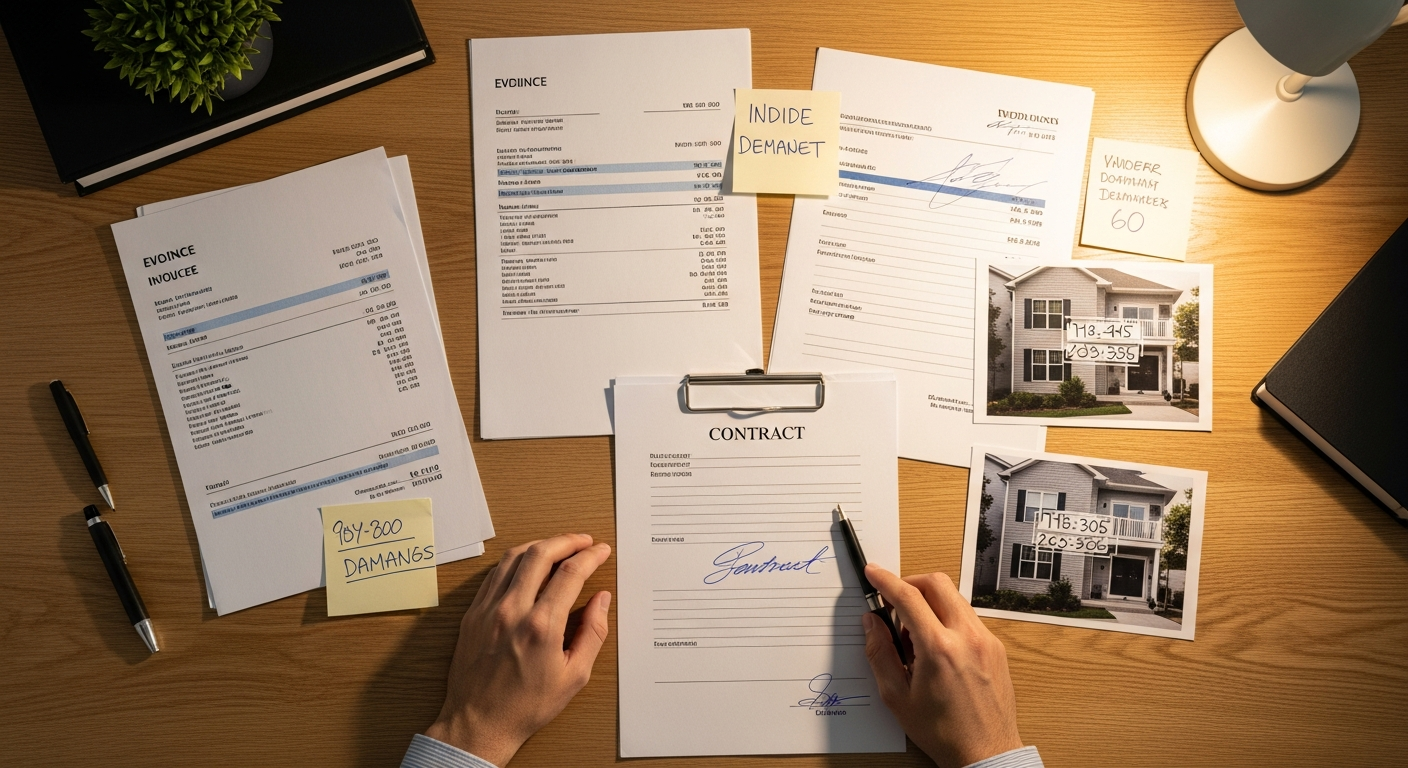
For unpaid invoices: the original invoice, any signed contract or agreement, payment history, and every written communication where payment was discussed or promised.
For property damage: photos with timestamps, repair estimates or receipts, any correspondence with the responsible party.
For breach of contract: the signed agreement, evidence of your own performance, documentation of how the other party failed to perform.
You won't attach all of this to the letter — but having it organized does two things. First, it helps you write with precision. A final demand letter that says "you owe $4,750 per Invoice #2024-112 dated March 3, 2026, which remains unpaid" is far more credible than one that says "you owe me money for the work I did." Second, if the dispute does go to court, you already have your evidence ready.
Expected outcome: A clear factual record you can reference while drafting, with specific figures, dates, and reference numbers that make your letter credible and litigation-ready.
Step 3: Know Exactly What to Include in the Letter
A final demand letter that lacks key components loses its legal teeth. Here's what every one must contain:
Your full name and address — The letter must identify you clearly. If you're writing on behalf of a business, use the business's legal name.
The recipient's full name and address — Use their legal name. If you're writing to a business, address it to the business entity and, where appropriate, name the owner or registered agent.
Date of the letter — This establishes the timeline. If you give a 14-day deadline, the court will calculate from this date.
A clear statement of the debt or dispute — What is owed, why it's owed, and what the basis is (contract, invoice, verbal agreement, property damage). Be specific: dollar amounts, invoice numbers, dates.
Reference to prior attempts to collect or resolve — "Despite my email dated July 1, 2026, and follow-up call on July 15, 2026, no payment has been received." This establishes that you made reasonable efforts before escalating.
A specific deadline — 7, 10, or 14 days is standard. Give a hard date, not just "within two weeks." "Payment must be received by August 23, 2026" is clearer than any relative time reference.
The consequence of non-payment — State explicitly that failure to respond will result in legal action. You can specify small claims court, civil litigation, or both. Some senders also note that court costs and attorney fees may be sought.
Your signature — Physical or digital, but it should appear on the letter.
The demand letter template for unpaid invoices on WriteToMail covers all of these components with customizable fields — useful if you want a framework before using the AI generator.
Expected outcome: A letter that covers every element a court would expect to see in pre-litigation documentation.
Step 4: Draft the Letter
You have two options here: write it yourself or use an AI drafting tool.
Writing it yourself works well if you're comfortable with formal written communication and your dispute is straightforward. Keep the tone professional and unemotional. Courts don't care that you're frustrated — they care about facts. State what's owed, why, by when, and what happens if it isn't paid. Nothing more.
Avoid threats beyond legal action (threatening to contact employers, post on social media, or involve third parties can constitute harassment or extortion in some states). Don't make legal claims you can't support. Don't pad the letter with emotional language that obscures the core demand.
Using WriteToMail's AI demand letter generator is faster and eliminates the risk of forgetting a critical component. You describe your situation in plain English — "A web design client owes me $3,200 for a project completed on May 15, 2026. They have not responded to two invoices or three emails. I want to give them 14 days before I file in small claims court." — and the AI drafts a professionally structured demand letter.
The generated letter includes all legally relevant components in the right order, with a formal tone appropriate for pre-litigation correspondence. You can then edit it in the rich text editor — adjust font, style, amounts, dates — before mailing it.
For context on what good demand letter writing looks like, how to write a demand letter that prompts payment includes annotated examples across three dispute types.
Expected outcome: A complete, professionally worded final demand letter ready for review and delivery.
Step 5: Choose Your Delivery Method
How you send this letter matters — legally and psychologically.
Physical mail outperforms email for demand letters on both dimensions. A 2023 study on direct mail response rates by the Data & Marketing Association found physical mail generates significantly higher engagement than digital communications. More relevantly for legal purposes, a physical letter creates a tangible paper trail. It was sent on a specific date. It arrived at a specific address. It's harder to claim you never received something that was mailed to your front door.
For most pre-litigation demand letters, USPS First-Class Mail is sufficient. Some disputes — particularly those governed by specific statutes, such as FDCPA collections or lemon law claims — may require certified mail. If you're uncertain which applies, the detailed comparison of when certified mail is legally required versus recommended addresses this directly.
For the vast majority of payment disputes, contract breaches, and property damage claims, First-Class Mail is the standard and appropriate delivery method.
Expected outcome: You've selected the right delivery method for your dispute type and understand why physical mail matters for this kind of letter.
Step 6: Send the Letter Through WriteToMail
This is where the process becomes genuinely fast.
Once your letter is drafted and reviewed, sending it via WriteToMail takes under five minutes:
- Go to WriteToMail.com and open the demand letter template or the AI generator.
- Draft or paste your letter using the AI generator or the rich text editor. If you already have a completed PDF, you can upload it directly.
- Enter the recipient's mailing address — the full legal name and address where the letter should be delivered.
- Enter your return address — this appears on the envelope and in the letter header.
- Review the letter — check the amount, deadline date, and consequence statement one final time.
- Submit for mailing — WriteToMail handles printing, postage, and USPS First-Class Mail delivery. No printer needed. No stamps. No post office trip.
WriteToMail is SOC 2 compliant, meaning your document data is handled with enterprise-grade security standards. This matters when you're mailing documents that may later be referenced in litigation.
Expected outcome: Your final demand letter is physically mailed via USPS within one business day — with no equipment required on your end.
How Courts View Pre-Litigation Demand Letters
Judges and mediators consistently view documented pre-litigation demand letters favorably toward the sender. Sending one demonstrates good faith. It shows you attempted resolution before consuming court resources.
In some jurisdictions, a pre-filing demand letter is legally required. California's consumer protection statutes, for instance, require a 30-day written demand before filing certain claims. Many small claims courts in Texas and Florida recommend or expect evidence of a prior demand. Some insurance disputes and lemon law claims have statutory notice periods where a proper demand letter starts the clock.
Beyond legal requirements, there's a practical litigation advantage. If you do end up in court, your attorney (or you, in small claims) can present the letter as evidence that the defendant had formal notice and chose not to pay. Courts have discretion over fee awards, and demonstrating that the defendant ignored a clear, documented demand can influence that discretion.
The pre-litigation demand letter mailing service guide covers this legal context in greater depth, including what makes a demand letter "pre-litigation" versus a general collection letter.
Common Mistakes That Weaken Your Final Demand Letter
Setting a deadline that's too short or too long. A 48-hour deadline reads as unreasonable and may actually work against you in court. More than 30 days signals you're not serious. 7–14 days is the standard.
Using emotional language. "You're a thief and a liar" does not belong in a legal document. Keep it factual. Emotional content shifts the reader's focus from the substance of your claim to your state of mind.
Failing to specify the exact amount. "You owe me for all the work I did" is not a demand. "You owe $4,750 per Invoice #2024-112" is.
Not mentioning prior communication. If this is truly a final demand, reference the attempts that came before it. This is what establishes it as final.
Sending it only by email. Email is easy to ignore, easy to dispute receipt of, and lacks the psychological weight of a physical letter. Even if you send an email version as a courtesy, the official demand should go by physical mail.
Forgetting to keep a copy. Before you mail anything, save a copy of the exact letter you sent. Date it. If the case goes to court, you'll need it.
Threatening action you won't follow through on. If you say you'll file within 14 days, file within 14 days if payment doesn't arrive. Repeated "final" letters with no follow-through train the recipient to ignore you.
Next Steps After Sending
Once the letter is in the mail, you wait — and document.
Note the date you sent it and the date your deadline expires. If the other party responds and offers a settlement, consider whether it meets your needs before accepting. A partial payment accepted without conditions can sometimes complicate your ability to pursue the remainder in court.
If the deadline passes without payment or response, you have clear standing to file. In small claims court (for disputes under the threshold in your state — typically $5,000 to $25,000 depending on jurisdiction), you can represent yourself. Your final demand letter becomes a key exhibit.
If the amount exceeds small claims thresholds or the legal issues are complex, consult a civil litigation attorney. Many offer free initial consultations, and having a well-documented paper trail — including your final demand letter — will reduce the time (and cost) of bringing them up to speed.
For disputes where you're managing collections across multiple clients or accounts, it's worth knowing you can also send collection letters without a collections agency — a useful option for small businesses dealing with recurring non-payment issues.
Sources
- American Bar Association — Demand Letters Before Litigation — context on how courts view pre-litigation demand letters and their role in good-faith dispute resolution
- Data & Marketing Association (DMA) — physical mail engagement and response rate research cited in Step 5
- California Courts — Small Claims Overview — state-specific small claims filing requirements and demand letter prerequisites
- Texas Courts — Small Claims and Justice Court Guide — Texas small claims procedures and pre-filing expectations
- Florida Courts — Small Claims Procedures — Florida small claims court procedures and documentation requirements
- Federal Trade Commission — Fair Debt Collection Practices Act — FDCPA requirements relevant to demand letters in debt collection contexts
- USPS — First-Class Mail Service Overview — delivery standards and documentation for First-Class Mail used in legal correspondence