
Sending a formal written warning to an employee by mail sounds simple — but do it wrong and you've created a documentation gap that could cost you in an employment dispute. Physical mail matters more than most HR managers realize, especially when the employee is remote, on leave, or disputing that they received anything at all.
This guide covers when physical mail is legally advisable, what your warning letter must include, and how to send it today — no printer, no stamps, no post office visit required.
Table of Contents
- Why Send a Formal Warning by Physical Mail?
- When to Use a Written Warning Letter
- What a Formal Written Warning Must Include
- Written Warning Letter Template
- How to Send a Formal Warning by Mail — Without a Printer
- Step-by-Step: Using WriteToMail to Send Your Warning
- Common Mistakes to Avoid
- FAQ
- Sources
Why Send a Formal Warning by Physical Mail
Email feels faster and easier. But in HR and employment law, "faster and easier" often means "harder to prove" when it counts.
A physical letter sent via USPS creates a tangible, time-stamped record that is much harder to dispute than an email. Employees can claim they never received an email, that it went to spam, or that they deleted it before reading it. A physical letter sent to a known home address is far more difficult to deny.
Three situations make physical mail the clear choice:
Remote workers. When an employee works entirely from home, there's no opportunity for an in-person meeting or a signed-acknowledgment exchange. Mailing a formal warning to their home address creates documented delivery — and signals the seriousness of the matter.
Employees on leave. FMLA leave, medical leave, or a suspension can make in-person delivery impossible. Physical mail reaches the employee wherever they are.
Contested disciplinary actions. If you anticipate the employee may dispute the warning, challenge the progressive discipline process, or eventually file a wrongful termination claim, a mailed warning with a delivery record strengthens your paper trail significantly. The same logic applies when sending written notice to a contractor by mail — physical mail carries weight that email simply cannot replicate in a dispute.
According to the Society for Human Resource Management (SHRM), inadequate documentation is one of the most common reasons employers lose wrongful termination cases. A formal written warning, sent and received, closes that documentation gap.
When to Use a Written Warning Letter
A written warning is typically the second or third step in a progressive discipline process — following a verbal warning and, in some organizations, a written record of that verbal conversation.
Common triggers for a formal written warning include:
- Repeated attendance violations (tardiness, unexcused absences)
- Performance failures that persist after coaching
- Policy violations (acceptable use, dress code, workplace conduct)
- Insubordination or failure to follow direct instructions
- Behavior that creates a hostile work environment
The written warning serves two purposes simultaneously: it notifies the employee clearly that their behavior must change, and it documents that the employer took corrective action before any termination decision. According to SHRM's employee discipline guidance, organizations with documented progressive discipline policies are significantly better protected in unemployment and wrongful termination proceedings.
What a Formal Written Warning Must Include
A vague warning letter creates more risk than no letter at all. Specificity is what gives a written warning its legal and procedural weight.
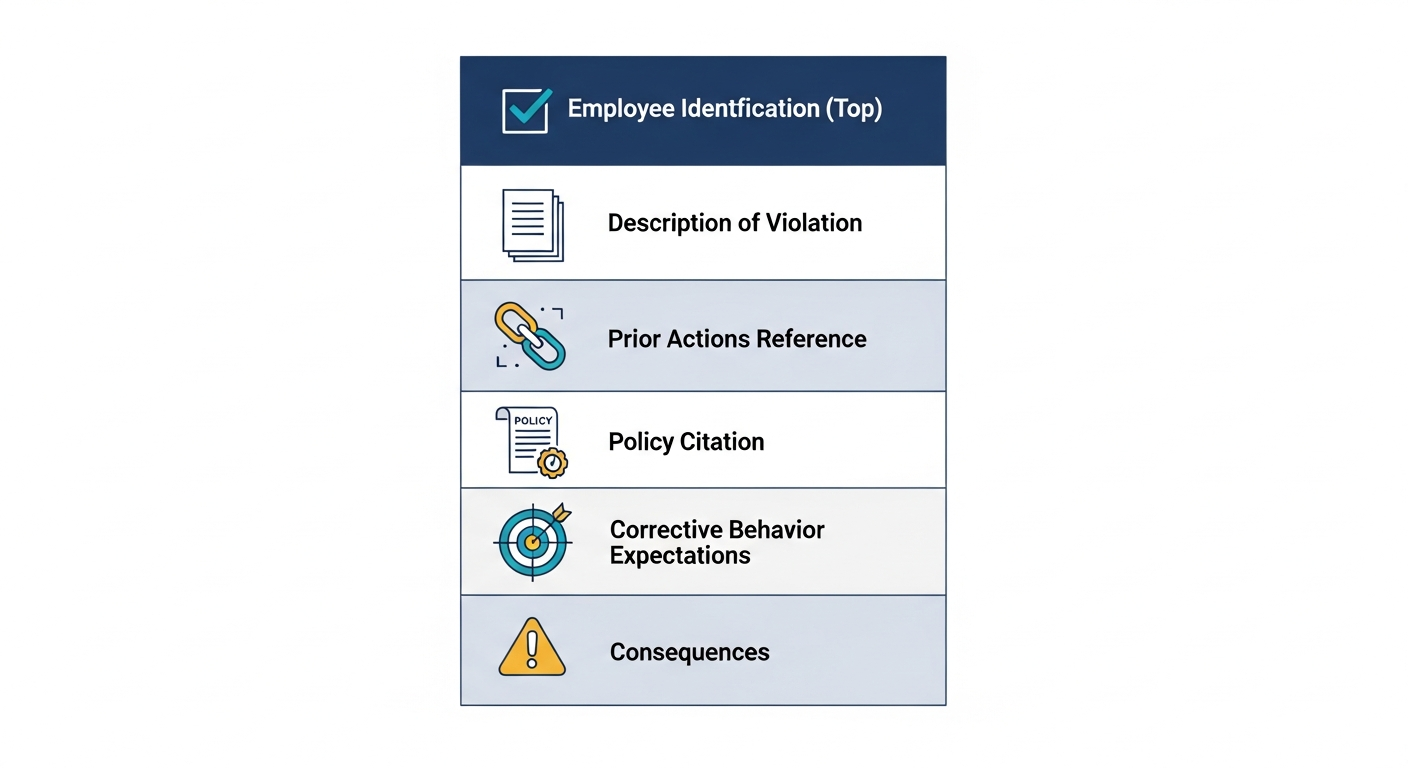
Every formal written warning letter should include:
Employee and Company Identification
- Employee full name, job title, and department
- Company name, address, and HR contact
- Date of the letter
Description of the Violation
Be specific. Include dates, times, locations, and witnesses where applicable. "John failed to meet the quarterly sales target of $45,000 — achieving $28,700 in Q2 2026" is infinitely more useful than "John has performance issues."
Reference to Prior Actions
If a verbal warning was given, state when and by whom. If a previous written warning exists, reference it. This establishes the progressive discipline chain.
The Policy Being Violated
Cite the specific section of your employee handbook or policy document. This closes the "I didn't know that was a rule" defense entirely.
Expected Corrective Behavior
State exactly what must change and by when. "John must achieve a minimum of $40,000 in sales during Q3 2026" is a measurable, enforceable standard. "John must improve his performance" is not.
Consequences of Non-Compliance
Be direct. If the next step is termination, say so. Ambiguity here does no favors for the employee or the employer.
Signature Block
Include signature lines for the HR manager or supervisor issuing the warning, the employee (if acknowledgment is requested), and the date. When mailing, you won't get a signed acknowledgment immediately — but the letter should still include an acknowledgment request and a response deadline.
Written Warning Letter Template
Use this as a starting point. Customize every bracketed field.
[Company Name] [Company Address] [City, State, ZIP] [Date]
PRIVATE & CONFIDENTIAL
[Employee Full Name] [Employee Home Address] [City, State, ZIP]
Re: Formal Written Warning — [Brief Description of Issue]
Dear [Employee First Name],
This letter serves as a formal written warning regarding [specific behavior or performance issue]. This warning is issued in accordance with [Company Name]'s progressive discipline policy, outlined in Section [X] of the Employee Handbook dated [date].
Description of the Issue
On [date(s)], it came to our attention that [specific description of violation — include dates, facts, and relevant details]. This incident follows a verbal warning issued by [Manager Name] on [date of verbal warning], at which time you were advised that [summary of expectations communicated].
Policy Violated
Your conduct is in violation of [Company Name] Policy [policy name or number], which states: "[Exact policy language or close paraphrase]."
Required Corrective Action
Effective immediately, you are required to [specific corrective action — measurable and time-bound]. Progress will be reviewed on [date].
Consequences of Non-Compliance
Failure to meet the corrective action expectations outlined above may result in further disciplinary action, up to and including termination of employment.
Acknowledgment
Please sign and return a copy of this letter to [HR contact name] at [address or email] by [date — recommend 5–7 business days]. Your signature acknowledges receipt of this warning, not necessarily agreement with its contents.
Please contact [HR contact name] at [phone/email] with any questions.
Sincerely,
[HR Manager or Supervisor Name] [Title] [Company Name]
Employee Signature (Acknowledgment of Receipt)
Date: _______________
How to Send a Formal Warning by Mail — Without a Printer
Most HR managers assume that mailing a letter means printing it, folding it, finding an envelope, buying stamps, and making a post office run. That's the 2005 workflow.
WriteToMail handles the entire process online. You compose or upload your warning letter, enter the employee's address, and WriteToMail prints it, envelopes it, stamps it, and delivers it via USPS First-Class Mail — without you ever touching a piece of paper.
This is particularly useful for:
- HR teams without a physical office — fully remote operations where nobody has access to a printer
- Managers working from home who need to send a formal document with a USPS postmark
- Time-sensitive situations — when you need same-day mailing to establish the delivery date
If you already have the warning letter drafted as a PDF — from your HR software, Word, or a legal template — you can use WriteToMail's PDF upload feature to mail it directly. No reformatting, no retyping.
The platform is SOC 2 compliant, which matters when you're mailing confidential employee documents.
Step-by-Step: Using WriteToMail to Send Your Warning
Getting a formal warning letter in the mail takes about five minutes.
Step 1: Compose or upload your letter Navigate to writetomail.com and either use the rich text editor to compose your warning letter from scratch, or upload your existing PDF document directly.
If you need a starting point, WriteToMail's AI-powered letter drafting feature can generate a draft from a plain-language description — for example: "Write a formal written warning to an employee for repeated tardiness after a prior verbal warning."
Step 2: Customize and review Use the built-in editor to adjust fonts, add your company letterhead details, and verify all names, dates, and policy references. Every detail matters in a disciplinary letter.
Step 3: Enter the delivery address Enter the employee's home mailing address. Double-check this against their employment file — a returned letter due to an outdated address creates a documentation problem you don't want.
Step 4: Send Confirm and submit. WriteToMail handles printing, postage, and USPS First-Class Mail delivery. The letter goes out the same business day.
Step 5: Document the send date Keep a record of the date you submitted the mailing. Combined with USPS delivery windows, this establishes when the employee can reasonably be expected to have received the letter.
Common Mistakes to Avoid
Sending a warning with no prior record of the issue. A formal written warning carries more weight when it's part of a documented discipline chain. If you skipped the verbal warning step, at minimum document why the situation warranted bypassing it.
Using vague language about expectations. "Must improve attitude" will not hold up under scrutiny. Tie expectations to measurable, observable behaviors.
Sending only by email when physical mail is appropriate. Email is fine for routine HR communications. For formal disciplinary action — especially when you expect pushback — a physical letter sent to a verified address creates a stronger record. This is the same reasoning behind why legal professionals recommend sending legal notices by physical mail for high-stakes situations.
Failing to reference the applicable policy. Without a policy citation, the employee can argue the rule wasn't clear. Every warning letter should anchor to a specific handbook section or workplace policy.
Not keeping a copy. Save the exact letter you sent — including the date — in the employee's personnel file. If the situation escalates to litigation, you'll need it.
FAQ
Does a formal written warning have to be delivered by physical mail?
Not in every situation — but physical mail is strongly advisable when in-person delivery isn't possible, the employee is remote or on leave, or you anticipate a dispute. Email can be used, but physical mail creates a more defensible paper trail.
Should I use certified mail for an employee warning letter?
Certified mail provides a delivery confirmation signature, which creates the strongest possible proof of receipt. For a standard written warning, USPS First-Class Mail is typically sufficient. If the warning precedes a potential termination or legal action, consider certified mail for the additional documentation.
What if the employee refuses to sign the acknowledgment?
Document the refusal. Have a witness (another manager or HR representative) note in writing that the employee received the warning and declined to sign. Their refusal doesn't invalidate the warning.
Can I send a written warning while an employee is on FMLA leave?
Issuing a written warning to an employee on FMLA leave can raise retaliation concerns if the warning relates to absences covered by FMLA. Consult with an employment attorney before doing so. If the warning involves unrelated performance issues that predated the leave, it is generally permissible — but documentation of the timeline is critical.
How many written warnings are required before termination?
This depends entirely on your company's progressive discipline policy. Most policies specify one to three written warnings before termination, depending on the severity of the issue. Gross misconduct (theft, harassment, violence) typically allows immediate termination without prior written warnings. Whatever your policy says, follow it consistently — inconsistency is what creates legal exposure.
Can I use WriteToMail to send warning letters to multiple employees at once?
Yes. WriteToMail supports bulk mailing via CSV upload. If you're managing a large workforce action or sending warnings to multiple locations, you can upload a spreadsheet with employee names and addresses, and send personalized letters to all of them simultaneously using variable data mail merge. This is the same bulk mailing capability used by HR and legal teams sending notices to large recipient lists.
Is it legal to send HR documents to an employee's home address?
Generally, yes — especially for disciplinary documents. Employers routinely mail formal communications to employees' addresses of record. Just ensure the address in your system is current, and that your mailing complies with any applicable state privacy laws regarding employee records.
Sources
Society for Human Resource Management (SHRM) — Employee Relations — cited for documentation failures as a common reason employers lose wrongful termination cases
SHRM — Progressive Discipline Policy Sample — cited for guidance on progressive discipline and its importance in unemployment and termination proceedings
U.S. Department of Labor — Family and Medical Leave Act (FMLA) — background on FMLA leave and employer obligations during the leave period
U.S. Equal Employment Opportunity Commission — Retaliation — background on retaliation concerns when disciplinary action intersects with protected leave or activity
National Labor Relations Board — Employee Rights — context on employee rights in formal disciplinary proceedings