

Healthcare billing departments send millions of collection letters every year. Most of them contain protected health information — account numbers, balance amounts, provider names, service dates. That makes every single one of them subject to HIPAA.
Getting this wrong isn't just a compliance headache. The HHS Office for Civil Rights can impose penalties ranging from $100 to $50,000 per violation, with annual caps reaching $1.9 million per violation category. A single batch of improperly handled collection letters can trigger an investigation that costs far more than the balances you were trying to collect.
This guide walks you through exactly how to send patient collection letters that are HIPAA compliant — from understanding what makes a mail service legally safe, to uploading your patient list and getting notices delivered via USPS First-Class Mail without touching a printer or a stamp.
What you'll achieve: A repeatable, compliant workflow for sending personalized patient balance notices at scale, with zero in-house printing infrastructure required.
Prerequisites:
- A patient balance list ready to export from your billing system
- Basic familiarity with CSV/spreadsheet files
- A signed Business Associate Agreement (BAA) with your mail vendor
Step 1: Understand What Makes a Patient Collection Letter HIPAA Compliant
Before you send anything, you need to know what you're actually protecting and why physical mail requires the same scrutiny as electronic communications.
A patient collection letter contains Protected Health Information (PHI) the moment it includes any combination of identifiable information linked to a healthcare service. Patient name plus account balance qualifies. Name plus provider name qualifies. The HIPAA minimum necessary standard requires that your letter includes only the information needed to communicate the balance and collect payment — nothing more.
What makes a mail service HIPAA compliant:
- Business Associate Agreement (BAA): Any vendor who processes, prints, or handles PHI on your behalf is a Business Associate under HIPAA. You must have a signed BAA before transmitting any patient data to them. No BAA means no compliance — full stop.
- SOC 2 certification: SOC 2 audits verify that a vendor's data handling, access controls, and security practices meet defined standards. A SOC 2 compliant mail service gives you documented proof that the vendor treats your data with the controls HIPAA requires.
- Encrypted data transmission: Patient data uploaded to a print-and-mail platform must be encrypted in transit. No exceptions.
- Audit trails: HIPAA requires you to demonstrate who accessed PHI and when. A compliant mail platform should maintain records of what was sent, to whom, and when.
- Physical handling controls: Printing happens in controlled facilities with limited staff access. Letters are sealed before leaving the facility.
Physical mail has one compliance advantage over email that gets overlooked: HIPAA does not require encryption for paper mail the way it requires encryption for email. But the vendor handling your data digitally before printing still needs every control listed above. The HIPAA-compliant physical mail requirements for healthcare organizations cover this distinction in detail.
Step 2: Prepare Your Patient Collection Data in CSV Format
Your billing system almost certainly has an export function. Use it.
A properly structured CSV is the foundation of compliant bulk mailing. Every column becomes a variable field in your letter — personalized per patient, merged automatically, with no manual data entry required.
Required fields in your CSV:
| Column | Example Value |
|---|---|
FirstName |
Maria |
LastName |
Chen |
Address1 |
1842 Elmwood Drive |
Address2 |
Apt 4B |
City |
Columbus |
State |
OH |
Zip |
43215 |
AccountNumber |
HC-2024-88341 |
AmountDue |
$312.50 |
DueDate |
September 15, 2026 |
ProviderName |
Riverside Family Medicine |
Data hygiene matters before you upload:
- Standardize address formatting (USPS prefers all-caps for delivery efficiency, but most platforms handle normalization)
- Remove duplicate accounts — two letters to the same patient for the same balance creates confusion and potential HIPAA exposure
- Verify balances are current before export; collection letters with incorrect amounts trigger disputes that cost more than they collect
- Strip any fields not needed for the letter (diagnosis codes, SSN, full insurance IDs) — applying the minimum necessary standard at the data level, not just the letter level
The CSV you upload will contain PHI. Treat it accordingly: store it on a secured drive, limit who can access it, and delete it from local machines once the mailing is complete.
Step 3: Choose a HIPAA-Compliant Mail Platform and Sign a BAA
Not every online mail service can legally handle patient data. Most consumer-facing mail platforms are not HIPAA compliant and carry no Business Associate Agreement — meaning any PHI you upload to them constitutes a potential breach.
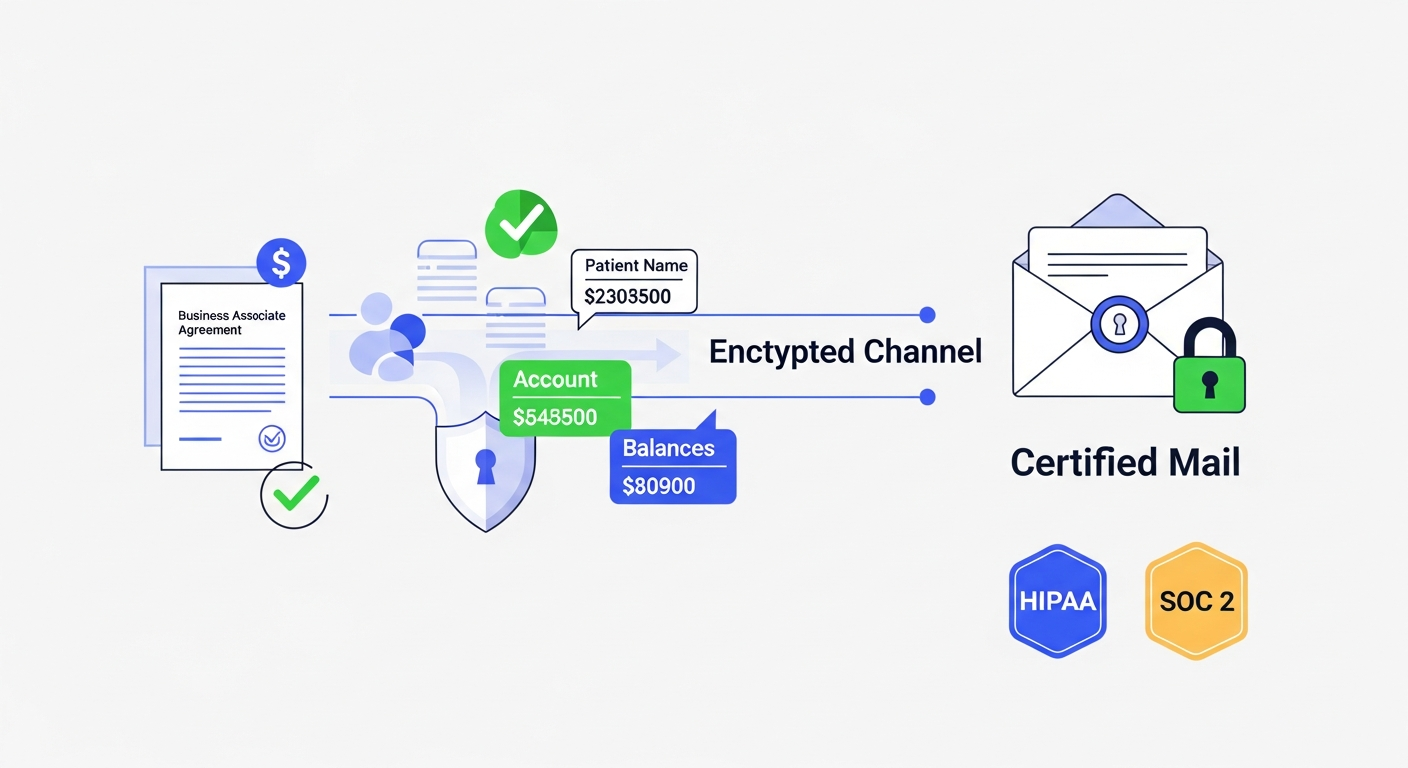
WriteToMail is a HIPAA-compliant and SOC 2 certified print-and-mail platform built to handle exactly this use case. It supports:
- Bulk mailing via CSV upload — upload your patient list, map columns to letter placeholders, and send hundreds or thousands of letters in a single session
- Variable data mail merge — patient name, account number, amount due, due date, and any other CSV column can be personalized automatically in the letter body
- PDF upload and mail — if your billing system generates a statement PDF, upload it and send it directly without recomposing
- USPS First-Class Mail delivery — the same delivery class used for sensitive correspondence, with no delay, no bulk mail stigma
- No printer, stamps, or post office visit required — the platform handles printing, postage, and physical delivery end-to-end
Before uploading any patient data, execute the BAA. WriteToMail provides this as part of its HIPAA-compliant service. Keep a signed copy on file — it's part of your HIPAA documentation requirements.
For a broader look at what to evaluate when selecting a platform, the guide to sending HIPAA-compliant letters online covers BAA requirements, encryption standards, and audit trail expectations in technical detail.
Step 4: Draft Your Patient Collection Letter
A HIPAA-compliant collection letter is also a legally careful collection letter. Healthcare collections exist in a specific regulatory space — HIPAA governs the PHI, while the Fair Debt Collection Practices Act (FDCPA) governs how you communicate about the debt, even when the debt is medical.
Core components every patient collection letter must include:
- Provider name and contact information — clearly identified at the top
- Patient name and account number — personalized via mail merge
- Balance amount — specific dollar figure, not a range
- Service date or billing period — helps the patient identify the debt
- Payment instructions — where to pay, how to pay, payment plan options if available
- Dispute instructions — the patient's right to dispute the balance
- FDCPA required language — if your practice qualifies as a "debt collector" under the FDCPA, specific disclosures are legally required
Keep the letter to one page. A dense, multi-page collection notice gets ignored. A clean, single-page letter with a clear call to action gets responses.
WriteToMail includes an AI-powered letter drafting tool — describe the letter you need and it generates a draft you can review and customize. You can also use the rich text editor to format your letter with your practice's branding, font, and style before sending.
For practices managing escalating balances, a structured sequence works significantly better than a single notice. The patient collection letter mailing service guide covers escalation cadences — reminder, past-due, and final notice — in detail.
Step 5: Upload Your CSV and Map Variable Fields
Log into WriteToMail, navigate to bulk mailing, and upload your CSV file.
The platform's variable data mail merge maps your CSV columns to placeholders in your letter template. A placeholder like {{FirstName}} in the letter body populates with "Maria" for one recipient and "James" for the next — automatically, across every letter in the batch.
The mapping process:
- Upload the CSV
- The platform reads your column headers
- You match each column to a placeholder in your letter (name, address fields, amount due, account number, etc.)
- Preview a sample letter with real data populated to verify the merge is working correctly
- Confirm the recipient count matches your expected list size
Address fields deserve extra attention. USPS delivery depends on accurate address formatting. If your CSV has combined fields (full address in one column instead of split into street, city, state, zip), you'll need to split those before upload. Most spreadsheet applications handle this in minutes using text-to-columns tools.
Once mapping is confirmed, review your letter one final time. A typo in a collection letter mailed to 500 patients requires a costly correction mailing to fix.
Step 6: Review, Confirm, and Send
Before submitting the batch, complete a final compliance and quality check.
Pre-send checklist:
- BAA signed and on file with WriteToMail
- CSV contains only minimum necessary PHI fields
- Letter contains required FDCPA disclosures (if applicable)
- Sample letters reviewed with merged data — no field mapping errors
- Recipient count verified against your billing export
- Payment address and portal URL are current and correct
- Return address on envelope matches your practice's current address
Submit the batch. WriteToMail handles printing, enveloping, postage application, and USPS induction. Letters go out via USPS First-Class Mail — the same class used for personal correspondence, which carries no stigma of bulk mail and no delay compared to standard marketing mail classes.
Expected outcome: Your patients receive individually addressed, personalized collection notices within the standard USPS First-Class Mail delivery window, typically 2-5 business days.
Step 7: Track Results and Build a Follow-Up Cadence
A single collection letter rarely closes all outstanding balances. Effective healthcare collections use a timed sequence.
A typical three-letter cadence:
- Letter 1 (Balance Reminder): Sent at 30 days past due. Friendly tone, assumes the patient may have overlooked the balance. Full payment instructions.
- Letter 2 (Past-Due Notice): Sent at 60 days. Direct tone. Restate the balance, reference the previous notice, offer a payment plan option.
- Letter 3 (Final Notice): Sent at 90 days. Formal tone. State that the account may be referred to collections if not resolved within a specific timeframe.
Each letter in the sequence can be built as a separate template in WriteToMail. When the next interval arrives, export the still-outstanding balance list from your billing system, upload the updated CSV, and send the next letter — the entire process repeats in minutes.
According to the American Hospital Association, hospitals provided $42.5 billion in uncompensated care in 2023. A significant portion of that represents collectible patient balances that were never systematically pursued. A documented, repeatable collection letter sequence is the operational difference between capturing that revenue and writing it off.
Common Mistakes to Avoid
Skipping the BAA. This is the most consequential mistake. No BAA with your mail vendor means no HIPAA compliance, regardless of how carefully you draft the letter itself. Every covered entity that has faced HHS enforcement action for mailing-related PHI exposure had this gap somewhere in the chain.
Including excess PHI. Collection letters do not need diagnosis codes, procedure codes, or insurance identification numbers. Include what's necessary to identify the debt and instruct payment. Everything else increases your exposure without increasing collection rates.
Using a non-HIPAA-certified platform. General-purpose mail platforms — services designed for marketing or personal use — are not Business Associates and cannot execute a BAA. Uploading patient data to them is a reportable breach.
Inconsistent return addresses. If a letter is returned undeliverable, it needs to come back to a location where staff can update the patient address record. A wrong return address means lost mail and no address correction.
No dispute process in the letter. FDCPA requires debt collectors to include information about the patient's right to dispute the validity of the debt. Even for practices that aren't technically "debt collectors" under the statute, including dispute instructions protects you and builds patient trust.
Sending on a bad list. Mailing to patients who have filed for bankruptcy, deceased patients, or accounts already resolved creates legal risk and wastes postage. Scrub your list against your billing system's disposition codes before every send.
Why Physical Mail Is the Right Channel for Healthcare Collections
Email is convenient. It's also unreliable for collections — spam filters, unverified addresses, and the sheer volume of email make it easy to miss or ignore.
Physical mail has a 98% open rate, compared to email open rates that average around 20-30% for healthcare communications. A letter that arrives in an envelope, addressed personally, gets opened. It also creates a tangible paper trail — something a patient can hold, a provider can document, and a court can reference if the balance is ever disputed.
For healthcare billing specifically, physical mail carries legal weight that email cannot match. Notices sent via USPS can be documented as mailed — with date, recipient address, and content — in a way that digital communication cannot always replicate cleanly.
The combination of HIPAA-compliant handling and USPS First-Class Mail delivery makes a platform like WriteToMail the operationally sound choice for any billing department serious about collections compliance. For departments managing large patient volumes, the ability to send HIPAA-compliant bulk mail without building in-house print infrastructure is a meaningful cost and time advantage.
Next Steps
Once your collection letter workflow is running, consider expanding your HIPAA-compliant mail infrastructure to cover the full patient communication lifecycle:
- Appointment reminders and no-show follow-ups
- Explanation of Benefits (EOB) letters for self-pay patients
- Notice of Privacy Practices distribution
- HIPAA breach notifications — where the 60-day deadline makes a fast, scalable mail process critical
You can start sending HIPAA-compliant patient letters through WriteToMail today — no printing equipment, no postage accounts, no trips to the post office.
Sources
- HHS Office for Civil Rights — HIPAA Enforcement — Civil money penalty ranges for HIPAA violations, tiered by culpability
- American Hospital Association — Uncompensated Care Fact Sheet 2023 — $42.5 billion in uncompensated hospital care in 2023
- USPS Delivers — The Mail Moment — Physical mail open rate data and household engagement statistics
- HHS — HIPAA Minimum Necessary Standard — Guidance on limiting PHI disclosure to what is minimally required for the purpose
- Consumer Financial Protection Bureau — FDCPA Overview — Fair Debt Collection Practices Act requirements for debt communication, including required disclosures
- HHS — Business Associate Contracts — BAA requirements for vendors handling PHI on behalf of covered entities