

Every year, employers across the U.S. run background checks on job applicants — and many of those checks turn up something that gives HR pause. Before you can legally decline to hire someone based on that information, federal law requires you to send a pre-adverse action notice by mail. Skip this step, and you're looking at FCRA violations that carry statutory damages of $100 to $1,000 per violation, plus attorney's fees.
This guide walks HR departments and hiring managers through exactly what the pre-adverse action notice requires, what it must contain, how to format and send it, and how to process multiple notices at once when you're running background checks in volume.
What You'll Need Before You Start
Prerequisites:
- A copy of the consumer report (background check) that flagged information affecting your hiring decision
- The applicant's full legal name and mailing address
- A completed pre-adverse action notice letter (see Step 3 for the template)
- A copy of the Summary of Consumer Rights under the FCRA — you are legally required to enclose this
- A copy of the consumer report itself — also required as an enclosure
- A mailing method that creates a delivery record
What you'll achieve: By the end of this guide, you'll have a legally compliant pre-adverse action notice drafted, formatted, and sent via USPS First-Class Mail — with a documented paper trail your legal team can point to if any dispute arises.
Step 1: Understand the FCRA Two-Step Notice Requirement
The Fair Credit Reporting Act (FCRA) mandates a two-step process before an employer can take adverse action based on a consumer report. Most employers understand the final adverse action notice. Fewer realize the pre-adverse action notice is equally required — and must come first.
Here's the sequence:
- Pre-adverse action notice — Sent before the hiring decision is finalized. Gives the applicant time to review the report and dispute any inaccuracies.
- Final adverse action notice — Sent after a "reasonable period" has passed and the decision is confirmed.
Under 15 U.S.C. § 1681b(b)(3), employers must provide the pre-adverse action notice along with a copy of the consumer report and a written summary of the applicant's rights before adverse action occurs. This article covers Step 1 — the pre-adverse action notice. For the final adverse action process, see our companion guide on how employers send adverse action notices by mail.
The FTC and CFPB both enforce FCRA compliance. According to the CFPB, enforcement actions against employers and consumer reporting agencies have accelerated in recent years, with multi-million dollar settlements becoming increasingly common. The pre-adverse action notice isn't bureaucratic overhead — it's your primary legal protection.
Step 2: Confirm the Timing Window
The FCRA doesn't specify an exact number of days you must wait between the pre-adverse and final adverse action notice. What it requires is a "reasonable period of time" — which courts and regulatory guidance have consistently interpreted as at least 5 business days.
Practically speaking, most employment attorneys recommend waiting 5 to 7 business days minimum. Some states impose stricter timelines. California, for example, requires employers to wait at least 5 business days before finalizing an adverse decision. New York City's Fair Chance Act requires 3–5 business days depending on the situation, plus additional steps for covered positions.
The clock starts the day the applicant receives the notice — not the day you mail it. Build in transit time. If you're sending via USPS First-Class Mail, expect 1–3 business days for delivery, which means the full waiting period from the date you mail is realistically 6–10 business days before you can send the final adverse action notice.
Document everything. Note the exact date you mailed the notice. A timestamped mailing record is your evidence if the applicant later claims they never received adequate opportunity to respond.
Step 3: Draft the Pre-Adverse Action Notice Letter
Your pre-adverse action notice must include specific elements. Missing any of them voids your compliance. Here's exactly what the letter must contain:
Required elements:
- Your company's name and contact information
- The applicant's full name and mailing address
- A statement that you are considering adverse action based on information in a consumer report
- The name, address, and phone number of the consumer reporting agency (CRA) that provided the report
- A statement that the CRA did not make the adverse action decision and cannot explain why the decision is being considered
- Notice that the applicant has the right to obtain a free copy of the report from the CRA within 60 days
- Notice that the applicant has the right to dispute the accuracy or completeness of the report with the CRA
- The Summary of Consumer Rights under the FCRA (enclosure — not just mentioned, actually enclosed)
- A copy of the consumer report (enclosure)
Here's a working template you can adapt:
[Your Company Letterhead]
[Date]
[Applicant Full Name] [Street Address] [City, State ZIP]
Re: Pre-Adverse Action Notice — Employment Application
Dear [Applicant Name],
We are writing to inform you that we are considering taking adverse action regarding your application for the position of [Job Title] at [Company Name]. This decision is being considered based in whole or in part on information contained in a consumer report obtained from:
[CRA Name] [CRA Address] [CRA Phone Number]
The consumer reporting agency that provided this report did not make this decision and is unable to explain why this action is being considered.
You have the right to obtain a free copy of your consumer report from the CRA within 60 days of receiving this notice. You also have the right to dispute the accuracy or completeness of any information in the report directly with the CRA.
Please review the enclosed copy of your consumer report and the Summary of Your Rights Under the Fair Credit Reporting Act. If you believe any information in the report is inaccurate or incomplete, we encourage you to contact the CRA directly.
You have [5–7 business days] from receipt of this notice to respond before a final determination is made.
Sincerely,
[Authorized HR Representative Name] [Title] [Company Name] [Phone / Email]
Enclosures:
- Copy of Consumer Report
- Summary of Consumer Rights Under the FCRA
Use WriteToMail's rich text letter editor to paste this template, add your company's details, and format the letter with your letterhead styling — fonts, colors, layout — before sending. The platform handles printing and USPS delivery, so you never touch a printer or a stamp.
Step 4: Send the Pre-Adverse Action Notice by Mail
Physical mail is the right choice here — and not just for tradition. Mailing via USPS First-Class Mail creates a postmarked record of when the notice was sent. That postmark matters if a dispute arises about timing or receipt.
Here's how to send the pre-adverse action notice by mail using WriteToMail:
- Go to writetomail.com and start a new letter.
- Paste or compose your pre-adverse action notice text using the rich text editor. Apply any formatting adjustments — font, spacing, your logo or letterhead elements.
- Enter the applicant's mailing address as the recipient.
- Attach your enclosures — the consumer report and CFPB Summary of Rights. These can be uploaded as a PDF alongside your letter.
- Review the preview to confirm all required elements are present.
- Submit for mailing. WriteToMail prints, envelopes, stamps, and delivers the letter via USPS First-Class Mail — typically arriving within 1–3 business days.
You don't need a printer, an envelope, a stamp, or a trip to the post office. The entire process takes under 10 minutes per notice.
For employers who need to send legal notices regularly — not just FCRA notices — it's worth understanding how to send legal notices by mail online across different compliance contexts. The workflow is largely the same, but the legal requirements vary by notice type.
Step 5: Send in Bulk via CSV When Processing Multiple Notices
High-volume hiring situations — staffing agencies, seasonal employers, large enterprises — may require sending dozens or hundreds of pre-adverse action notices simultaneously. Sending them one by one isn't just tedious; it's a compliance risk when timing deadlines are running for each applicant separately.
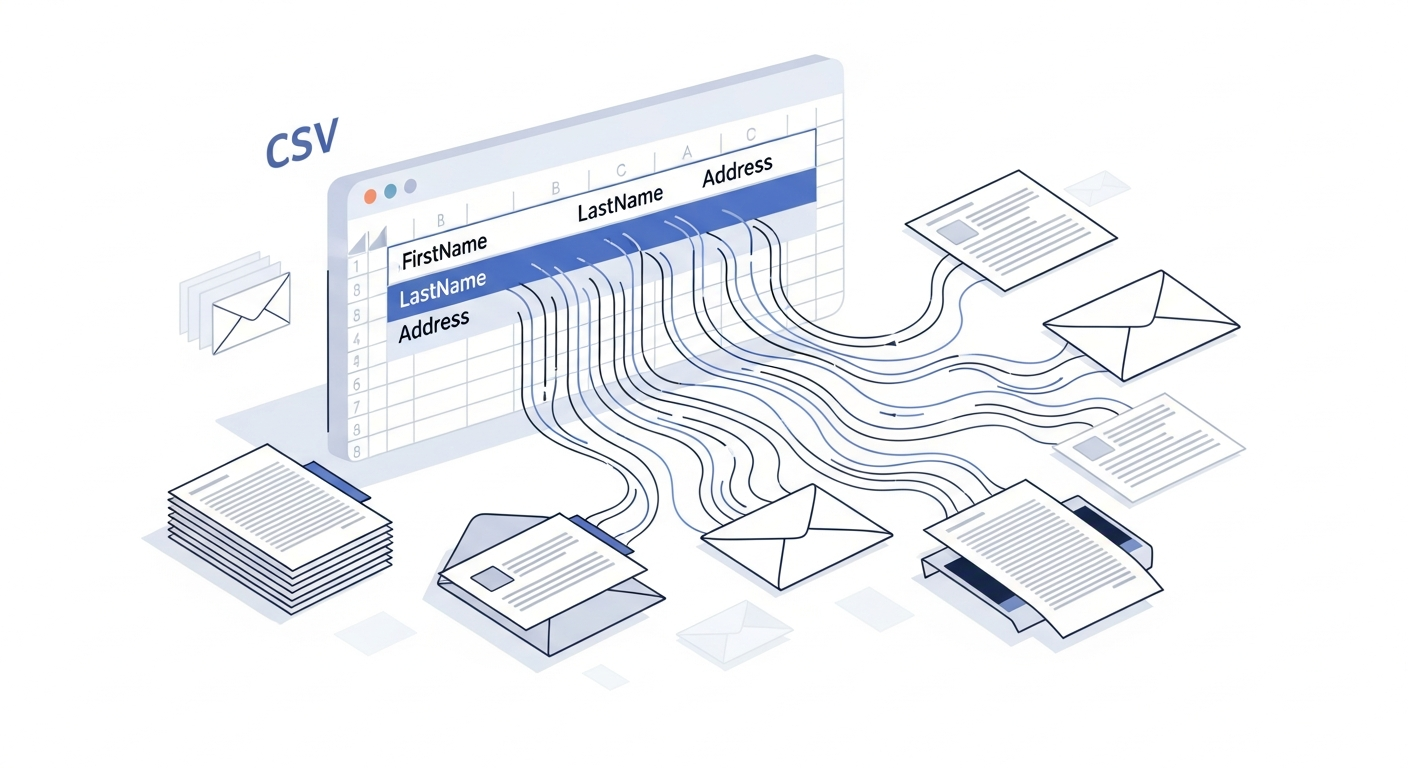
WriteToMail's bulk mailing via CSV upload solves this. Here's how it works for FCRA notices:
Prepare your CSV file. Create columns for each variable in your letter template:
FirstName,LastName,Address1,Address2,City,State,ZIP,JobTitle,CRAName,CRAAddress,CRAPhone,ResponseDeadline.Build your letter template with placeholders. Your letter text uses bracketed variables that match your CSV column headers — e.g., "Dear {{FirstName}}" or "position of {{JobTitle}}."
Upload the CSV to WriteToMail. The platform maps each column to the corresponding placeholder in your template, generating a personalized letter for each row.
Review a sample. Spot-check a few generated letters before confirming the batch.
Submit the batch. Every applicant receives their own individually addressed, printed, and mailed pre-adverse action notice — with their specific CRA information, their job title, and their name on the letter.
This is the same variable data mail merge approach used by collections departments, law firms, and property managers for high-volume compliance mailings. For HR departments processing 50+ background checks at a time, it's not optional — it's the only practical way to stay compliant without dedicating days to manual letter prep.
Step 6: Document the Mailing
Compliance doesn't end when you click "send." You need a record.
After each mailing — single or bulk — retain the following:
- Date the notice was mailed
- Applicant's name and mailing address used
- Copy of the letter as sent (including all variable fields filled in)
- Confirmation that both required enclosures were included
- Any response received from the applicant and the date received
Store these records for a minimum of 5 years, or longer if your industry or state requires it. The FCRA doesn't specify a retention period for pre-adverse action documentation, but EEOC recordkeeping guidance recommends retaining all employment-related records for at least 1 year, and most employment attorneys recommend 5 years for anything litigation-adjacent.
Common Mistakes That Create FCRA Liability
Sending only one notice. Some employers send either the pre-adverse or the final adverse notice — not both. Both are legally required. The pre-adverse must come first.
Forgetting the enclosures. The consumer report copy and the CFPB Summary of Rights aren't optional. They're part of the legal requirement. A letter without them is non-compliant even if the letter text is perfect.
Starting the waiting period from the mail date instead of receipt date. If you mail on Monday and the letter arrives Thursday, your 5-business-day window begins Thursday — not Monday.
Using email instead of mail. Email can supplement your notice, but courts and regulators have not uniformly accepted email-only delivery as sufficient under the FCRA. Physical mail with a postmark is the defensible standard.
Using an outdated Summary of Rights. The CFPB updates the Summary of Consumer Rights periodically. Always download the current version from cfpb.gov before enclosing it.
Sending the final adverse action too quickly. Rushing through the waiting period defeats the purpose of the pre-adverse notice. If an applicant disputes the report within the waiting window, you must pause the adverse action process while the CRA investigates.
Next Steps
Once the pre-adverse action waiting period expires and no dispute has been filed — or after a dispute is resolved — you'll need to send the final adverse action notice. That notice has its own required elements under 15 U.S.C. § 1681m, including the CRA's contact information and a statement of the applicant's right to obtain a free report.
For HR teams who regularly send time-sensitive legal correspondence, it's also worth reviewing how physical mail compares to email for formal legal notices — specifically around the question of which delivery method creates a more defensible paper trail.
If your HR department is also responsible for other formal employee correspondence — written warnings, termination letters, or contractor notices — WriteToMail's platform handles all of these through the same workflow. The guide to sending written notice to a contractor by mail covers a similar compliance-driven mailing process with a different legal context.
Sources
- Fair Credit Reporting Act, 15 U.S.C. § 1681b(b)(3) — FTC Legal Library — statutory authority for the pre-adverse action notice requirement
- CFPB — Action Against Background Check Company for Faulty Reports — cited for context on CFPB enforcement acceleration
- CFPB — Consumer Reporting Companies List and Summary of Rights — source for the required Summary of Consumer Rights enclosure
- EEOC — Recordkeeping Requirements for Employers — guidance on employment record retention periods
- FTC — Using Consumer Reports: What Employers Need to Know — FTC guidance on employer obligations under the FCRA including adverse action procedures
- CFPB — Fair Credit Reporting Act Summary of Rights (Current Version) — official current version of required FCRA enclosure