
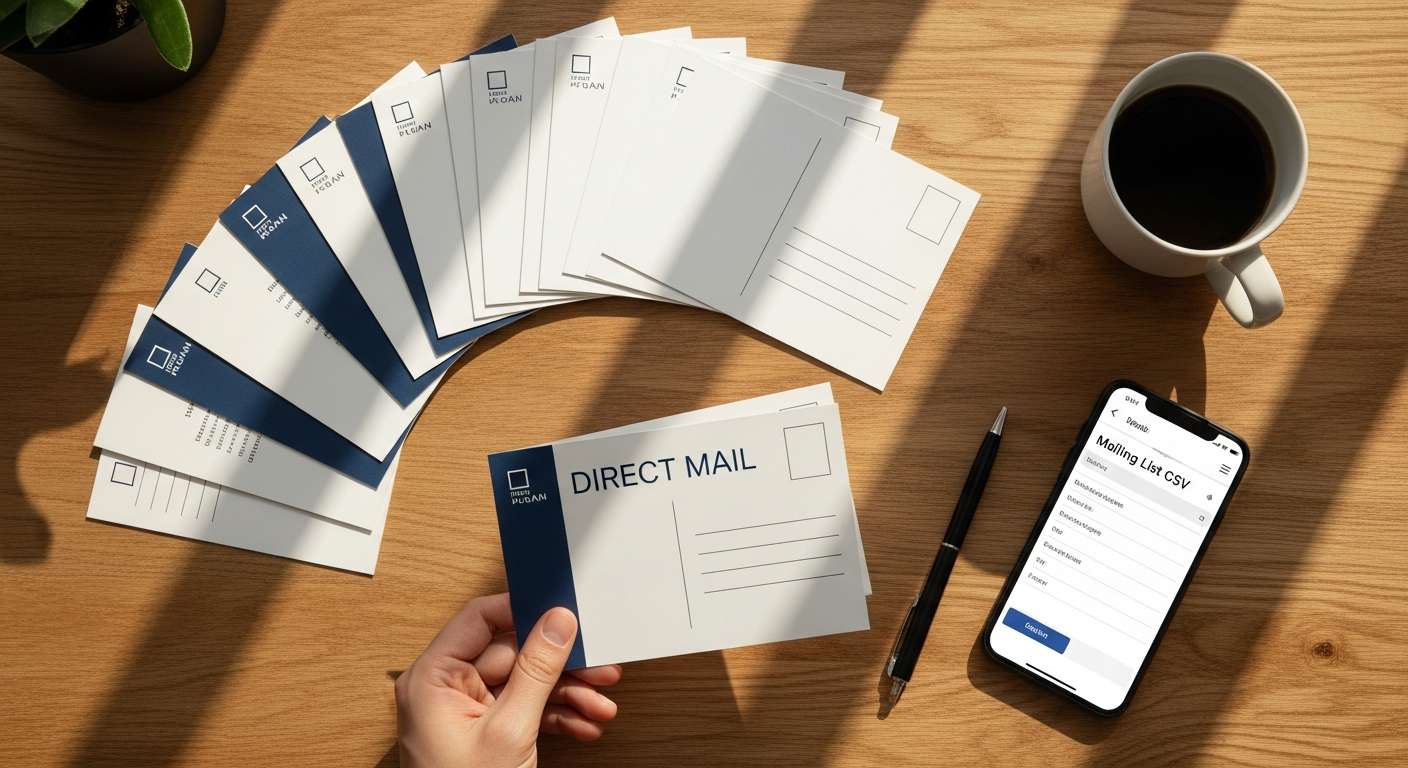
Most small business owners treat direct mail as an afterthought — something to try when digital ads stop working. That's a mistake in the other direction. Direct mail postcards have a response rate of 4.4% to 9%, compared to email's 0.12%. Physical mail gets opened, touched, and often pinned to a refrigerator. A well-designed postcard doesn't fight algorithms. It just shows up.
The challenge isn't whether postcards work. It's knowing which campaign type fits your situation, and how to execute without a print shop, a graphic designer, or a mailing house slowing you down.
These seven direct mail postcard ideas for small business are drawn from proven campaign formats that consistently generate responses. Each one includes a design concept, target audience, and a clear execution path using WriteToMail's online postcard mailing service — where you can upload a CSV, personalize each card, and send to hundreds of addresses without touching a printer.
1. Grand Opening Announcement
The idea: You have one chance to make a first impression on your neighborhood. A grand opening postcard gets in people's hands before they've formed an opinion — and plants your name before competitors do.
Design concept: Bold headline: "[Business Name] Is Now Open in [Neighborhood]." Include your address, a map QR code, your hours, and a single opening offer — 15% off first visit, a free consultation, or a complimentary item. Keep the design clean. One photo. One offer. One phone number.
Who it's for: Restaurants, salons, retail stores, fitness studios, medical or dental practices, any brick-and-mortar opening in a defined geographic area.
How to execute: Pull a mailing list of addresses within a 2–5 mile radius of your location. Most list brokers and USPS's Every Door Direct Mail program can supply this. Format it as a CSV with Name, Address, City, State, and ZIP columns. Upload it to WriteToMail, set your postcard design, and send. The platform handles printing, postage, and USPS delivery — no trips to the post office required.
Why it works: Proximity matters. According to USPS research, 73% of American consumers say they prefer direct mail for brand communications from businesses they haven't heard from before. A physical postcard arriving at someone's home carries more weight than a sponsored post they scroll past.
2. Seasonal Promotion Card
The idea: Every business has a calendar. Tax season, back-to-school, holiday shopping, summer slowdowns — tie your offer to a moment that's already on your customer's mind.
Design concept: Headline tied directly to the season or event: "Beat the Summer Heat — 20% Off Whole-Home AC Tune-Ups Through August 31." Or for retail: "Holiday Shopping Starts Early This Year. Here's Your Head Start." Include a deadline. Urgency drives action. Add a promo code to track response.
Who it's for: HVAC, landscaping, tax preparers, retail stores, e-commerce businesses with physical customer lists, restaurants promoting seasonal menus.
How to execute: Segment your existing customer list by purchase history or last-visit date. Export to CSV, add a personalized promo code column (SUMMER-{FirstName} format works well), and use WriteToMail's variable data mail merge to populate each card with the recipient's name and unique code. Mail 3–4 weeks before the season peaks — not the week of.
One thing most businesses get wrong: They send the postcard too late. If you're mailing for a summer promotion, print and send in mid-May, not July 1st. Give people time to plan.
3. Appointment Reminder Card
The idea: No-shows cost money. A mailed appointment reminder lands differently than a text — it's physical proof of a commitment, and it sits on a desk or counter until the appointment date.
Design concept: Clean, minimal layout. Large text: "Your Appointment Is Confirmed." Below: patient or client name, date, time, location, and a phone number to reschedule. Optionally include a small map or parking instructions. This isn't a sales piece — it's a service touchpoint.
Who it's for: Dental offices, medical practices, veterinarians, attorneys, financial advisors, home service companies scheduling inspections or installs.
How to execute: Export your upcoming appointment schedule as a CSV. Columns needed: patient/client name, appointment date, appointment time, provider name, and mailing address. Upload to WriteToMail and use variable fields to personalize each card. Mail 7–10 days in advance. For practices with HIPAA obligations, WriteToMail operates as a HIPAA-compliant physical mail service.
Why bother when texts exist? Because MGMA data shows that no-show rates for practices using physical reminders alongside digital outreach are measurably lower than digital-only approaches. A postcard on someone's kitchen counter doesn't get buried in notifications.
4. Just-Listed Real Estate Card
The idea: Real estate postcards are a staple for good reason — they work. A just-listed card reaches every homeowner in a neighborhood and tells them two things simultaneously: a home nearby is for sale, and you're the agent who listed it.
Design concept: Front: large property photo, "Just Listed" banner, address, price, and 3–5 key specs (beds, baths, square footage). Back: your headshot, brokerage name, contact info, QR code linking to the full listing, and a one-line market hook: "Homes in [Neighborhood] are selling 12% above asking. Thinking about selling? Let's talk."
Who it's for: Residential real estate agents and teams farming a geographic area or neighborhood.
How to execute: Pull the surrounding neighborhood's mailing list — typically 200–500 addresses within a few blocks. Format as a CSV and upload to WriteToMail. Because each card goes to a different address but shares the same property listing, the personalization here is address-level, not message-level. Simple to set up. For agents running higher-volume campaigns, the full workflow is covered in this guide to bulk postcard mailing for real estate agents.
Response benchmark: According to NAR data, agents who consistently mail to a farm area for 6+ months see 3–5x higher listing inquiry rates from that area versus cold outreach. Consistency beats one-off sends every time.
5. Service Area Introduction Card
The idea: You've expanded — new neighborhood, new city, new ZIP code. Or you've always served an area but never formally introduced yourself to it. A service area introduction card is a direct mail version of knocking on every door. Minus the awkwardness.
Design concept: Headline: "[Business Name] Now Serves [Neighborhood/City]." Brief description of what you do (two sentences max). Introductory offer for first-time customers. Website or phone number. A line that creates local credibility: "Trusted by over 400 homeowners in [Adjacent City] since 2019."
Who it's for: Plumbers, electricians, landscapers, cleaners, pest control companies, any service business expanding into a new geographic market.
How to execute: Get a targeted mailing list by ZIP code or radius. Upload the CSV to WriteToMail and send your postcard via USPS. Because you're targeting strangers, the offer matters more here than in retention campaigns. Make the introductory incentive strong enough to justify a first call.
If you want a deeper look at setting up this kind of campaign end to end, the bulk direct mail from spreadsheet guide covers exactly how to structure your CSV for geographic targeting and avoid common formatting errors.
6. Customer Win-Back Offer
The idea: A lapsed customer already knows you. They chose you once. Win-back campaigns target people who haven't purchased or visited in 6–18 months — and convert at dramatically higher rates than cold prospecting because trust already exists.
Design concept: Headline that acknowledges the gap without being weird about it: "It's Been a While. Here's Something Just for You." Personalize with their first name. Include a meaningful offer — not 5% off, but something that actually moves the needle. 20% off, a free service add-on, a credit toward their next purchase. Add a deadline. No deadline means no urgency.
Who it's for: Restaurants, salons, retail stores, e-commerce brands with physical addresses, gyms, subscription services with known cancellation dates, any business with a customer database.
How to execute: Export your CRM or POS data and filter for customers with no activity in the past 6–18 months. CSV format: First Name, Address, Last Purchase Date, and (optionally) a unique promo code generated per recipient. Map those fields to your postcard template in WriteToMail using variable data mail merge. Each card lands personalized — their name, their code — at scale. For a complete step-by-step walkthrough, the direct mail campaign from CSV guide covers data formatting, segmentation, and common errors.
The math on win-back campaigns: Acquiring a new customer costs 5–7x more than retaining an existing one, according to Harvard Business Review. A win-back postcard mailing to 500 lapsed customers at $1.20 per piece costs $600. If even 3% redeem — 15 customers — and each spends $80, that's $1,200 in recovered revenue from a $600 spend. The ROI math favors this campaign type heavily.
7. Referral Request Card
The idea: Your best customers know other people like them. A referral postcard gives them a tangible reason — and a specific mechanism — to make an introduction. "Tell your friends" doesn't work. "Hand them this card for $25 off their first visit" does.
Design concept: Two-sided format works best here. Front: "You Love [Business Name]. Your Friends Will Too." + the referring customer's name printed on the card. Back: the referral offer spelled out clearly — what the new customer gets, what the existing customer gets (if you're running a two-sided incentive), and how to redeem. Include a unique referral code tied to the sender.
Who it's for: Service businesses with strong retention (salons, gyms, cleaning services, pet care), professional services relying on word-of-mouth (accountants, attorneys, financial planners), and any business where a single new customer has meaningful lifetime value.
How to execute: Pull your top-tier customers — highest purchase frequency, longest retention, or highest spend. Export as a CSV with First Name and mailing address. Add a unique referral code column. Upload to WriteToMail and use variable fields so each card prints with the recipient's name and their personal code. Mail directly to their home so the card arrives as a standalone piece they'll notice.
One detail that matters: Print the referring customer's name on the card itself. When it says "Sarah, share this with someone you know," it feels personal. When it says "Dear Valued Customer," it goes in the recycling bin.
Key Takeaways
- Match the campaign type to the goal. Grand opening and service area cards are for acquisition. Win-back and referral cards are for retention and lifetime value. Appointment reminders are operational. Don't use the wrong format for the wrong job.
- Personalization dramatically lifts response rates. A card with the recipient's name and a custom offer outperforms a generic blast every time. CSV mail merge makes this possible at scale without manual effort.
- One offer per card. The biggest design mistake is trying to say too much. Pick one call to action. One phone number. One deadline.
- Timing is execution. Mail seasonal cards 3–4 weeks early. Appointment reminders 7–10 days in advance. Win-back cards as soon as a customer hits your lapse threshold — not a year later.
- Track every campaign. Use unique promo codes, dedicated phone numbers, or QR codes that point to campaign-specific landing pages. If you can't measure it, you can't improve it.
Direct mail postcard ideas for small business only work when they're actually executed. The gap between "we should do a postcard campaign" and a postcard sitting in 500 mailboxes is smaller than most business owners think. With a CSV list and WriteToMail's platform, you can go from idea to in-the-mail in the same day — no printer, no stamps, no post office line. If you're newer to the channel, the direct mail marketing for small businesses beginner's guide is worth reading before you launch your first campaign.
Methodology
These seven postcard campaign ideas were selected based on three criteria: documented response rate performance across published industry research, applicability across multiple small business verticals (not just one niche), and practical executability without requiring a large budget or design team. Priority was given to campaign types with clear targeting logic, measurable outcomes, and a defined personalization opportunity — since those factors most reliably separate high-performing postcard campaigns from generic mailers.
Sources
- Data & Marketing Association (DMA) — Response Rate Report — direct mail vs. email response rate benchmarks
- USPS Business — Direct Mail Overview — consumer preference data for direct mail from new businesses
- National Association of Realtors — Research & Statistics — real estate agent listing inquiry data tied to consistent geographic farming
- Harvard Business Review — "The Value of Keeping the Right Customers" — customer acquisition vs. retention cost ratio
- USPS Every Door Direct Mail (EDDM) — geographic saturation mailing lists and targeting by ZIP/route
- MGMA — Medical Group Management Association — no-show rate benchmarks for medical practices using multi-channel reminder strategies