
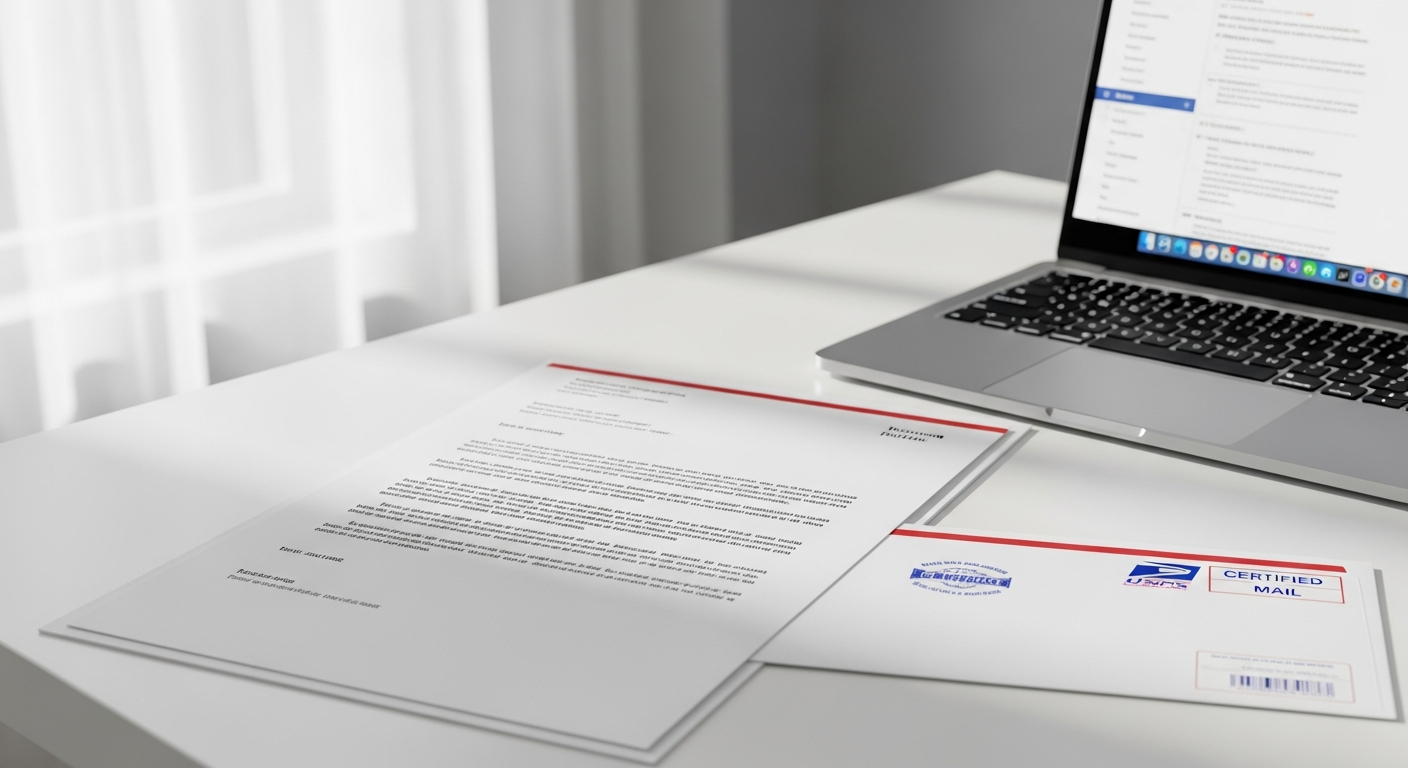
Before you can file a lawsuit in small claims court, pursue a lemon law claim, or invoke certain consumer protection statutes, the law often requires you to send a formal written notice first. That notice is a statutory demand letter — and skipping it can get your case dismissed before it starts.
This guide explains exactly what a statutory demand letter is, when it's legally required, what it must contain, and how to mail a statutory demand letter online without a printer, stamps, or a trip to the post office.
Table of Contents
- What Is a Statutory Demand Letter?
- When Is a Statutory Demand Letter Legally Required?
- State-Specific Notice Requirements
- Certified Mail vs. First-Class Mail: Which One Do You Need?
- What a Statutory Demand Letter Must Include
- How to Draft a Compliant Demand Letter With AI
- How to Mail a Statutory Demand Letter Online With WriteToMail
- Common Mistakes That Invalidate a Statutory Notice
- FAQ
- Sources
What Is a Statutory Demand Letter?
A statutory demand letter is a formal written notice required by law before a party can take certain legal actions — filing suit, invoking arbitration, or triggering specific statutory remedies. The word "statutory" matters: it means the requirement comes from a statute, not just common courtesy or legal strategy.
This distinguishes it from a standard demand letter, which is always a good idea but not always legally mandated. A statutory demand letter has a specific function: satisfying a legal prerequisite. If you skip it, courts can — and do — reject filings, deny remedies, or award attorneys' fees against you.
If you want deeper background on demand letters generally, the article what is a demand letter covers the full definition, legal weight, and real-world examples across different dispute types.
When Is a Statutory Demand Letter Legally Required?
Several categories of law mandate written notice before litigation. Here are the most common:
Small Claims Court Prerequisites
Many states require plaintiffs to send a written demand before filing in small claims court. The intent is to encourage settlement and reduce court volume. California, for example, strongly encourages (and in some disputes, requires) a demand letter before filing. Texas Rule 500.2 explicitly references prior demand in its small claims framework.
Consumer Protection Statutes
Several federal and state consumer protection laws require written notice before a lawsuit can proceed:
- Magnuson-Moss Warranty Act: Requires a reasonable opportunity to cure before a consumer can sue for breach of written warranty.
- FDCPA (Fair Debt Collection Practices Act): Debt collectors must send a written validation notice within five days of first contact, and consumers have 30 days to dispute. This intersects with statutory notice obligations.
- State UDAP (Unfair and Deceptive Acts and Practices) statutes: Many states — Massachusetts (M.G.L. c. 93A), Tennessee, Georgia — require a 30-day demand letter before filing a UDAP lawsuit. In Massachusetts, skipping this step eliminates your right to multiple damages and attorney's fees.
Lemon Law Claims
Every state has a lemon law, and most require the consumer to provide written notice to the manufacturer before filing a claim. The National Highway Traffic Safety Administration maintains a state-by-state lemon law overview. Sending the notice properly — to the right party, by the right method — is critical. Many lemon law claims fail not because the car wasn't defective, but because the notice was sent to the dealership instead of the manufacturer.
Landlord-Tenant Disputes
Lease termination, security deposit return demands, habitability complaints — virtually all of these require statutory written notice with defined timing. State landlord-tenant notice laws vary significantly, but the requirement for physical mail delivery is nearly universal.
Insurance Claims
Most states require a written proof of loss or a formal demand letter before an insured can sue an insurer. Many property insurance policies also have contractual notice clauses that mirror this requirement.
Government Entity Claims
Suing a city, county, or state agency? You almost certainly need to file a government tort claim — essentially a statutory demand — within a narrow window (often 30 to 180 days of the incident). Miss that window and your lawsuit is barred entirely.
State-Specific Notice Requirements
Notice periods and mailing requirements vary by state and statute. Here are several key examples:
| State | Context | Notice Period | Method Required |
|---|---|---|---|
| California | Small claims prerequisite | Recommended; varies by claim type | Written, mailed or delivered |
| Massachusetts | M.G.L. c. 93A (consumer protection) | 30 days before filing | Written, mailed or delivered to registered agent |
| Texas | Lemon Law (Transportation Code §2301.606) | Reasonable opportunity to cure | Written notice to manufacturer |
| Florida | Construction defect (Ch. 558) | 60 days before filing | Certified mail or personal delivery |
| New York | Notice of claim (CPLR §3012-a, medical malpractice) | 90-day notice requirement | Written, specific filing |
| Georgia | FBPA (O.C.G.A. §10-1-399) | 30 days before filing | Written demand |
This table is illustrative, not exhaustive. Always verify requirements under the specific statute governing your claim. For complex matters, consult a licensed attorney in your state.
Certified Mail vs. First-Class Mail: Which One Do You Need?
The method of mailing matters legally. Some statutes specify certified mail. Others accept first-class mail. A few require both.
Certified mail creates a USPS tracking record and provides a return receipt (green card or electronic) confirming delivery. Courts treat this as strong evidence that the recipient received the notice. Florida's construction defect statute (Chapter 558) explicitly requires certified mail.
First-class mail is legally sufficient in many contexts — and courts often presume delivery when a properly addressed letter is sent via first-class mail. The mailbox rule in contract law holds that a properly sent letter is "received" when deposited in the mail, regardless of actual delivery confirmation.
The safest approach: send certified mail when in doubt. Several statutes allow either method, but certified mail eliminates arguments about whether the recipient got the letter. The detailed guide on sending a demand letter by certified mail covers costs, proof-of-delivery documentation, and what to do when a recipient refuses the envelope.
One rule: never send a statutory demand letter only by email if the statute specifies physical mail. Courts in multiple jurisdictions have rejected notice arguments where the only evidence was an email. Physical mail creates a paper trail that email simply cannot replicate.
What a Statutory Demand Letter Must Include
A defective demand letter can be as bad as no letter at all. Courts have dismissed claims — and denied statutory damages — because the notice was missing required elements.
Every statutory demand letter should include:
1. Sender identification Your full legal name (or business entity name), address, and contact information. If you're representing yourself, say so clearly.
2. Recipient identification The full legal name and address of the party being noticed. For lemon law and warranty claims, this means the manufacturer — not the dealership. For government claims, it means the correct governmental entity.
3. Date of the letter This establishes the start of the response clock. Do not omit it.
4. Clear statement of the dispute Describe the problem factually: what was purchased, what failed, when it failed, what repairs were attempted. Be specific. Vague descriptions give the recipient a basis to argue the notice was inadequate.
5. Statutory basis Name the statute you're invoking where applicable. "Pursuant to Massachusetts General Laws Chapter 93A, Section 9..." is far stronger than "I want to file a complaint."
6. The demand itself State exactly what you want: a refund, a replacement, a specific dollar amount, repair, cessation of conduct. Be concrete.
7. Response deadline Most statutes specify the deadline (30 days, 60 days). State it explicitly: "You have 30 days from receipt of this letter to respond."
8. Consequences of non-response Inform the recipient that failure to respond will result in legal action. Many statutes allow courts to award enhanced damages if the defendant received proper notice and failed to cure.
9. Mailing method notation At the bottom of the letter, note how it was sent: "Sent via USPS Certified Mail, Article No. [tracking number]."
For a deeper breakdown of structure and tone, how to write a demand letter that gets paid includes annotated examples across multiple dispute types.
How to Draft a Compliant Demand Letter With AI
Most people know they need to send a statutory demand letter. Few know how to write one that actually meets legal requirements. This is where AI drafting removes a significant barrier.
WriteToMail's AI-powered letter drafting tool lets you describe your situation in plain English — "The manufacturer refused to refund my car after four failed repair attempts under warranty" — and generates a professionally structured demand letter with the correct legal framing, appropriate tone, and all required components.
You're not locked into that draft. The rich text editor lets you modify language, add statutory citations, adjust the dollar amount, and format the letter exactly as needed. The result is a letter that looks and reads like something an attorney drafted — without the $300-per-hour billing rate.
AI drafting works particularly well for:
- Lemon law notices: The AI can structure the vehicle history and repair attempts in the format manufacturers expect.
- Consumer protection demands: Plain-language descriptions get converted into properly framed UDAP notices.
- Small claims prerequisites: Concise, direct letters that establish the dispute and demand resolution before court.
- Security deposit disputes: Itemized demands referencing applicable landlord-tenant statutes.
One important note: AI-generated letters are a strong starting point, not a substitute for legal advice in complex matters. If significant money is at stake or the statutory requirements are unclear, have an attorney review the letter before sending.
How to Mail a Statutory Demand Letter Online With WriteToMail
Once your letter is drafted, you need to get it physically mailed. WriteToMail handles the entire physical mailing process — printing, postage, and USPS delivery — without you touching a printer or visiting a post office.
Here's how the process works:
Step 1: Draft or upload your letter Write your statutory demand letter using the AI drafting tool, start from WriteToMail's demand letter template, or upload a PDF you've already prepared. The PDF upload option is especially useful if you've had an attorney draft the letter and you just need it physically mailed.
Step 2: Customize formatting Use the rich text editor to adjust fonts, spacing, and layout. Statutory demand letters should look formal — clean formatting signals that you're serious.
Step 3: Enter recipient address Enter the full legal name and address of the recipient. For lemon law claims, this is the manufacturer's registered agent address. For government tort claims, it's the clerk of the relevant agency.
Step 4: Select your mailing method Choose USPS First-Class Mail for most standard notice situations. For statutes that explicitly require certified mail, use the certified mail option to get delivery confirmation and a paper trail.
Step 5: Send WriteToMail prints, envelopes, stamps, and hands your letter off to USPS. You get confirmation of mailing, which you can reference if the recipient disputes receiving notice.
The entire process takes minutes. No printer. No post office. No stamps.
For law firms handling multiple statutory notice requirements — sending lemon law notices to manufacturers, UDAP demands across a caseload, or bulk government tort claim notices — WriteToMail's law firm mailing capabilities support bulk sending via CSV upload with variable data fields, so you're not manually entering hundreds of addresses.
Common Mistakes That Invalidate a Statutory Notice
Even a well-written letter can fail if these errors appear:
Sending to the wrong party. Lemon law notices must go to the manufacturer, not the dealership. Government tort claims go to specific clerks or offices, not the department involved in your incident. Verify the correct legal recipient before mailing.
Wrong mailing method. Some statutes require certified mail. Sending first-class when certified is required may invalidate the notice entirely.
Missing the deadline. Government tort claims have particularly brutal deadlines — some as short as 30 days. Calculate your notice deadline from the date of injury or incident, not from when you decided to take action.
Vague demand amount. "Compensation for damages" is not a demand. "$4,800 representing three months of reduced rent due to uninhabitable conditions" is.
No statutory citation. Invoking the relevant statute by name transforms a complaint letter into a statutory demand. Without it, the recipient — and later a court — may argue the notice was insufficient.
Only sending by email. Physical mail is required in virtually every statutory notice context. The article on whether demand letters need to be sent by physical mail covers this distinction in full, including court admissibility differences between mailed and emailed notices.
FAQ
What happens if I skip the statutory demand letter? Courts can dismiss your case entirely, particularly in UDAP claims and government tort actions where notice is a jurisdictional prerequisite. You may also lose the right to statutory damages or attorney's fees that would otherwise be available.
Can I write my own statutory demand letter without an attorney? Yes, for many dispute types. Small claims prerequisites, consumer protection notices, and lemon law demands are commonly sent by individuals without attorneys. The key is including the required elements and following the correct mailing procedure. For high-value disputes or complex statutes, consult an attorney.
Does the letter have to be notarized? Not in most cases. Statutory demand letters are typically not notarized. Exceptions exist for certain government claims and specialized legal filings — check the specific statute.
How long do I keep records of the mailing? Indefinitely until the dispute is fully resolved, including any appeals. Keep your mailing confirmation, certified mail receipt, and a copy of the letter itself.
What if the recipient refuses the certified mail? Refusal generally does not invalidate the notice. Courts typically treat a refusal as constructive receipt — the recipient had the opportunity to accept delivery and chose not to. Document the refusal and keep the USPS tracking record.
Can I mail a statutory demand letter online if the statute says "certified mail"? Yes. WriteToMail offers certified mail delivery through USPS, which satisfies statutory certified mail requirements the same way in-person post office certified mail does.
Is a statutory demand letter the same as a regular demand letter? They overlap significantly but aren't identical. A regular demand letter is a strategic tool you can send any time before litigation. A statutory demand letter satisfies a specific legal prerequisite imposed by statute. The same letter can serve both functions if drafted correctly.
Sources
Texas Courts — Justice Court Rules of Civil Procedure — Reference for Texas small claims court demand requirements under Rule 500.2
National Highway Traffic Safety Administration — Lemon Laws — State-by-state lemon law overview, including manufacturer notice requirements
Cornell Law School Legal Information Institute — Mailbox Rule — Definition and legal application of the mailbox rule in contract and notice law
Massachusetts General Laws Chapter 93A — Massachusetts consumer protection statute requiring 30-day written demand before filing suit
Florida Statutes Chapter 558 — Construction Defects — Florida's construction defect notice requirements, including certified mail mandate
Federal Trade Commission — Magnuson-Moss Warranty Act — Overview of warranty cure requirements before consumer litigation
Consumer Financial Protection Bureau — FDCPA — Overview of Fair Debt Collection Practices Act written notice obligations