

Sending a 60-day notice to vacate by mail sounds simple until a judge throws out your case because the notice was mailed wrong, or included the wrong date, or was sent via email when your state requires physical delivery. This guide eliminates that risk.
You'll walk away knowing exactly what the notice must contain, when 60 days is legally required instead of 30, which mailing method satisfies your state's service requirements, and how to draft and mail the notice entirely online — including bulk sends to multiple tenants at once — without printing a single page or visiting the post office.
Prerequisites and What You'll Achieve
Before you start, have these ready:
- Tenant's full legal name(s) as listed on the lease
- Property address including unit number
- Lease start date and current lease term
- The specific reason for the notice (end of lease, no-fault termination, etc.)
- Your state's notice period requirement (confirmed — not assumed)
- A WriteToMail account at writetomail.com
By the end of this guide, your 60-day notice will be drafted, legally formatted, and in USPS transit — with a paper trail to prove it.
Step 1: Confirm You Need a 60-Day Notice (Not 30)
This step matters more than people think. Sending a 30-day notice when your state requires 60 days doesn't just delay your timeline — it may invalidate the entire proceeding and force you to restart from scratch.
When 60 days is typically required:
- The tenant has lived in the unit for one year or more (California, Oregon, and several other states mandate this)
- The property is subject to local rent control or just-cause eviction ordinances
- The lease termination is a no-fault action (landlord wants to move in, demolish, or renovate)
- Local law adds requirements on top of state minimums
California is the clearest example. Under California Civil Code § 1946.1, a landlord must give 60 days' written notice to a tenant who has resided in the property for one year or more. Tenants under one year only require 30 days. Oregon's SB 608 similarly imposes 90-day notice requirements for no-fault terminations in many situations.
States with notable 60-day requirements:
- California: 60 days for tenants with 1+ year of occupancy
- New Jersey: 60 days for certain no-cause terminations in rent-controlled jurisdictions
- Washington: 60 days for rent increases over 10%, which is adjacent but signals state-level trend toward longer windows
- Nevada: 60 days for month-to-month tenancies in some circumstances
Always verify the current requirement with your state's statutes or a licensed attorney. Laws change — and local ordinances can override state minimums. If you're in a jurisdiction with complex just-cause rules, our guide on how to send a landlord-tenant notice by mail covers layered notice scenarios in more depth.
Expected outcome: You've confirmed that 60 days is the correct notice period, not 30, not 90.
Step 2: Draft a Legally Valid Notice
A notice to vacate isn't a casual letter. Courts look for specific elements. Missing one can sink an otherwise solid case.
Required elements in most jurisdictions:
- Date the notice is written — this matters for calculating the notice period
- Tenant's full legal name(s) — exactly as listed on the lease
- Property address — include unit number, city, state, and ZIP
- Clear statement of termination — the tenancy will end on a specific date
- Move-out deadline — the exact date by which the tenant must vacate (60 days from proper service, not from when you write it)
- Reason for termination — required in many states for no-fault terminations
- Your name and contact information — as landlord or authorized agent
- Statement of consequences — what happens if the tenant does not vacate (eviction proceedings)
- Method of service — some jurisdictions require you to state how the notice is being served
The move-out date calculation trips up a lot of landlords. The 60 days typically begins when the tenant receives the notice — not when you send it. If you're mailing, most states add 3–5 additional days to account for delivery. California, for example, adds 5 days to the notice period when serving by mail, per CCP § 1013.
So a mailed 60-day notice in California effectively requires you to give 65 days from the date you drop it in the mail.
Use WriteToMail's tenant notice to vacate template as your starting point. It includes the standard fields and placeholder language that covers most jurisdictions. You can customize it directly in the platform's rich text editor — adjust fonts, add your letterhead, and modify the body language to match your state's requirements.
Expected outcome: A complete, properly formatted notice ready to send.
Step 3: Choose the Correct Mailing Method for Your State
Not all mail is created equal in the eyes of a landlord-tenant court. Using the wrong method can mean the notice was never legally "served," even if the tenant physically received it.
The three common service-by-mail methods:
Certified Mail (Return Receipt Requested)
Certified mail creates a USPS tracking record and requires the recipient's signature. That green return receipt card becomes your proof of delivery. Many landlord attorneys recommend this as the gold standard because the documentation is nearly unimpeachable.
Downside: if the tenant refuses to sign or doesn't pick up the certified letter, the notice may not be considered served in all states.
First-Class Mail
Simpler and faster. Several states accept first-class mail as valid service for notices — especially when combined with a certificate of mailing (the USPS stamp on a postal form proving you mailed it that day).
Both Methods Together
Many landlords and property attorneys send both a certified copy and a regular first-class copy simultaneously. The rationale: if the tenant refuses the certified letter, the first-class copy still arrives and courts often treat that as valid service. This is the safest approach in states that allow mailed service.
WriteToMail sends your letters via USPS First-Class Mail, handling printing, postage, and delivery entirely from the platform. For the most legally conservative approach in high-stakes situations, you can use WriteToMail for the first-class copy and supplement with a certified mail send through USPS separately. Or, for portfolio-level terminations where documentation per unit matters, sending bulk mail online via WriteToMail gives you a consistent, timestamped record of every send across every unit.
Expected outcome: You know which mailing method(s) your state requires and are ready to send.
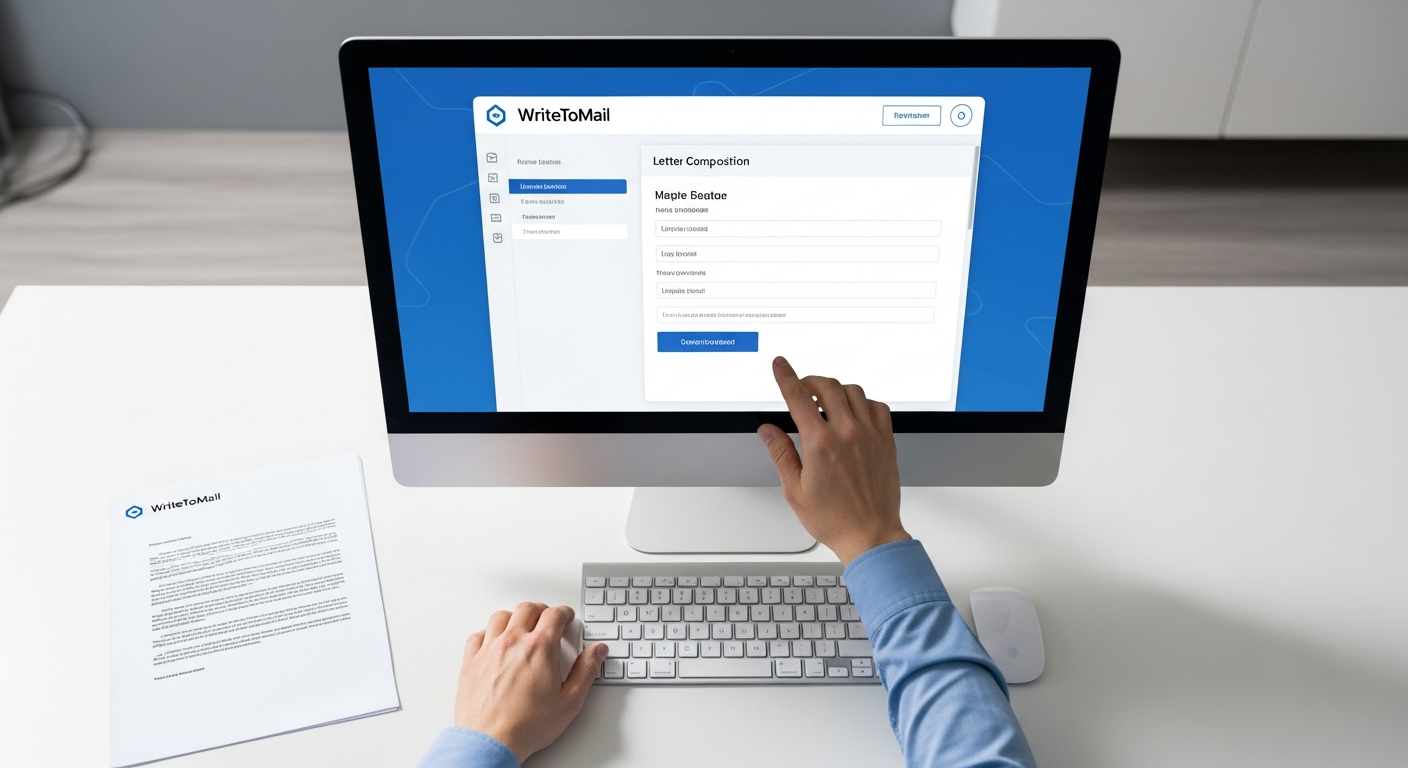
Step 4: Send the Notice Using WriteToMail
This is where everything comes together. WriteToMail eliminates the friction that makes landlords delay sending notices — no printer, no stamps, no post office run.
For a Single Tenant
- Go to writetomail.com and log in (or create a free account)
- Start a new letter — either use the AI-powered drafting tool by describing the notice, or open the rich text editor and paste your drafted notice
- Customize the letter — add your letterhead, adjust formatting, verify all required fields are populated
- Enter the recipient address — tenant's name and property address
- Enter your return address as the sender
- Review the preview — confirm the move-out date calculation, tenant name spelling, and property address are accurate
- Submit — WriteToMail prints, envelopes, stamps, and hands the letter to USPS
The entire process takes under 10 minutes for a single notice. You get a confirmation that the letter has been submitted for mailing, which serves as your record of send date.
For Multiple Tenants (Portfolio-Wide Terminations)
Property managers ending month-to-month tenancies across multiple units — or handling a building-wide lease termination — don't need to repeat this process 40 times.
WriteToMail's CSV bulk mailing feature handles this in one session. Here's how:
- Build your CSV file with one row per tenant. Include columns for: tenant name, property address, unit number, move-out date, and any other variable fields in your letter template
- Draft your master notice letter using variable placeholders (e.g.,
{{TenantName}},{{PropertyAddress}},{{MoveOutDate}}) - Upload the CSV to WriteToMail's bulk mailing tool
- The platform maps your CSV columns to the letter's variable fields automatically
- Each letter renders with that tenant's specific data — personalized, not generic
- Review a sample, confirm, and submit the entire batch
Every tenant receives a physically printed, individually addressed letter via USPS First-Class Mail. You don't touch a single envelope.
This matters for large portfolios because consistency reduces legal exposure. Every notice looks the same, contains the same required language, and was mailed on the same date — all documented through WriteToMail's confirmation.
Expected outcome: Your notice (or notices) are submitted, printing, and entering USPS delivery — without leaving your desk.
Step 5: Document Everything
Sending the notice is step one. Proving you sent it correctly is what protects you in court.
Immediately after submitting through WriteToMail, document the following:
- Screenshot or save the send confirmation from WriteToMail with the date and recipient address visible
- Record the mailing date in your property management system or a dedicated spreadsheet
- Calculate and record the earliest legal move-out date — mailing date + delivery days + 60-day notice period
- Note the mailing method — USPS First-Class Mail via WriteToMail
- Store a copy of the letter itself — keep the exact text you sent, not just a generic template
If you sent certified mail in addition to the first-class copy, staple or scan the tracking number and green return receipt card when it comes back.
This documentation becomes your evidentiary record if the tenant challenges service or claims they never received the notice. Courts take documentation seriously. A timestamped confirmation + a copy of the exact letter sent puts you in a much stronger position than a vague claim that "you mailed it."
Expected outcome: A complete paper trail ready to submit as evidence if needed.
Common Mistakes (and How to Avoid Them)
Miscalculating the move-out date. The 60-day clock typically starts from the date of service, not the date you wrote the notice. Add 3–5 days for mailing when calculating the deadline. When in doubt, add more time rather than less — an early vacate date doesn't hurt you; an insufficient notice period can kill your case.
Using the wrong tenant name. The notice must match the name(s) on the lease exactly. "Mike" instead of "Michael D. Rodriguez" could create grounds for challenge.
Sending to the wrong address. If your tenant has notified you of a different mailing address, you may need to serve both. Check your lease for the tenant's designated notice address.
Not keeping a copy of what you sent. Always save the exact letter you mailed. Don't rely on a template — the document you actually sent is what matters.
Assuming email counts as service. For most formal notices to vacate, email alone does not satisfy service requirements. Physical mail is required or strongly preferred in virtually every U.S. jurisdiction. This is why services like WriteToMail exist — to make physical mail as easy as sending an email.
Using 30 days when local ordinance requires 60. State law sets a minimum, but city and county ordinances often impose longer requirements. Los Angeles, San Francisco, and New York City all have local rules that can require longer notice periods than state law mandates. Check local ordinances, not just state statutes.
Next Steps and Related Resources
Once your notice is sent and documented, here's what comes next:
- If the tenant complies: Begin the move-out inspection process on or just after the vacate date. Document the unit's condition with photos and video. Refer to your state's security deposit return timeline.
- If the tenant does not vacate: Proceed to unlawful detainer (eviction) proceedings. Your sent notice becomes Exhibit A. Review our guide on how to send an eviction notice by mail for the next stage.
- If you need to send pay-or-quit notices to other tenants: The process is similar — the notice to quit mailing service guide walks through that workflow with state-specific requirements.
- If you're managing a portfolio with mixed notice types: WriteToMail's bulk CSV feature handles simultaneous sends of different notice types to different tenants. Each letter can be personalized, and each mailing is documented.
Landlord-tenant law moves fast. Jurisdictions that required 30 days three years ago may now require 60 or 90. Build a habit of verifying notice requirements before each send — especially in California, Oregon, Washington, New York, and New Jersey, where tenant protection laws have evolved significantly since 2023.
Sources
- California Civil Code § 1946.1 — California Legislative Information — Statutory basis for California's 60-day notice requirement for tenants with one or more years of occupancy
- California Code of Civil Procedure § 1013 — California Legislative Information — Rule adding 5 days to notice periods when service is made by mail in California
- National Conference of State Legislatures — Landlord-Tenant Law — Overview of state-level landlord-tenant statutes and recent legislative trends
- Oregon Senate Bill 608 — Oregon Legislative Assembly — Oregon's 2019 rent stabilization and no-fault eviction notice requirements, including extended notice periods