

Sending a lease non-renewal notice by mail is one of the most consequential communications a landlord makes. Get it wrong — wrong timing, wrong delivery method, missing information — and a tenant can challenge it in court, buy themselves extra months they aren't entitled to, and cost you thousands in lost rent.
This guide gives you a ready-to-use template, a breakdown of every section, and a clear process for getting the notice delivered and documented through USPS mail. No printer required.
Who This Template Is For
This template works for any landlord or property manager who needs to formally notify a tenant that their lease will not be renewed at the end of its current term. Common situations include:
- Month-to-month tenants you want to end a tenancy with
- Fixed-term lease tenants whose lease is expiring and you don't plan to renew
- Tenants who are problematic but not yet at the eviction threshold
- Situations where you're selling the property, moving in a family member, or changing the unit's use
Non-renewal notices are different from eviction notices. You're not alleging a lease violation — you're simply exercising your right not to continue the tenancy. That makes the tone of the letter more neutral, but the delivery requirements are just as strict.
State Notice Period Requirements
Before you draft anything, confirm your state's required notice period. Sending a 30-day notice when your state requires 60 days gives the tenant grounds to argue the notice is invalid.
Here's a quick reference for the most common state requirements:
| State | Month-to-Month | 1-Year Lease Ending |
|---|---|---|
| California | 30 days (tenant < 1 yr) / 60 days (tenant ≥ 1 yr) | 60 days |
| New York | 30–90 days depending on tenancy length | 30 days minimum |
| Florida | 15 days (month-to-month) | Per lease terms |
| Texas | 30 days | Per lease terms |
| Illinois | 30 days | 30 days |
| Washington | 20 days | 20 days |
| Oregon | 30–90 days (just cause laws apply) | 30–90 days |
California's tenant protection laws under AB 1482 require landlords to include a "just cause" reason for non-renewal in many cases. New York has similar requirements under the Housing Stability and Tenant Protection Act of 2019. Check your local ordinances — some cities (like Los Angeles, Seattle, and Portland) layer additional protections on top of state law.
When in doubt, give more notice than the minimum. A 60-day notice is almost always safer than a 30-day notice, and the downside of too much notice is minimal.
The Lease Non-Renewal Notice Template
Copy and customize this template. Fields in brackets are placeholders — replace them with your actual information before sending.
[YOUR NAME OR PROPERTY MANAGEMENT COMPANY NAME] [Your Street Address] [City, State, ZIP Code] [Phone Number] [Email Address]
[Date of Letter]
[TENANT FULL NAME] [Tenant Street Address] [City, State, ZIP Code]
RE: Notice of Lease Non-Renewal — [Property Address, Unit Number if applicable]
Dear [Tenant Full Name],
This letter serves as formal written notice that your lease agreement for the property located at [Full Property Address, including Unit Number] will not be renewed at the end of its current term.
Your current lease expires on [Lease Expiration Date]. You are required to vacate the premises and return possession of the property to the landlord no later than [Move-Out Deadline — typically the lease expiration date or the date that satisfies your state's notice requirement].
[OPTIONAL — include if required by state law or desired for clarity:] The reason for this non-renewal is: [state reason here if required by just-cause jurisdiction, e.g., owner move-in, sale of property, substantial renovation, or simply omit this paragraph if not required].
Please ensure that the property is returned in clean condition, with all personal belongings removed and all keys, fobs, and access cards returned by the move-out deadline. Your security deposit of $[Amount] will be processed in accordance with [State] law, which requires the return of any remaining deposit within [state-specific timeframe, e.g., 21 days in California, 30 days in most states] of your vacating the premises.
If you have questions about this notice, the move-out process, or scheduling a final walkthrough, please contact me at [Phone Number] or [Email Address].
Sincerely,
[Your Signature]
[Your Printed Name] [Landlord or Property Manager Title] [Date]
This notice was sent via USPS First-Class Mail on [Date of Mailing].
Section-by-Section Breakdown
Header Block — Your Contact Information
Your name and contact details go at the top. If you manage multiple properties under an LLC or management company name, use the entity name here, not your personal name. This matters if the notice ever gets challenged in court — consistency between the entity named in the lease and the entity signing the notice is important.
Date of Letter
Use the date you're actually sending the notice, not the date you drafted it. Most states calculate the notice period from the date of mailing, not the date the tenant receives it. A letter dated July 1 but mailed July 10 may not satisfy the notice requirement if the count starts from the mailing date.
Tenant Name and Address
Use the full legal name that appears on the lease. If two people signed the lease, include both names. Send individual copies if your state requires separate service for each leaseholder — some states do.
RE Line
The RE (reference) line immediately tells the recipient what the letter is about. Include the full property address, including the unit number if it's a multi-unit building. This prevents any ambiguity about which unit the notice applies to.
Lease Expiration and Move-Out Deadline
These are two different dates — and confusing them is a common mistake. The lease expiration is when the current term ends. The move-out deadline is the date by which the tenant must vacate. In most standard non-renewals, these dates are the same. But if your state requires you to give notice a set number of days before the expiration, and the lease is expiring sooner than that, you may need to set a move-out date that extends past the lease expiration to satisfy the notice requirement.
Reason for Non-Renewal
In states without just-cause eviction requirements, you don't need to explain why you're not renewing. Many landlords include a brief, neutral reason anyway — it reduces the chance of confrontation and signals professionalism. In just-cause jurisdictions (California for covered units, New York, Oregon, and others), stating the reason isn't optional — it's legally required.
Security Deposit Language
Referencing the security deposit in the non-renewal notice sets clear expectations and demonstrates you're operating in good faith. Include the specific number of days your state allows for deposit return. California requires 21 days, while many states allow 30. Missing this deadline exposes landlords to double or triple damages in some states.
Mailing Notation at the Bottom
This line — "This notice was sent via USPS First-Class Mail on [Date]" — matters. It creates a self-referential record of the delivery method and date. Combined with a copy of the letter in your files and your mailing receipt, this is your documentation that proper service was made.
Why Physical Mail Creates a Legally Defensible Record
Email is easy to dispute. A tenant can claim they never received it, their spam filter caught it, or they deleted it by accident. Text messages are harder to prove were read. Hand-delivery creates conflict.
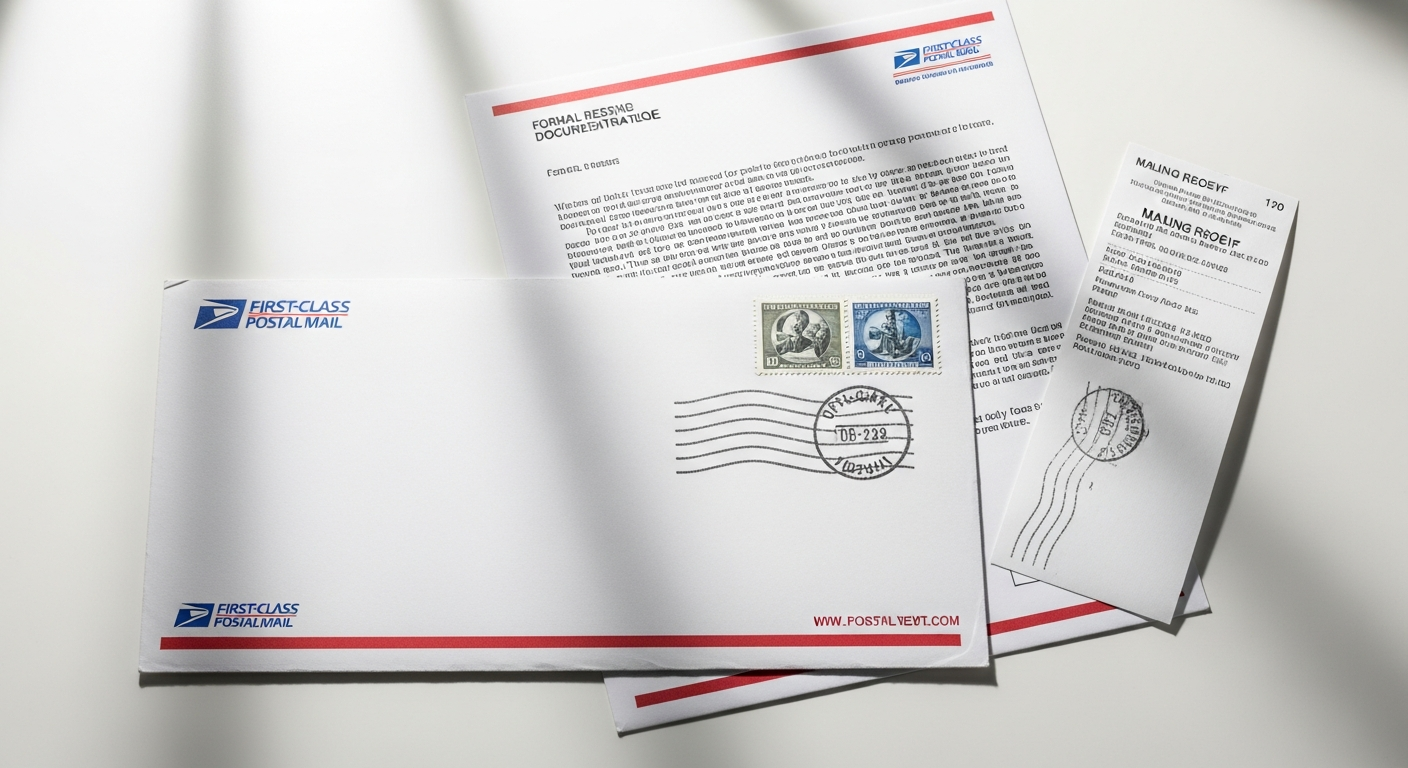
USPS First-Class Mail operates differently. The postmark is a government-stamped timestamp. Most states accept First-Class mail as valid legal service for non-renewal notices — and some states specifically require it. According to the National Multifamily Housing Council, more than 40 states recognize USPS mail as a valid service method for lease termination notices.
Mailing through an online platform like WriteToMail adds a layer of documentation that's harder to achieve when you do it yourself. The platform records the date of submission, handles printing and postage, and routes the letter through USPS First-Class Mail — all without you touching a printer or driving to the post office.
For landlords managing multiple units, the notice to quit mailing service process is the same whether you're sending one notice or fifty.
Customization Tips for Different Scenarios
Month-to-Month Tenancy
Remove references to "lease expiration date" and replace with "the end of the current rental period." Give the notice the required number of days in advance — typically 30 or 60 days depending on tenancy length in your state.
Owner Move-In
Add a sentence after the reason paragraph: "The owner of the property intends to occupy the unit as their primary residence." Some states require additional documentation to support an owner move-in non-renewal — check your local rules before relying on this reason.
Property Sale
If you're selling the property, you may need to include the buyer's name or the expected close date, depending on state requirements. Note that in some jurisdictions, a property sale does not automatically terminate a tenancy — the new owner inherits the lease.
Just-Cause Jurisdictions
In cities like Los Angeles, San Francisco, and Portland, non-renewal notices in covered buildings must cite a specific just-cause reason AND may require relocation assistance payments. This template's reason section covers the basic requirement, but consult local ordinances for any additional steps.
Multiple Units
If you're sending non-renewal notices to multiple tenants at once — end of a building rehabilitation project, portfolio sale, or seasonal closure — you can upload all tenant addresses via CSV to WriteToMail's bulk mailing platform and send personalized letters to each tenant in a single session. Each letter gets individual printing, enveloping, and USPS delivery.
How to Send This Template via WriteToMail
If you don't have a printer, don't want to deal with stamps, or need a documented mailing record, here's the fastest path to getting this notice delivered:
Step 1: Draft your notice. Use the template above, or use WriteToMail's AI drafting feature. Describe your situation — property address, tenant name, notice period, reason if applicable — and the platform generates a draft you can review and edit.
Step 2: Customize. Use the rich text editor to adjust language, formatting, and any state-specific additions. Replace all bracketed fields with your actual information.
Step 3: Enter the recipient's address. Add the tenant's full name and mailing address. This becomes the delivery address on the envelope.
Step 4: Send. WriteToMail prints the letter, envelopes it, applies postage, and delivers it via USPS First-Class Mail. You receive a confirmation with the mailing date — your documentation that service was made.
For landlords managing multiple properties, the same workflow scales. Upload a CSV file with all your tenant names and addresses, map the variable fields (tenant name, unit number, move-out date), and send a personalized non-renewal notice to each tenant simultaneously.
This approach is especially useful when you need to send non-renewal notices across a portfolio at once — common when a property owner is refinancing, repositioning, or preparing for renovation. It also eliminates the risk of forgetting to send one notice or sending it late, which can cascade into a legal complication you don't need.
If you've already drafted your notice in Word or another document editor, you can also upload it as a PDF and have it mailed directly — no reformatting required. The send physical mail online guide walks through every available format.
Related Notice Types
A lease non-renewal isn't always the right tool. Here's a quick comparison:
- Non-renewal notice: Used when the lease is ending and you simply don't want to renew. No violation required.
- Notice to vacate: Used when you need the tenant to leave, sometimes mid-lease for specific legal reasons. See the tenant notice to vacate template for a comparable template.
- Pay or quit notice: Used when a tenant hasn't paid rent and you're initiating the eviction process. See the guide on how to send a pay or quit notice by mail.
- 60-day notice to vacate: A longer-notice version typically required for longer-term tenants or tenants in protected jurisdictions. The 60-day notice to vacate guide covers state-specific requirements in detail.
Choosing the right notice type matters. Sending a non-renewal notice when the situation actually calls for an eviction notice — or vice versa — can delay your timeline significantly.
Common Mistakes That Invalidate a Non-Renewal Notice
Sending too late. If your state requires 60 days and you send 45 days before the lease expires, the notice may be invalid. Count carefully from the date of mailing.
Wrong delivery method. Some states require certified mail, posting on the door, OR First-Class mail — and some require two methods simultaneously. Confirm your state's accepted methods before mailing.
Wrong tenant name. Using a nickname instead of the legal name on the lease gives tenants grounds to dispute whether the notice was properly served.
Missing required language. Just-cause jurisdictions often require specific statutory language or reference to the applicable code section. A missing phrase can void the notice.
Not keeping a copy. Always retain a copy of the letter as sent, along with proof of mailing. If the tenancy dispute goes to court, you'll need both.
A lease non-renewal notice sent by mail with proper documentation isn't just a courtesy — it's the foundation of a legally clean end to a tenancy. Get the notice right, send it on time, and keep the paper trail. Everything else follows from that.
Sources
- California AB 1482 — Tenant Protection Act of 2019 — just-cause eviction and non-renewal requirements for covered California units
- New York Housing Stability and Tenant Protection Act of 2019 — New York's tenant protection framework including notice requirements for non-renewals
- California Civil Code Section 1950.5 — Security Deposit Return — 21-day security deposit return requirement cited in the template section
- National Multifamily Housing Council — referenced for state-by-state acceptance of USPS mail as valid service for lease termination notices
- California Department of Consumer Affairs — Landlord-Tenant Guide — baseline reference for California landlord notice periods and tenant rights
- Oregon Residential Landlord Tenant Act — ORS Chapter 90 — Oregon just-cause non-renewal requirements and notice periods
- Florida Statutes Section 83.57 — Termination of Tenancy — Florida's 15-day notice requirement for month-to-month tenancies