
Sending a notice of intent to sue by mail is often the last step before formal litigation — and the first step that gets taken seriously. Whether you're a landlord pursuing unpaid rent, a contractor chasing an overdue invoice, or an individual whose rights have been violated, a formal written notice sent through the mail carries legal weight that a text message or email simply cannot match.
This guide gives you a ready-to-use template, explains what each section must contain, and shows you how to mail it without a lawyer, a printer, or a trip to the post office.
What This Template Is For — and Who Needs It
A notice of intent to sue (sometimes called a pre-litigation notice or demand to cure) serves a specific legal purpose: it formally informs the other party that you intend to file a lawsuit unless they resolve the dispute within a defined window.
Courts in many states require this notice before you can file. Small claims courts in California, Florida, and several others expect plaintiffs to demonstrate that they attempted resolution before filing. Some state statutes — particularly in consumer protection and landlord-tenant law — require written pre-suit notice as a condition of recovering attorney's fees or statutory damages.
Beyond legal requirements, this letter creates a documented record. That record can be introduced as evidence. It shows a judge you acted in good faith. It also forces the other party to respond in writing, which can be useful later.
This template works for:
- Unpaid invoices from clients, contractors, or tenants
- Property damage disputes
- Breach of contract claims
- Consumer protection complaints
- Personal injury pre-litigation demands
- Security deposit disputes
It is not a substitute for legal advice in complex litigation. If your dispute involves significant money, criminal conduct, or constitutional claims, consult an attorney.
The Notice of Intent to Sue Template
Copy and customize the template below. Fields in [brackets] should be replaced with your specific details.
[Your Full Name] [Your Street Address] [City, State, ZIP Code] [Your Phone Number] [Your Email Address] [Date]
[Recipient's Full Name] [Recipient's Title, if applicable] [Company Name, if applicable] [Recipient's Street Address] [City, State, ZIP Code]
RE: Notice of Intent to Sue — [Brief Description of Dispute]
Dear [Recipient's Name or "To Whom It May Concern"],
I am writing to formally notify you that I intend to pursue legal action against you [and/or your company, [Company Name]] unless the matter described below is resolved by [Response Deadline — typically 10–30 days from mailing date].
Description of the Dispute
On or about [Date of Incident or Agreement], [briefly describe the facts: what happened, what was agreed to, what was violated]. As a result, I have suffered [describe harm: financial loss, property damage, failure to receive promised services, etc.] in the amount of $[Dollar Amount], or in a manner that has caused [describe non-monetary harm if applicable].
Your Legal Obligations
Under [cite applicable law, contract clause, or legal basis — e.g., "the terms of our written contract dated [Date]," or "California Civil Code § 1942.4," or "the Fair Debt Collection Practices Act"], you are legally obligated to [describe the obligation: pay the amount owed, repair the property, return the security deposit, cease and desist the conduct, etc.].
My Demand
To resolve this matter without litigation, I demand that you:
- [First demand — e.g., pay $[Amount] in full]
- [Second demand, if applicable — e.g., provide written confirmation of payment]
- [Third demand, if applicable — e.g., cease all further contact except through written correspondence]
Response Deadline
You have [number] calendar days from the date of this letter to comply with the above demands. If I do not receive a satisfactory response by [specific date], I will file a lawsuit against you in [name of court — e.g., "the Superior Court of [County], [State]" or "[State] Small Claims Court"] seeking [damages, injunctive relief, legal fees, court costs, etc.].
This is your final opportunity to resolve this matter without judicial intervention.
I retain the right to pursue all remedies available to me under applicable law, including but not limited to compensatory damages, statutory damages, court costs, and attorney's fees where permitted by law.
Please direct all responses to me in writing at the address above or via email at [your email address].
Sincerely,
[Your Signature]
[Your Printed Name]
Sent via USPS Certified Mail / First-Class Mail — [Tracking Number, if applicable]
Walking Through Each Section
Sender and Recipient Headers
Full legal names matter here. Don't use nicknames. If you're sending to a business, include both the individual name (if you know it) and the company name. Courts sometimes dismiss notices that fail to identify the correct legal entity.
Date the letter on the day you mail it — not the day you write the draft.
The RE Line
The RE line tells the recipient immediately what this letter is about. Keep it specific but neutral: "RE: Notice of Intent to Sue — Unpaid Invoice #4872" or "RE: Pre-Litigation Notice — Security Deposit Dispute, [Property Address]."
Description of the Dispute
This is the factual core of the letter. Be precise. Name dates, amounts, locations, and agreements. If there's a written contract, reference it by date. If there were prior communications (emails, texts, phone calls), you can reference them briefly.
Avoid emotional language. Angry letters undermine credibility. State facts. Let the facts make the argument.
Legal Basis
Citing the law, statute, or contract clause that supports your claim is optional but powerful. It tells the recipient you've done your homework. For landlord-tenant disputes, state statutes are often directly applicable. For contract breaches, cite the relevant contract language. For consumer protection claims, federal statutes like the FDCPA or FCRA are common references.
If you're uncertain which law applies, this section can be simplified to: "Under the terms of our agreement dated [Date] / applicable state law / [relevant statute]."
Your Demand
Be specific. "Pay me what you owe" is weak. "$4,200 in full, via certified check or wire transfer, by July 30, 2026" is actionable. The clearer the demand, the harder it is for the recipient to claim confusion.
If there are multiple demands, number them. Courts appreciate clarity.
Response Deadline
Typical deadlines range from 10 to 30 days depending on the nature of the dispute and any statutory requirements. Personal injury pre-suit demands sometimes require 30 days. Small claims matters often use 10–14 days. Some government entities require 60–90 days under tort claims acts.
Check your state's specific requirements before choosing a deadline.
Closing Statement
The closing should be firm without being threatening or inflammatory. You're documenting a legal position, not venting frustration. The line "This is your final opportunity to resolve this matter without judicial intervention" is deliberate — it signals seriousness and finality.
State-Specific Legal Requirements You Should Know
Not every state handles pre-litigation notice the same way. Here are key variations:
California: Many consumer protection claims under the Consumers Legal Remedies Act (CLRA) require a 30-day written notice before filing. Failure to send it can bar your right to seek damages.
Florida: Florida Statute § 57.105 requires plaintiffs to notify defendants of alleged frivolous claims before filing. Separate pre-suit notice requirements apply to medical malpractice and construction defect claims.
Texas: The Texas Property Code requires landlords and tenants to follow specific written notice procedures. Similarly, the Texas Deceptive Trade Practices Act requires a written demand letter at least 60 days before filing suit.
Federal claims: The Federal Tort Claims Act requires a written administrative claim before suing the federal government, with a specific form and a two-year deadline.
These examples illustrate why knowing your state's rules matters. If you're unsure, the U.S. Courts website and your state legislature's public statutes database are good starting points.
Why Physical Mail Creates a Better Paper Trail Than Email
Email is easy to ignore, easy to delete, and easy to dispute in court. "I never received it" is a credible defense when your only proof is an email.
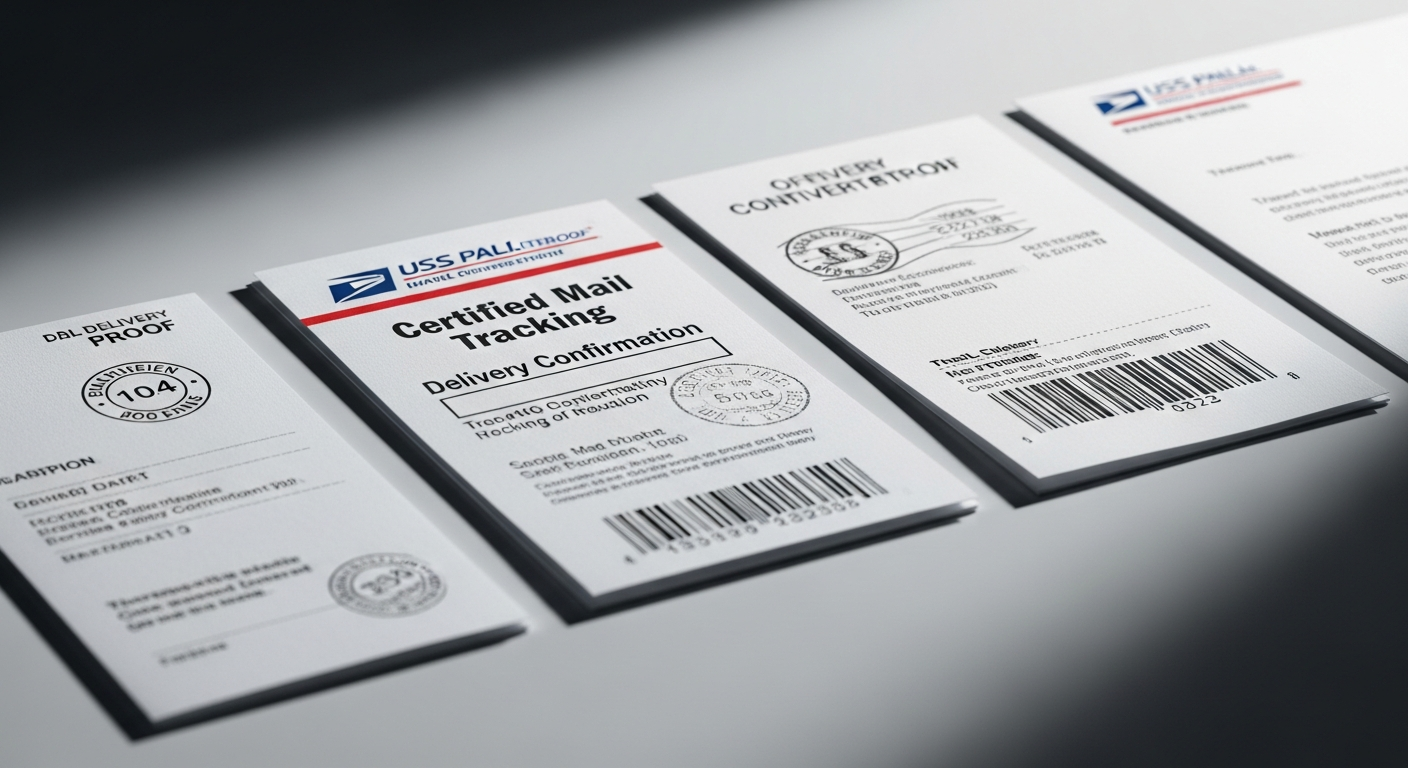
A physical letter sent via USPS Certified Mail creates a chain of documented evidence that's difficult to dispute:
- The postmark establishes when you mailed it
- The tracking number confirms USPS received the item
- The delivery confirmation shows when it arrived
- A signature (with Certified Mail) proves the recipient accepted it
For many state-law claims, physical mail delivery — specifically Certified Mail with return receipt — is the legally required method of service. Even when it's not legally required, it dramatically strengthens your position.
Sending legal notices by physical mail online is now straightforward: you don't need a printer, stamps, or a post office visit to create that paper trail.
Customization Tips for Common Use Cases
Unpaid Invoices or Breach of Contract
Include the original invoice number, the date payment was due, and any prior attempts to collect (phone calls, emails, prior demand letters). Reference the specific contract clause that establishes the payment obligation. Set a tight deadline — 10–14 days is standard for commercial disputes.
If you've already sent a demand letter and received no response, this notice of intent to sue should reference that prior letter by date and tracking number. For guidance on the initial demand, the demand letter template for unpaid invoices at WriteToMail is a useful companion piece.
Security Deposit Disputes
Include the property address, the dates of tenancy, the amount withheld, and your state's statutory deadline for returning deposits (which most states set at 14–30 days after move-out). Many state security deposit statutes allow you to recover 2–3x the withheld amount if the landlord acted in bad faith, so cite that statute explicitly.
Personal Injury Claims
Pre-litigation demands in injury cases typically require more detailed documentation: medical records, treatment costs, lost wages, and a pain-and-suffering calculation. Many personal injury attorneys send these letters with a 30-day response window. If you're sending this without an attorney, include copies of key documents as enclosures.
Consumer Protection Violations
If a company violated the FDCPA, FCRA, TCPA, or a state consumer protection statute, cite the specific statute and violation date. Many of these statutes allow statutory damages per violation — note that in your demand. The specificity signals you understand the law and are prepared to use it.
How to Use This Template: Quick-Start Guide
Step 1: Identify your legal basis. What law, contract, or obligation was violated? Look up your state's specific requirements for pre-suit notice in the type of dispute you have.
Step 2: Gather your documentation. Contracts, invoices, emails, photos, receipts, prior demand letters. You won't attach all of them, but you'll reference them.
Step 3: Fill in the template. Replace every bracketed field with your specific details. Don't leave placeholders in the final letter — it looks unprofessional and weakens your position.
Step 4: Set a realistic deadline. Choose a response window that gives the recipient time to respond while meeting any statutory minimums in your state.
Step 5: Send it by physical mail. This is the step most people underestimate. Email is convenient but legally weaker. A physical letter with a delivery record is harder to dispute.
Step 6: Keep your proof. Save the tracking number, the delivery confirmation, and a copy of the letter itself. If this matter goes to court, these are your exhibits.
Send Your Notice of Intent to Sue Through WriteToMail — No Printer Required
Most people draft this letter and then have no easy way to mail it. Printing it, buying stamps, finding a post office — that's four unnecessary steps.
WriteToMail handles printing, postage, and USPS delivery for you. You compose the letter in the platform's rich text editor (or use the AI-powered drafting tool to build the letter from your description), enter the recipient's address, and send — all from a browser in minutes.
The process:
- Draft or upload: Write your notice using the editor, use AI drafting to build it from a prompt, or upload a completed PDF.
- Review and customize: Adjust fonts, formatting, and content before sending.
- Enter the mailing address: Yours and the recipient's.
- Send via USPS First-Class Mail: WriteToMail handles printing and delivery. Your letter arrives as a physical piece of mail.
For law firms sending pre-litigation notices at volume, WriteToMail's bulk mailing via CSV upload lets you send personalized notices to hundreds of recipients simultaneously — each with individual addresses, amounts, and case-specific details.
If your dispute involves conduct you need stopped rather than compensated, you may want to consider whether a cease and desist letter better fits your situation — or whether you need both.
Frequently Asked Questions
Does a notice of intent to sue have legal force on its own?
It establishes your intent and creates a documented record, but it doesn't carry the enforcement power of a court order. Its legal value comes from what it enables: it satisfies pre-suit notice requirements, creates evidence of good-faith resolution attempts, and can be introduced in court.
What if the recipient ignores the letter?
Ignoring it is actually useful for you. It demonstrates to the court that you made a reasonable attempt to resolve the dispute and were refused. Keep your delivery proof and reference the letter in your court filing.
Should I send it by Certified Mail or First-Class Mail?
Certified Mail creates a stronger paper trail. But for disputes where the legal standard only requires "written notice," First-Class Mail is legally sufficient in many states — and the other party cannot credibly claim they never received a letter that was delivered to their address. When in doubt, send Certified. If there's a statutory requirement, follow it exactly.
Can I send this without a lawyer?
Yes. A notice of intent to sue is not a court filing. You do not need an attorney to draft or mail it. Many individuals and small businesses send these letters successfully without legal representation, particularly for small claims or consumer protection matters.
Sources
- U.S. Courts — Federal Tort Claims Act Overview — requirements for written administrative claims before suing the federal government
- California Consumers Legal Remedies Act — Cal. Civ. Code § 1782 — 30-day written pre-suit notice requirement for CLRA claims
- Florida Statute § 57.105 — Florida's pre-suit notice requirement for frivolous claim allegations
- Texas Deceptive Trade Practices Act — Tex. Bus. & Com. Code § 17.505 — 60-day written demand requirement before filing DTPA suit
- Texas Property Code § 92.109 — security deposit return deadlines and bad-faith liability provisions
- Fair Debt Collection Practices Act — 15 U.S.C. § 1692 — federal consumer protection statute governing debt collection conduct
- USPS Certified Mail — Delivery Confirmation Overview — documentation of USPS Certified Mail tracking and signature confirmation service