

Email gets ignored. A physical letter does not. If you have a client sitting on an unpaid invoice and your follow-up emails are disappearing into the void, sending a past due invoice by mail is one of the most effective escalation moves you can make — and it takes less time than you'd think.
This guide walks you through the entire process: when to escalate to physical mail, what your past-due invoice letter must include, free template language you can use today, and how to mail one letter or a batch of overdue invoices using WriteToMail — without a printer, stamps, or a post office visit.
What You'll Need Before You Start
Prerequisites:
- The client's full mailing address (not just email)
- Your original invoice number, invoice date, and due date
- The outstanding balance, including any late fees you're applying
- Your payment terms (net 30, net 60, etc.)
- A WriteToMail account (free to create)
What you'll achieve: By the end of this guide, you'll have a professional past-due invoice letter printed, stamped, and in the USPS mail stream — without touching a printer or driving anywhere.
Step 1: Decide Whether Physical Mail Is the Right Move
Not every overdue invoice needs a physical letter. Knowing when to escalate saves you time and keeps client relationships intact.
Send a past due invoice by mail when:
- Email has been ignored for 7+ days after the invoice due date
- The amount is significant — anything over $500 warrants the formality of physical mail
- You need a documented paper trail — physical mail creates a record that email cannot reliably provide
- The client has a history of late payment — escalating the format signals you're serious
- You're approaching a collections threshold — a physical letter is often required before engaging a collections agency
According to a Xero study on small business cash flow, 48% of invoices issued by small businesses are paid late. Physical mail consistently outperforms email for payment recovery — partly because it feels harder to ignore and partly because it signals escalation.
For a broader look at timing cadences — when to send at 30, 60, and 90 days — see this guide on how to send past due notices by mail.
Expected outcome: You've confirmed that physical mail is warranted and you have the client's mailing address ready.
Step 2: Gather the Required Information for Your Letter
A past-due invoice letter is a formal business document. Incomplete letters get dismissed — or worse, disputed.
Your letter must include:
| Field | Example |
|---|---|
| Your business name and address | Meridian Creative LLC, 220 Park Ave, NY 10003 |
| Client's full name and mailing address | James Holloway, 44 Oak Street, Austin TX 78701 |
| Original invoice number | Invoice #1047 |
| Original invoice date | April 1, 2026 |
| Original due date | May 1, 2026 |
| Days past due | 32 days |
| Original amount | $2,400.00 |
| Late fee (if applicable) | $48.00 (2% per month) |
| Total amount now due | $2,448.00 |
| Payment methods accepted | Check, ACH, credit card |
| Payment deadline in this letter | June 16, 2026 |
| Consequences of non-payment | Collections referral, legal action |
On late fees: Only apply late fees if your original invoice or contract stated them. Springing a late fee on a client with no prior notice is legally questionable and damages the relationship. If your terms do allow it, this is the moment to apply them — and the physical letter is the right place to do it formally.
Expected outcome: You have every piece of information needed to write a complete, accurate past-due invoice letter.
Step 3: Write Your Past-Due Invoice Letter
Below is a ready-to-use template. Copy it, fill in the bracketed fields, and adjust the tone based on how overdue the invoice is.
[Your Business Name] [Your Street Address] [City, State ZIP] [Your Phone] | [Your Email]
[Date]
[Client Name] [Client Street Address] [City, State ZIP]
RE: Past Due Invoice #[Invoice Number] — Payment Required
Dear [Client Name],
This letter is a formal notice that Invoice #[Invoice Number], dated [Invoice Date], remains unpaid as of today's date. The original payment due date was [Due Date], making this balance [X] days past due.
Amount originally invoiced: $[Original Amount] Late fee ([X]% per month per contract terms): $[Late Fee Amount] Total amount now due: $[Total Due]
We have previously contacted you regarding this balance on [list prior contact dates/methods]. To date, we have not received payment or a response.
Please remit payment of $[Total Due] by [New Deadline — typically 10-14 days from letter date] using one of the following methods:
- Check payable to [Business Name], mailed to [Your Address]
- ACH/bank transfer: [routing and account info or payment portal URL]
- Credit card: [payment link]
If we do not receive payment by [New Deadline], we will have no choice but to refer this matter to a collections agency and/or pursue legal action to recover the balance owed, including court costs and attorney fees where applicable.
If you believe this notice was sent in error or you have already submitted payment, please contact us immediately at [Phone/Email].
Sincerely, [Your Name] [Title] [Business Name]
Tone guidance:
- 30 days past due: Firm but polite. Assume a mistake.
- 60 days past due: Formal. Remove pleasantries. Lead with the amount owed.
- 90+ days past due: This is a final demand. Use the demand letter template for unpaid invoices language — it carries more legal weight and makes your intent clear.
Expected outcome: You have a complete, professional letter ready to send.
Step 4: Send Your Letter Through WriteToMail
This is where most business owners waste time — printing, folding, buying stamps, finding an envelope. Skip all of it.
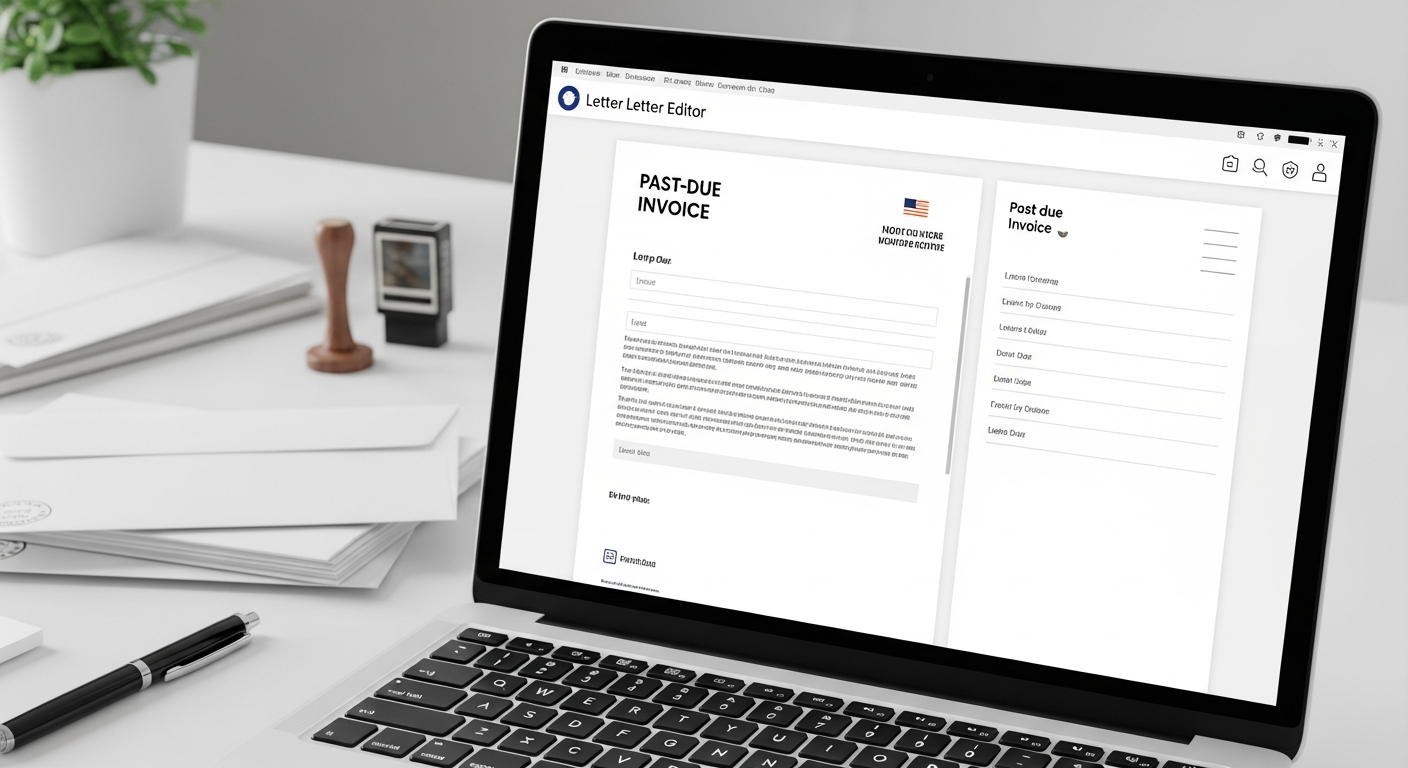
WriteToMail handles printing, postage, and USPS First-Class Mail delivery entirely online. Here's how to send your past-due invoice letter:
4a: Create your letter
- Go to writetomail.com and log in or create a free account
- Start a new letter using the rich text editor — paste your completed template directly into the editor
- Customize formatting if needed: adjust font, size, or layout to match your business style
- Alternatively, if you already have a formatted PDF invoice letter, use the PDF upload and mail feature to upload it directly — WriteToMail will print and mail it as-is
4b: Enter your recipient's address
Enter the client's full mailing address. Double-check it — a wrong ZIP code means the letter doesn't arrive, and you lose the paper trail.
4c: Review and send
Preview your letter, confirm the recipient address, and submit. WriteToMail handles the rest — printing, folding, sealing, stamping, and USPS drop-off.
You do not need a printer. You do not need stamps. You don't leave your desk.
Expected outcome: Your past-due invoice letter is in the USPS mail stream, typically within one business day.
Step 5: Send Bulk Past-Due Invoice Letters via CSV Upload
If you have multiple clients with overdue balances, sending letters one at a time is not a workflow — it's a bottleneck. WriteToMail's bulk mailing via CSV upload lets you mail personalized letters to dozens or hundreds of clients simultaneously.
How the CSV bulk send works:
Prepare your spreadsheet. Create a CSV file with one row per client. Include columns for:
FirstName,LastName,Address1,Address2,City,State,Zip,InvoiceNumber,OriginalAmount,DaysOverdue,TotalDue,PaymentDeadlineWrite your master template. Use placeholders that match your CSV column headers — for example: "Dear {{FirstName}}, your invoice #{{InvoiceNumber}} for ${{OriginalAmount}} is {{DaysOverdue}} days past due..."
Upload your CSV to WriteToMail. Map each column to the corresponding variable field in your letter template. The platform merges the data so each recipient gets a fully personalized letter.
Preview and approve. Review a sample of merged letters before sending. Confirm the variable fields populated correctly.
Submit your batch. WriteToMail prints, addresses, and mails every letter via USPS First-Class Mail. Each client receives their own individualized past-due invoice letter — with their specific balance, invoice number, and deadline.
For a detailed walkthrough of the CSV formatting requirements and variable field mapping, see this guide on variable data mail merge for bulk physical letters.
Accounts receivable teams handling large client bases should also look at the broader article on how small businesses send invoices and payment reminders by mail — it covers the psychology behind why physical mail gets paid faster than email alone.
Expected outcome: You've sent personalized past-due invoice letters to your entire overdue client list in a single workflow — no manual envelope stuffing, no post office run.
Common Mistakes to Avoid
Sending without a documented prior contact record Your past-due letter should reference prior contact attempts. "We emailed you on May 5 and May 12" strengthens your position if you ever need to escalate to collections or small claims court.
Using vague deadlines "Please remit payment soon" accomplishes nothing. Set a specific date — 10 to 14 days from the letter date. Urgency without a deadline is theater.
Applying late fees you never disclosed If your original invoice didn't include late fee terms, don't add them now. It gives the client a dispute angle and makes you look disorganized.
Wrong mailing address Always verify the address before sending. Use the billing address on file, not the client's general contact address. One wrong digit in a ZIP code and the letter bounces.
Mailing from a personal address Your return address should be your business address. A personal address on a formal past-due notice looks unprofessional and can undermine the letter's authority.
Waiting too long to escalate Many small business owners sit on overdue invoices for 60+ days before sending a physical letter. At 30 days overdue with no response to email, physical mail is appropriate. Waiting compounds the problem.
When to Escalate Beyond a Past-Due Letter
A past-due invoice letter handles most situations. But some clients don't respond to anything short of a formal legal threat.
If payment isn't received within 14 days of your past-due letter:
- Send a demand letter. A formal demand letter for an unpaid invoice explicitly states that legal action will follow if payment isn't received. It carries more legal weight than a billing notice.
- Refer to collections. If the balance warrants it, a collections agency can take over — but they typically require documentation of your prior contact attempts. Your mailed letters are that documentation.
- File in small claims court. For amounts under your state's small claims threshold (usually $5,000–$10,000), you can file without an attorney. The physical mailed notice strengthens your case.
Next Steps and Related Resources
Sending a past-due invoice by mail is a specific escalation step — but it works best as part of a consistent accounts receivable process. A 30/60/90-day cadence of increasingly formal notices, moving from email to physical mail, dramatically improves collection rates.
If you're managing overdue balances across a client list, explore how to send bulk mail online without going to the post office — the same CSV workflow that works for past-due invoices applies to any payment notice campaign.
For businesses that need ready-made letter language, the accounts receivable letter templates on WriteToMail's blog include 30, 60, and 90-day versions with variable fields already built in.
Ready to send your first past-due invoice letter? Start at WriteToMail.com — no printer, no stamps, no post office.
Sources
- Xero Small Business Insights — Data on the percentage of small business invoices paid late, referenced in Step 1
- USPS First-Class Mail Service Standards — Delivery timeline and service standards for physical letters sent via USPS First-Class Mail
- Federal Trade Commission — Debt Collection FAQs — Context on documentation requirements when escalating unpaid invoices to collections
- U.S. Small Business Administration — Getting Paid — General guidance on accounts receivable management and late payment handling for small businesses
- Freelancers Union — Late Payment Trends — Industry context on unpaid invoice prevalence among independent contractors and freelancers